Showing posts with label Weight loss. Show all posts

Thursday, February 16, 2012

eating in shangri-la

I don't really do diets. They don't work for me. Like many women, my weight has fluctuated during my life. When things start to go too far in the up direction the only thing that has ever worked for me is to get strict with portion control and try to up my exercise regime — mostly walking or biking. A neighbor of mine noticed I was hitting the gym more often lately and thought I might be interested in The Shangri-La Diet: The No Hunger Eat Anything Weight-Loss Plan, a book she had on her shelves but had never tried. She said it sounded interesting because there was science behind the diet. I'm not a scientist, but I gave it a look.


The author, psychologist Seth Roberts, discovered that he lost weight on a trip to Paris in 2000. He connected that weight loss to consuming French soft drinks with unfamiliar flavors, claiming that consuming unfamiliar tastes naturally quelled his appetite. He connected his personal experience to a report he read by Israel Ramirez, which concerned the stimulation and growth in rats due to saccharin. He believes that our bodies have a set point, a "perfect" weight that our brain tries to maintain. When our weight goes below this magic set point number we eat more. When our weight goes above the set point, our appetite decreases and we eat less.

His Paris vacation experience caused him to theorize that consuming unfamiliar-tasting, or optimally, flavorless foods, can actually suppress the appetite. Roberts believes that we can adjust our set point by consuming 100–400 calories per day (2 tablespoons) of extra light olive oil (not extra virgin, which has flavor associations) or sugar water (made with either fructose or sucrose — he claims the body doesn't register "sweet" as a taste). Hmmm. The olive oil or sugar water should be taken an hour outside of mealtimes. Otherwise a person can eat breakfast, lunch, and dinner as they normally do. There are no other dietary suggestions or restrictions.

I am very suspicious of his suggestion of consuming sugar water, no matter his scientific claims. I think we all consume too much sugar as it is, so I knew I wasn't going to even consider trying that. But how hard would it be to take two tablespoons of a light-tasting olive oil a day? So I gave it a whirl.

What became clear after a little more than a week of trying this out is:

#1 - It's cheap and easy - extra light olive oil is easy to find
#2 - By having to leave an hour on either side of swallowing the oil, that virtually eliminates snacking, so instant willpower
#3 - I haven't noticed any of the claims of appetite suppression due to the unfamiliar or non-taste of the oil, but I am more aware of what I'm eating, which goes back to my old dieting stand-by, portion control

Bottom line: I lost three pounds in a week and a half. I'm not sure whether that loss really has anything to do with the olive oil or is more me being more cognizant of not just what I am eating, but when. The Shangri-La Diet is really more about behavior and commitment to a course than dieting. I'd be interested if those of a more scientific turn of mind had a better sense of the supposed benefits of sugar water; if there are any real body mechanics behind it. I'm not sure how much longer I'll continue drinking olive oil, but if I do end up losing my desired ten pounds I guess I will have to admit that I have been to Shangri-La and back.
Enhanced by Zemanta

Monday, April 26, 2010

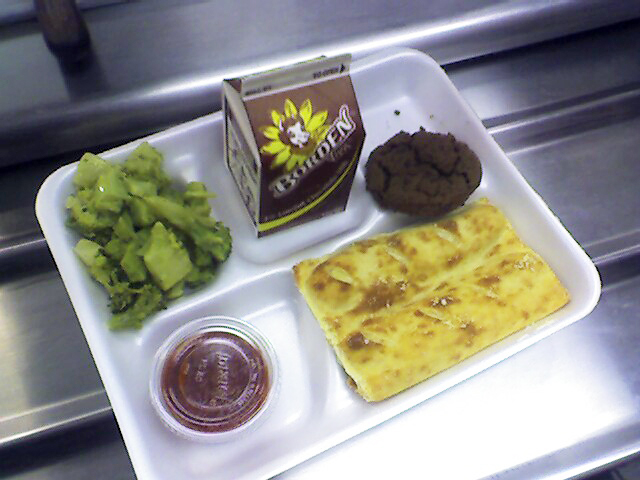
school lunches . . . really?

A threat to national security?

While I am completely in support of the nation serving up healthier fare to kids in schools, a group of retired military personnel calling themselves "Mission: Readiness" is trying to blame the increasing number of overweight and out-of-shape teenagers on school lunches—not so sure about that.

We are what we eat to a certain extent and I am currently testing that theory with my sugar-reduction challenge. I do believe kids and the entire country drink too much soda, diet or otherwise. It's all crap and it causes weight gain and contributes to who knows how many other adverse health side effects down the line (obesity, diabetes, etc., etc.) But to rest it all at the door of the albeit crummy offerings at school cafeterias—nuh uh.


If you want to target schools for their lackluster non-nutritional lunches, how about also getting them for slacking off on promoting the other side of good health—physical exercise? This country is very much about sports and achievement, but the focus is squarely on the winners, the ones who make the team. Is good exercise stressed for the rest who might not be a star basketball, football or baseball player? Is it stressed evenly between boys and girls? We rely more and more on computers to do our work at home and at school. Are students being encouraged to get up and away from the computer screens, to take a walk, a jog, get some fresh air?

And what about the parents of the kids who are just "too fat" for the military? How many jumbo liters of soda are in their fridges? How many times a week do they all hit a fast food joint for a meal? Do they dine together or separately?
Silhouettes and waist circumferences represent...Image via Wikipedia

I'm not trying to cast blame on anyone, really, but I think it's foolish to focus solely on the one meal a day that is served away from home. The vegetables on the menu may consist solely of french fries and ketchup—hey kids, two servings! If that is the case, I agree, that is sad. With cutbacks happening everywhere, the traditional lunch lady many of us grew up with who parceled out sloppy joes and baked beans may now be just a figure of myth. Most food served at school cafeterias these days seems to be either hot dogs and hamburgers or of the frozen dinner variety. Most kids are unlikely to get access to the other extreme, a chef-inspired lunch.

Focus on the quality of life in this country is unfortunately skewed. There is so much emphasis on money, money, money and all that it can buy a person—status, travel, beautiful clothes and surroundings, the latest gadgets. Not everyone can afford luxuries, but we all can eat. Food is the one thing that anyone can indulge and overindulge in. And what tastes "richer' than something sweet, or bubbly, or cheesy, or fried?

What seems almost comical to me is that this study is being presented with an attitude—"Mission: Readiness" is trying to scare the schools into serving better fare so that the kids can all be enlist- and draft-worthy. Shouldn't we try to inspire better eating habits and better health because it's better for all of us? Talk about inspiring kids to want to pack on the pounds. Who knew that might be a "quality" that makes you ineligible for service?
Reblog this post [with Zemanta]