Monday, September 23, 2019

i loved laura, except for . . .

Another book from my personal challenge of reading the source material for favorite classic movies: Laura, by Vera Caspary. This book is a detective noir, as hard-boiled and cynical as any of the genre, but written by a woman. It was originally published, a la Dickens, as a serial, "Ring Twice for Laura," in Colliers Magazine in 1942/43. The  classic film noir, starring Gene Tierney as Laura and Dana Andrews as a detective who finds himself falling in love with a dead woman as he investigates her murder, came out a year later—so Hollywood was right on this as the perfect tale for a hit movie.

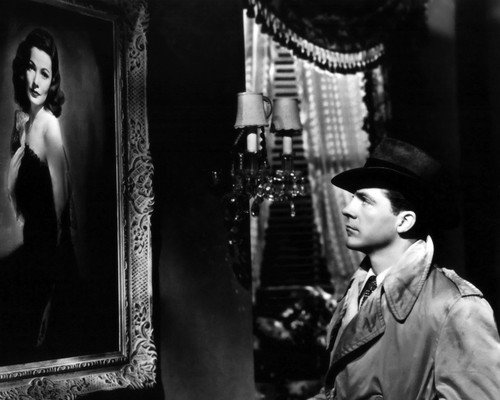
Detective Mark MacPherson (Dana Andrews) contemplates a portrait of Laura Hunt (Gene Tierney)

The story is told from the viewpoint of several main characters, including Detective Mark MacPherson, esthete and friend of the deceased Waldo Lydecker, and Laura's unfaithful fiancĂ© Shelby Carpenter. It is up to the reader to piece together the stories about this fascinating woman and race along with Mark to solve the crime. The murder is actually a quite brutal one—ostensibly Laura went to answer her doorbell and was killed with a shotgun blast to the face. The method of the crime is in stark contrast to the glamorous New York City apartments and surroundings of Laura's life as an advertising executive, an impressive job for a young woman in 1942. We learn quite a bit about Mark, Waldo, and Shelby, too. Laura, a romantic thriller, is a great book with great characters, and I loved it - with one major caveat. Spoiler alert—read no further if you haven't seen the movie . . .
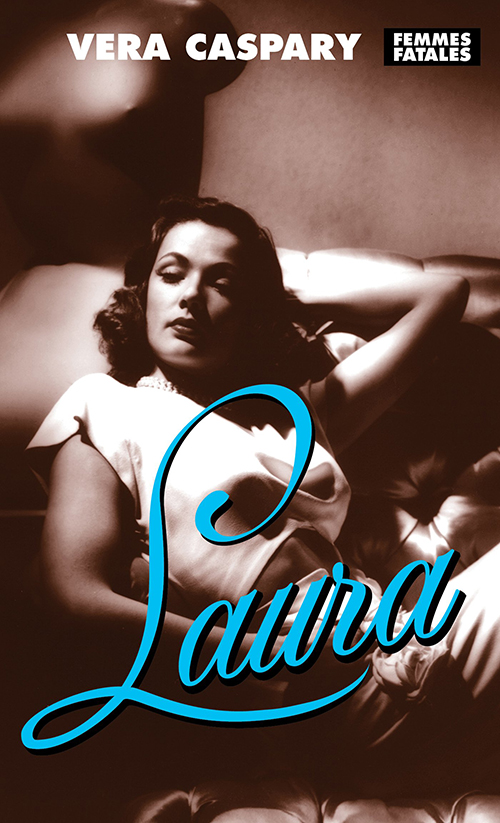

Laura, by Vera Caspary

SPOILER:

It is discovered more than halfway through the book that the body of the murdered woman in Laura's apartment was not Laura, so the reader finally gets to meet her and see if other's descriptions of her square with the genuine article. And at first, she does, beautifully. She is honest, earnest and even shows some interest in Mark, so things seem to be going quite smoothly to a romantic finish—as long as Laura isn't the murderer. But the real problem for me is that Caspary has Laura casually drop the "N" word in conversation and it completely soured my interest in her character. I understand that such casual racism was probably quite common in the 1940s, but . . . yuk.

I did a little research on the author, who led a quite interesting life, but found no clues as to her thoughts about race. She dabbled in Socialism and Communism, even going so far as visiting Russia to see if the country lived up to her expectations. She lived openly with her married British lover for years before finally marrying in 1948. She led an unusual life, like her protagonist, for a woman of the time.

Apparently the publisher of this reprint series, actually subtitled Femmes Fatales, and published by The Feminist Press at CUNY, didn't see any reason to add an editor's note about Laura's outburst. It's a single, strange event that happens and never occurs again in the text, by her or any other character.
Sigh. It's best to be honest about our past to go forward into the future. This is not the only instance of racist language that I have encountered in my recent book-to-film adventures. So far the 40s and 50s American popular literature is proving quite problematic.

This post also appears on Cannonball Read 11

Sunday, September 22, 2019

the uninvited: ghosts like us

I love old black and white movies, especially mysteries and horror movies. I was watching one of my all-time favorites, The Uninvited, a ghost story starring Ray Milland recently (it's a really superior film - I highly recommend it if you've never seen it) and I started to wonder where the idea for the movie had come from. Was it an original screenplay? A short story? A novel? A quick internet search revealed that the film, directed by English director Lewis Allen was based on a 1941 novel written by Irish author Dorothy Macardle. If I had these idle thoughts a few years ago I would have been out of luck, as the book had long been out of print. But luckily The Uninvited, or as it was originally titled in Britain, Uneasy Freehold, is now available in a reprint paperback, and even luckier, it is also a great ghost story in print.


Siblings Pamela and Roddy Fitzgerald (Ruth Hussey and Ray Milland) suspect they might not be alone in their new home

Brother and sister Roderick (Roddy, played by Ray Milland in the film) and Pamela Fitzgerald (played by Rich Hussey in the film) are on their way back to London from Devon (Cornwall in the film) when they are drawn to an old, abandoned house on the side of a cliff. The house is in great condition and unbelievably inexpensive. The pair decide to buy it and leave the city for the country. They soon discover the reason why it's a bargain. The house, called "Cliff's End," has a reputation for strange sounds and occurrences. The siblings try to unravel the history of the house and soon discover it may be centered around their lovely neighbor, Stella Meredith (Gail Russell in the film).


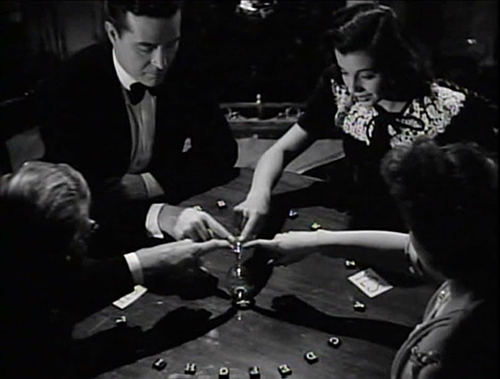
Trying to contact their uninvited guest

The film version definitely streamlined some of the characters (most notably, Dr. Scott), but it is as subtle and full of dread as its source. What struck me the most was how people talked to one another. People were just so much more polite and refined in their language. There is nothing stuffy about how these characters speak, they come across as very real people, they're just . . . more willing to listen to one another? The book is good at presenting how the average person might deal with a supernatural experience, and what it might really mean when you've sunk all your savings into a haunted house.
The Uninvitedhas compassion for its protagonists and even its ghosts. A great read.

This post also appears on Cannonball Read 11

fire & blood: blah, blah, blah, blah, blah…

I loved Game of Thrones from its very first episode. I was as shocked as any non-reader of the series at its Psycho-like twist in its penultimate first season episode. As soon as I could I grabbed a copy of the first novel. I read the rest and watched the series rush to its inevitable conclusion. I wasn’t as put off as some folks by plot turns that I felt I had seen coming, or at least had been hinted at as very possible outcomes. During the course of the show I probably even thought that some background of the dragon-loving Targaryan clan might be interesting to read. Boy, was I wrong about that. Fire & Blood, George R.R. Martin’s “history” of the Targaryan clan is a long, long, long read, and not a very good one. And to top it off, in typical GRRM fashion, this doorstop of a tome doesn’t even take us to the era of the television Targaryans. There’s another book to come, I fear. Or maybe even more than one. But they won’t be read by me.

To be fair, there were a few episodes, mainly about female Targaryans, in Fire & Blood that were fun stories, engaging the reader in classic GoT form. But they are surrounded by so, so many lists of characters with funky names and genealogies that even the invested GoT enthusiast can’t be expected to remember or care about any of them. After slogging through this mess of a book I’m not sure anymore what GRRM is up to. Does he have an editor? Does he want to even finish his unfinished GoT book series? Does it even matter? With an HBO prequel and teased additional GoT universe adaptations in the works maybe he has lost interest. I would suggest that he pick up a copy of Malory’s Le Morte d’Arthur and do a re-read. I’m sure that tale of King Arthur and his knights and their ladies was one of his original inspirations for GoT. It is an entertaining, at times sexy and bloody medieval saga. It has everything that the first GoT novel had, with no filler. It is not a boring history, like Fire & Blood, either.


Fire & Blood’s best feature are illustrations by Doug Wheatley


This post also appears on Cannonball Read 11