Article first published as Book Review: Wolf Hall by Hilary Mantel on Blogcritics.
After watching
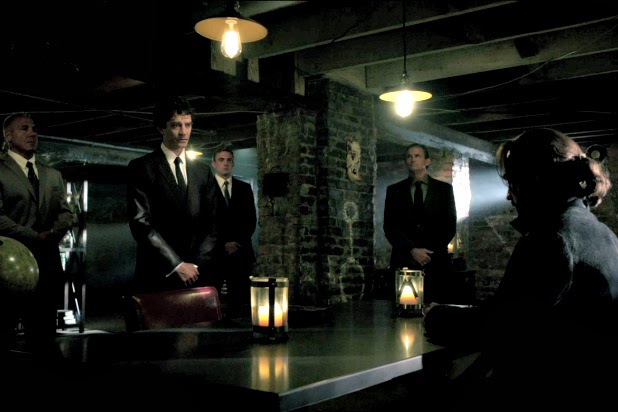
The Tudors, with the wonderful James Frain as Thomas Cromwell, it was impossible to read
Wolf Hall without a sense of dread—fear and knowledge of what's coming, for all of them—Cromwell, Henry the VIII, Anne Boleyn, Katherine of Aragon. But even with apprehension for the inevitable fates lurking around the corner for these characters and historical figures,
Wolf Hall is a wonderful book, a great read.
There is something still so poignant, so fascinating, about a king who was so obsessed with a woman, with having a male heir, so torn between what he thinks is right and his heart's desire, that he would eventually sacrifice everything—his queen, his Catholicism, his political ties.
Henry Tudor's story, his desperate attempts to continue his personal Tudor dynasty, wouldn't be interesting if it solely centered on the fact that he and Katherine couldn't have children and he cast her aside for a younger woman. Other kings did the same in the same situation.
What makes the story, the history so enduringly fascinating is Henry VIII himself. His conscience and religious fears refused to allow him to just discard Katherine—at first. Henry wanted the church and his peers to approve, or at least not stand in his way. The timing of his great problem coincided with the
Reformation. Disaffection was rising with the control exerted by the Catholic Church on people's, and most importantly in England's case, king's lives. Henry and his advisors, most of all
Thomas Cromwell, saw the opportunity to change England's position both politically and religiously, shaking off the hold the Holy Roman Empire had on them. Not only a potential new heir was to be gained, but all the money that went to Rome and the Church could now be funneled to "poor" king Henry, if Cromwell, where his predecessor Cardinal Wolsey and so many others had failed, was able to succeed in getting Henry what he wanted.
As Cromwell is told, and as he tells everyone in in his household, "Arrange your face." Everyone involved in the king's "great matter" had an angle, just as everyone in life and politics does today. Henry wants a son. Cromwell wants a king he can influence. Anne Boleyn wants to be Queen. Katherine is queen and doesn't want to see her daughter Mary, the rightful heir, disinherited. But these desires are not pure, they are motivated by outward pressures. Henry by his masculinity and obsession with his Tudor lineage. Cromwell needing to make a better place in the uncertain world for himself and his family. Each of the central players is torn between two opposing forces. Henry his strong religious beliefs and guilt. Cromwell between his past loyalty to Cardinal Wolsey and his desire to break the Catholic Church's hold on England and be the perfect, best advisor to Henry. Anne Boleyn between her ambitions to be queen and her desire to be an independent woman who can love who she wants. Katherine between her enduring love for Henry and her desire to not lose face or position—the proud daughter of Spain's Ferdinand and Isabella, she has lived in England since she was a child, but she can't go back to Spain and she can't remain England's queen.

Henry's reconciliation with Anne Boleyn, etching, published by Cunningham & Mortimer, 1842.
Anne Boleyn is always fascinating. How did she exert such a hold over Henry for the seven years it took to make her queen? Not just because she wouldn't sleep with him. She had a mind and modern attitudes about religion. She was fresh and new, represented hope. She wasn't like anyone the sheltered Henry had ever met before. As the second son Henry would have gone into the church if his older brother, the heir, hadn't died and left him, the spare, as king. The Boleyns wanting to be "the" family in England, so they push first one daughter, than the other at any king who will have them. Using their daughters as political pawns and sexual favors, older sister Mary is offered as a king's plaything, first to Francois I of France and later to Henry. Even after her sister Anne managed to achieve the impossible and become queen, Mary was still at Henry's service until she managed to escape—but only by marrying into obscurity. Her social-climbing family were so ashamed that she had eloped with a commoner they cut her off and she all-but-disappears from history.
Cromwell put his hopes in Anne and the Boleyns, even though he saw how dangerous a risk that was. Precarious times for everyone—Cromwell at the whim of the Kings favor, Anne's fortunes dependent on whether she can produce a healthy male heir, Henry's kingdom and legacy based on whether he can father a prince.
The story is so dense, so intricate. All of this political intrigue and what passed for romance at the Tudor court is still just background to the real story of
Wolf Hall, the depiction of the man, Thomas Cromwell. Hilary Mantel's Cromwell is a genius at adapting to his surroundings. Born to a blacksmith, he runs away from an abusive father and makes his way to France and Italy as a servant, soldier and ultimately advisor. How a blacksmith's son could travel the world, learn law, multiple languages and manage to carve out for himself a dynasty back in England is made utterly believable. But Cromwell remains a puzzle to those who surround him. "A man's power is in the half-light, in the half-seen movements of his hand and the unguessed-at expression of his face. It is the absence of facts that frightens people: the gap you open, into which they pour their fears, fantasies, desires." Mantel brings history to life with her Cromwell, a modern man, forward-thinking and always on the alert for advancement. Anne Boleyn could never have become queen and Henry would never have become the head of the Church of England if not for Cromwell.
In the Netherlands Cromwell met his wife and worked in the wool trade. Eventually he returned to England and found a place in the household of Cardinal Wolsey, Lord Chancellor to Henry, where he quickly advanced, due to his fine wit and legal knowledge. He learns from Wolsey the appreciation of the finer things of life, but like Wolsey is not a "gentleman." Wolsey was the son of a butcher and the noblemen who surround Henry never let either of them forget their low origins. The lords treat Cromwell with disdain, exactly like they treated the cardinal. But where Wolsey eventually fell, Cromwell manages to not fall with him, a huge feat in itself, and catches Henry's eye and respect—as long as he continues to provide good counsel and help Henry get what he wants. Everyone condescends to "Le Cremuel," but he lets all slights and abuse fall off of him. He endured much worse before he came to Henry's court.

Portrait of Thomas Cromwell. New York, Frick Collection. Oak panel, 76 x 61 cm.
Date between 1532 and 1533, The Frick Collection, Hans Holbein the Younger (1498–1543).
Cromwell is a keen observer of people and has a true survivor's intellect, always watching how the wind blows and how it might serve his advantage. But he never seems scheming—just bound and determined to give his family the best and most secure future that he can. One of the best parts of the book is Mantel's take on Cromwell's generous nature. He loves a full household. He can see the potential in anyone, from a young lord sent to him to learn accounting, to a tavern boy who has lived by his wits from moment to moment. He finds a place for all of them in his household and gives them shelter and opportunities. From this he gets the family that he never had as a boy and replaces the family (wife and two daughters) that he lost too soon to the
sweating sickness.
Wolf Hall was written over the span of five years. Mantel told
The Wall Street Journal that "The trickiest part was trying to match her version to the historical record. ... You really need to know, where is the Duke of Suffolk at the moment? You can't have him in London if he's supposed to be somewhere else." Such attention to detail pays off, as the reader really feels how Henry and his court pull Cromwell closer, inch by inch, day by day. If I have any criticism of the book it is Mantel's choice to write Cromwell using only "he" to identify him and portray his thoughts and impressions. She obviously wanted to avoid writing in the first-person "I" to avoid Cromwell sounding narcissistic, or the third person and make him seem distant. But it makes it a little confusing to know who is speaking at times, with so many potential "hes" to choose from in this huge cast of characters. It's an affectation, but you get used to it, and the rest of the book is so great it becomes only a minor annoyance.
The importance of religion plays a huge part in
Wolf Hall and the fate of its characters. Religion played such an important part in people's lives at that time, because it was interwoven into all aspects of life. The Catholic church ruled all, including the King. Cromwell wants to break the Church's hold on land and money and government, freeing both Henry and his people. As much as Cromwell loved Wolsey, he realizes while still with the Cardinal that they can never achieve what really needs to be done in England. A member of the Church is still responsible to the Church. Cromwell has much more power and flexibility as Henry's advisor.
Mantel's Cromwell witnessed the burning of a "heretic" at a young age and the author doesn't stint on the depiction of how horrible a death that was, nor what a spectacle. How many of the people that were burned for simply wanting to read the Bible in English, rather than Latin
is unclear. It is clear that the Church didn't want the common man to interpret the Bible in his own way and they weren't hesitant to burn men, women, and children to keep their hold and control on the text. According to Mantel and others, one of the most ardent burners and torturers of English heretics (before Henry's first-born,
Bloody Mary) was
Thomas More, who is portrayed at times in
Wolf Hall as Cromwell's equal, mentor and great adversary. Mantel's More is a zealot and a man, not for all seasons, but lost in the past.
I was relieved that
Wolf Hall 
didn't take me all the way to the end of Cromwell. It is clear as the book is two thirds through and Anne Boleyn has just been crowned queen that Mantel has lots more to tell about the Tudors and especially, Thomas Cromwell. Luckily, she is writing a second book. Hopefully it won't take another five years to complete, but I wouldn't want her to rush it through either, as his fall deserves as rich a treatment as his rise.
Book #6 in reading challenge Cannonball Read 3, sponsored by Pajiba