Showing posts with label Demi Moore. Show all posts

Tuesday, December 17, 2019

demi moore, inside out


Reading Demi Moore’s memoir Inside Out is like having a seat in the room while she is undergoing therapy. And yoga. And flirting with Bruce Willis. And being abused by her parents. And, strangest of all, not spending much time in Hollywood. But you do get a pretty good picture of her home and life in Hailey, Idaho, which she clearly loves, an oasis she has created for her family and herself.


Demi Moore, Inside Out: A Memoir

Inside Out flows, but it is not exactly an easy book to read. Real pain and trauma is spread throughout its pages. Moore had an extremely difficult childhood, raised by parents (mostly her mother) who at best ignored her, at worst practically pimped her out as a young girl. It is amazing to think how far she has come, considering her rough start. Moore is unflinchingly honest in her revelations and discoveries about her family’s and her own weaknesses. She tends to downplay her own achievements, certainly as an actress, so it is hard for the reader who might want to learn some more details behind how she got her role in Ghost as much as how Joel Schumacher helped her kick her booze and cocaine habit during the filming of St. Elmo’s Fire. She was successful at both, and stayed sober for years. Her substance abuse issues would crop up again later in her life, in her 40s, when she was married to Ashton Kutcher, who apparently enabled bad choices and then chose to look away when things got to be too much for her to handle.
Where Moore allows herself to feel proud of herself and crow a bit are when she talks about her love of being pregnant, a mother, and her love for her daughters. She also toots her own horn a little when she discusses her iconic Vanity Fair (August 1991) cover shoot by Annie Liebovitz, taken when she was seven months pregnant. The cover was quite controversial at the time, and paved the way for women to celebrate their “baby bumps” – wearing more form-conscious fashion, something we take for granted now. Moore also was one of the first actresses to earn $10 million for a single film in Hollywood. She starred in numerous blockbusters in the 90s: Ghost, A Few Good Men, Indecent Proposal, Disclosure, as well as producing If These Walls Could Talk and the Austin Powers movies.
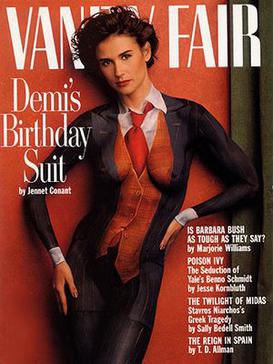
“Demi’s Birthday Suit” Vanity Fair, August 1992

She appeared nude again for Vanity Fair, photographed by Liebovitz, covered in body paint, a year later. The photo was a testament to bouncing back from pregnancy weight as well as highlighting Moore’s intense workout regimen, which was highlighted throughout her movie career, most notably in G.I. Jane and Striptease. Moore describes herself as an obsessive personality, who has not just battled drugs and an eating disorder, but also working out too much, to the point of making herself ill. It is hard to determine how much Hollywood’s fixation with women’s bodies and her own trauma from childhood sexual abuse played a part in her feelings about herself and her body. But she is not afraid to ask the question or try to find the answer.
What might have been the most gossipy part of the book – her relationships with high-profile men like Emilio Estevez, Bruce Willis, and Ashton Kutcher – are less about fun times than highlighting her or their inability to connect. At the end of Inside Out I don’t feel sorry for Moore, but I do feel empathy. And maybe a little hope, as she continues on her path to self-discovery.

This review first appeared on Cannonball Read 11

Wednesday, August 18, 2010

the magpie effect

previously published on Associated Content.

All that glitters . . . musings on the Rachel Zoe Project

I have always liked things shiny. Baubles, bangles and beads. Is that the reason I find myself, like the proverbial magpie, drawn to watch the Rachel Zoe Project? I share this impulse for bright things with the celebrity stylist, who said in her latest installment, (paraphrasing here) that "it doesn't matter how great the dress is, it's all about the jewels." Looking at the results of her styling efforts it's hard to disagree. The jewelry, which she considers "the most fun," was the best part if the show, and I suspect, the best part of her job. She actually looked animated, practically giddy as she sorted through tens of thousands of dollars worth of gaudy gems to adorn her clients, as opposed to her perpetual glum demeanor when faced with finding a designer gown (or just trying to get a sample delivered.) Trying to select the "right dress" is almost always agony for Zoe and her staff.

It would be easy to make fun of her, and her cockeyed world and its values. Many do, but what is probably most surprising is how willing Zoe herself is to poke fun of her image (which she is also so desperately trying to promote.) Watching her deadly serious depression at the LA "downpour" that might ruin her clients' red carpet moment—well it's hard not to snigger. But the tiny woman takes her job seriously and she does want her charges to look their best. It may be a superficial world that she inhabits, but it is true that a "great red carpet moment," the right dress (matched with fabulous baubles) might actually boost the career of an actress whose latest films may not have been huge at the box office.


Most of what Zoe does is behind the scenes, and I suspect, still off camera, as what the audience gets to see is a lot of worrying and kvetching, but not a lot of actual legwork or even schmoozing of new clients. The editing of the show wants to add the drama by hinting at troubles with previous assistant Taylor (drop that - she's gone and bringing her up is boring) and intimations of her marriage possibly suffering as a consequence of her pursuit of success. We are only two shows into the season and her husband Rodger is whiny and downright pissy about wanting to be a dad and his fear that her clock is losing ticks by the moment. There is also a lot of proclaiming on his part of his masculinity and weariness of always being surrounded by girls and gays (protest much?) Do we need this storyline? I might be a tad more sympathetic to "his story" and the human angle the show is trying to push if he didn't (I assume) let his wife style him with white flowing scarves and get his hair cut like Justin Bieber. Who needs it, just get back to the clothes.

No offense to the domestic discord or bliss that may occur in their white-on-white world (their furniture reminds me of Sex and the City's Charlotte and her horror that her husband Harry might sit his naked butt down on her pristine white furniture), but the real appeal, the real "story" of the show is the suspension of disbelief that Zoe and her career can actually exist and the vicarious thrill of imagining playing dress up with all of those designer samples. Even though she is proving her clout this year by trotting out some of her bigger-name clients (Demi Moore, Kate Hudson, Cameron Diaz), it is mostly the inexplicably eternally stressed Zoe that fascinates.

What was the most interesting moment of the second episode? After all the flurry and build-up of Zoe and crew to dress four women for the Golden Globes, after Zoe's frantic rushing around to fit each actress, she didn't hang around all the lights and cameras but quietly returned home in time to watch the pre-show on television, with her buds, just like any other fan, albeit insecure that her husband might make fun of her and her love of fashion (he did and does in his soliloquies) or not like her work (he actually was quite supportive.)

Suddenly it all seemed like one big dream. Is Zoe delusional? Did she really do all or any of what we just watched? Who's to say that Jennifer Garner didn't dress herself? It's the most ephemeral of careers to fairy-godmother these Cinderellas. No wonder Zoe has decided lately that she might also like to go to the ball.
Enhanced by Zemanta