At first glance
The Big Heat 
may seem like a standard crime drama, if a bit on the grim side. But if you stick with it, you will soon realize that you're seeing something akin to Shakespearean-noir. As the movie progresses, bodies are dropping right and left, and the hero, Dave Bannion, a police sergeant played by Glenn Ford, like Hamlet has learned that all was not well in the fictitious city of Kenport.
Ford plays the last honest cop, maybe last honest man around, who gets the case of a fellow cop, Tom Duncan, who has committed suicide. Duncan's wife (Jeanette Nolan), seems distraught and tells Bannion that her husband was fatally ill. It seems an open-and-shut case — at first. But Bannion, a family man with a wife and young daughter, is soon pulled into a web of corruption that goes all the way to the top of the police department and the town of Kenport.
|
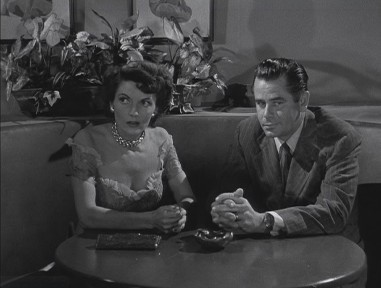
The Bannions, when life is still (briefly) idyllic |
Bannion is honest, but he is also rigid, and can't see how his denunciation of the evil around him might impact himself and his family. In a real twist, the "hero," rather than aiding or rescuing, brings destruction to every woman who comes across him in his investigation. Although we know he is morally on the side of the right, it is hard to get behind him as we watch the women around him die. He views women as either a madonna, like his wife (and mistakenly, Mrs. Duncan) or whore (pretty much every other woman he meets.)
The Big Heat features a series of strong women. They are all probably stronger and even smarter than Bannion. Mrs. Duncan is a tough cookie and not to be trifled with. Duncan's mistress Lucy (Dorothy Green), is the first to try and clue Bannion into the case being more than a simple suicide, but our hero dismisses her as a "barfly" only out for a shakedown. Unfortunately for Lucy his interview with her draws the wrong kind of attention — she soon turns up murdered.
A mobster named Lagana (Alexander Scourby), who runs the town and the police department and lives in luxury together with his psychotically violent henchman, Vince Stone (a brutal Lee Marvin) are behind all the crime in Kenport. Vince has a girlfriend, Debby (Gloria Graham), who seems to be treating her affair with a gangster as a lark, making fun of him and his pals every chance she can get.
Vince: Hey, that's nice perfume.
Debby: Something new. It attracts mosquitoes and repels men.
|
Lucy tries to tell Bannion the score, but he's not listening |
The movie, which came out in 1953, was pretty violent for its day. Director Fritz Lang (Metropolis, M, Ministry of Fear), pulls no punches and practically all of them are directed at the many women in the film. This isn't gory violence, to which current audiences have been anesthetized. The movie code in the '50s wouldn't have allowed that. But the violence is powerful nonetheless, and steadily escalates.
The first incident, a body found dumped by the side of the road, is Lucy, the woman Bannion had questioned earlier. It occurs off-screen, but is described, callously, and in detail, by the medical examiner, making both the hero and the audience cringe, "Trouble automatically catches up with girls like her. Looks like a sex crime to me ... I'd say pretty definitely it was psychopathic. You saw those cigarette burns on her body."
When Bannion hears about Lucy and that she was not just found dead but was tortured, he finally believes her story, puts two and two together, and goes after Lagana. But Lagana is not the kind of man who puts up with being threatened. Bannion's idyllic home life is blown to bits when the next incident occurs while the hero isn't looking — his innocent wife Katie (Jocelyn Brando), just like in The Godfather, dies from a car bomb that was meant for him.
|
Carolyn Jones in a cameo as a barfly that runs up against a crazed Lee Marvin |
Bannion understandably loses it, and sees that even the police commissioner is part of Lagana's sphere of influence. Hell-bent on revenge, he goes against Lagana and anyone connected with him, with justice taking second place. He traces Vince to the same hangout Lucy used to frequent when another incident occurs — onscreen, but just out of the frame — when Vince "disciplines" barfly Doris (Carolyn Jones) by putting his cigar out on her hand before Bannion can intervene. Debby watches Bannion stand up to Vince and run him out of the bar after he hurts Doris and decides that she might want to start hanging out with a different fellow.
|
Debby lets Bannion know she's eager to help, "Well, you're about as romantic as a pair of handcuffs."
|
The most shocking and famous scene of the movie, indeed one of the most famous in film noir, happens right before our eyes, brutal and unnecessary. Vince attacks Debby for just talking to Bannion by throwing a pot of scalding hot coffee in her face. It is still alarming and upsetting. Lang treats the audience to a view of Debby's disfigured face later in the film, in case anyone might hold any hope that she wasn't too badly burned.
Ford may be the official hero of the piece, but Graham's character quickly moves into the role of avenging angel. She becomes a one-woman assassination squad, enacting retribution on Duncan's wife and Vince, all the while being sure to protect Bannion's reputation. He may not ever be able to go back to his old happy home life, but thanks to Debby he can go back to being a cop without anyone's blood (no matter how deserved) on his hands. She's kept him honest.
After Debby throws her retaliatory hot coffee at Vince, he fatally shoots her, but she has bought Bannion enough time to close in and close the case. Bannion tells her a bit about his wife as she is dying, something he didn't feel that he could do before, "You and Katie would have gotten along fine." In their own way Debby and Bannion have also had a full relationship in the short time they have known each other. And maybe now Bannion will treat and take women a little more seriously, a little less judgmentally. He still has a young daughter to raise.
Fun trivia: when Lee Marvin first sees Glenn Ford face to face, the music in the background is "Put the Blame on Mame," a reference to Ford's performance in
Gilda
.

 , is the latest release from Twentieth Century Fox in its Fox Cinema Archives collection. Like many of the other films in the archives, the film comes to DVD for the first time.