Showing posts with label Ingrid Bergman. Show all posts

Friday, May 02, 2014

favorite song friday: "play it once sam, for old time's sake ..."

This song seems an appropriate ear worm for me for this weekend, where I'll be attending the Humphrey Bogart Film Festival in Key Largo.


Ilsa [Ingrid Bergman], "There's still nobody in the world who can play "As Time Goes By" like Sam."

You can here the full song, performed by Dooley Wilson, here.

Tuesday, March 12, 2013

happy alfred hitchcock day!

Today is National Alfred Hitchcock Day. I'm not sure exactly why, but I really don't care, as any opportunity to celebrate Hitch is appreciated. My movie-buff parents introduced me to the master at a young age, via his movies on television. I'm not sure which one I saw first exactly, but suspect it was Shadow of A Doubt, with Joseph Cotton as Uncle Charlie. Still one of my favorites, and probably why I prefer the black and white, atmospheric Hitchcock films to big screen confections like To Catch A Thief.


Hitchcock was such a meticulous artist that it is hard to pick a favorite film. He started making films in the 1920s, and many of them are definitely worth a look, but the ones I hold dear and that have forever influenced the art of cinema are from the mid-'30s and onwards. Here are twelve of his absolute best (I couldn't narrow it down to ten):

Rebecca (1940) - Hitchcock may have had problems working with demanding producer David O. Selznick on his first major Hollywood studio film, but the result is flawless, and a Best Picture winner to boot.

On the set of Suspicion

Suspicion (1941) - This may be considered a minor Hitchcock, in part because the director himself complained for years how he had to alter the ending to suit the studio, but Cary Grant and Joan Fontaine are wonderful together, and Hitch does allow Grant to indulge in his dark side, while maintaining his humor and charm — the perfect anti-hero.

Shadow of a Doubt (1943) - Joseph Cotton helps the director turn the usual depiction of small-town America inside out. With someone like Uncle Charlie on the loose in our towns and our homes, no one is quite safe. And Teresa Wright makes a winning female heroine, a young girl who rescues her family while having to grow up fast and watch her dream man turn into a nightmare. This is such a great, creepy film.

Filming Shadow of a Doubt
Notorious (1946) - The ultimate Hitchcock romance, with Cary Grant as an abusive lover and Ingrid Bergman a woman who has hit such depths that she is willing to marry another man (Claude Rains, a Nazi) to please him. It also includes one of the sexiest, longest kisses in screen history, as Grant and Bergman try to accomplish a spy maneuver in her husband's wine cellar, but can't hide their passion for one another.

Strangers on a Train (1951) - When Robert Walker says "Criss Cross" to Farley Granger as they share a train compartment the movie takes Granger down the rabbit hole and the audience with him. Walker has come up with the idea for the perfect murder — two complete strangers each perform a murder for one another. And he's not joking. The film includes so many wonderful Hitchcock details and set pieces — a woman's eyeglasses, the clue of a cigarette lighter, the ending on a fairground carousel. A masterpiece.

Dial M for Murder (1954) - Hitchcock was experimenting with 3D with this film, his first starring screen muse Grace Kelly (and his first in color). But it is Ray Milland who steals the show as her murderous-plotting husband. He is ruthless, but also sympathetic and unfailingly polite throughout the proceedings. A bit stagy, but still incredibly entertaining. Cary Grant wanted to play the role of the husband, but the studio didn't want him to portray a murderer.

Backstage on Rear Window
Rear Window (1954) - Hitchcock had the entire New York City apartment building courtyard where Jeff (James Stewart), who has broken his leg lives, constructed on the studio lot. It is the ultimate voyeuristic exercise, as a bored Jeff looks out his window at his neighbors and the audience eagerly joins him. What starts at first as spying on pretty girls and squabbling couples soon becomes looking in on a possible murder, with girlfriend Lisa (Grace Kelly) and nurse Stella (Thelma Ritter) eagerly joining the chase for clues. Hitchcock has a lot to say in Rear Window about how people live and how we observe each other. Each window in Jeff's apartment complex holds an interesting story, and a potential parallel or outcome to Jeff and Lisa's on-again, off-again relationship.

Vertigo (1958) - Many consider this Hitchcock's ultimate masterpiece (I might go for Rear Window), but it is certainly his most artistic, and probably most personal. He plays with the idea of female identity, as he allows Jimmy Stewart to make over Kim Novak in the vision of a dead love. Themes of love and death and sex abound, as Hitchcock has his actors take us through a dizzying, hypnotic tour of San Francisco. The film had been out of release for many years, and I saw it for the first time in a New York City theater in an '80s re-release. If only everyone could experience this film on a huge screen. It's time for another re-release!

Directing Kim Novak on Vertigo
North by Northwest (1959) - Cary Grant is the ultimate Hitchcock "wrong man" in this cross-country, wide-screen adventure. There are so many fabulous set-pieces, including the scene in the field with the crop-dusting plane, the face-off at the U.N. building, the climax at Mount Rushmore. Fun, fun, fun.

Psycho (1960) - So many horror films owe Psycho a debt, but most of them have never come close to the shock and brutality of this film. Hitchcock returned to black and white, as the famous shower scene would have been too much for 1960 audiences in color. Anthony Perkins turns in the performance of a lifetime as Norman Bates, while Janet Leigh's role helped redefine what could happen to a movie's leading lady.

The Birds (1963) - Hitchcock dabbles in horror and maybe even science-fiction with this wonderful, still-scary film. The tables are turning, and our avian friends are deciding that maybe they want the planet to themselves. But Hitchcock keeps everything personal, following a young, spoiled woman (Tippi Hedren) pursuing a romance with a man she has just met (Rod Taylor) in a small California seaside town. Their story becomes the backdrop for the much larger question — what is happening with all of the birds?

On the set of The Birds
Frenzy (1972) - A serial rapist/killer is on the loose in London. Hitchcock identifies the villain (Barry Foster) right away, and the audience can only wonder if he will be caught or if the "hero," the not-too-likable Richard Blaney (Jon Finch), will go to jail for his crimes instead. Frenzy was considered quite racy at the time, Hitchcock's first film to feature female nudity.

So now my only problem is which Hitch to view to honor the master today?
Enhanced by Zemanta

Monday, January 16, 2012

best movies ever — casablanca

If some Hollywood hotshot scriptwriter or director thinks Casablanca is ripe for a remake I hope there's another writers' strike, because Casablanca is unique. For its time, its stars, its general attitude. They don't make 'em like this anymore. They can't.

When Casablanca came out in 1942 the United States was at war. The characters that populate the Casablanca of the film were mostly war refugees, trying to escape their invaded homelands for a better life in America. The film takes place right before the United States stepped into the fray. War in the 21st century is an entirely different proposition. We live in such a global world these days that wars are at once not so very far away and just far enough to be forgotten as we cruise the Internet for the next viral video.

"I stick my neck out for nobody."
But that wasn't the case for Rick Blaine (Humphey Bogart, in his first major romantic role). We first see Rick in the remote Vichy France outpost of Casablanca, with local French Captain Louis Renault (Claude Rains) lording it over the inhabitants. Casablanca is a way station for anyone trying to escape the Third Reich or their demons. Rick has opened Rick's CafĂ© AmĂ©ricain, and everyone comes to Rick's — to get new identity papers, make illegal transactions, gamble, or just have a drink (or two or three.) But Rick is a lone wolf, and won't sit down to drink with his customers.
Woman: What makes saloonkeepers so snobbish?
Banker: Perhaps if you told him I ran the second largest banking house in Amsterdam.
Carl [waiter]: Second largest? That wouldn't impress Rick. The leading banker in Amsterdam is now the pastry chef in our kitchen.
Banker: We have something to look forward to.
Rick's has a truly international clientele, and every table at Rick's has someone trying to work some deal to get out of Casablanca, including everything from selling jewels to sexual favors. Bogart as Rick interacts with some of Hollywood's best character actors, including Peter Lorre as Ugarte, who has stolen letters of transit and asks Rick to hold them for him, and Sydney Greenstreet as Signor Ferrari, a rival nightclub owner who also runs the local black market. The letters of transit are one of the most famous of film MacGuffins. They are key to the plot, and practically every character mentions them or wants to get hold of them. Some even die for them, but they are so unimportant by the end of the movie, as the only thing anyone watching cares about is whether Rick and Ilsa Lund (Ingrid Bergman) will end up together.

The divide between what was happening at Rick's and what was going on in the real world outside the theater when the film was first released was a very slender one. Many of the extra and bit-part actors in Casablanca were actual Jewish and/or European refugees from the Nazi occupation: Peter Lorre (M), Conrad Veidt (The Cabinet of Dr. Caligari), S. Z. "Cuddles" Sakall, Marcel Dalio (The Rules of the Game, Grand Illusion), and Helmut Dantine, to name just a few.

Louis, "The waters? What waters? We're in the desert." Rick, "I was misinformed."
Casablanca starts off like many other pictures of the period, with a spinning globe, stern narrator, and the announcement that two German couriers bearing letters of transit have been killed. Nazi Major Strasser (Veidt) lands at the Casablanca airport, greeted by Louis, who assures him not to worry as he expects to apprehend the perpetrator that evening at the local hotspot, as "Everyone comes to Rick's." Rains as Louis is wonderful and complicated, and practically steals the movie from its top stars. He enjoys his authority and the illicit pleasures it brings as perquisites, but he is no fool. He kowtows to the Germans and Vichy government when necessary. He has a fondness for Rick, but not so much so that he wouldn't turn him in to the Germans if he was pressed and it would save his hide. He is first and foremost out for himself, and could easily, if more charmingly, have echoed Rick's famous line, "I stick my neck out for nobody."

Rick is the ideal role for Bogart. He combines the steel edge from gangster roles like "The Roaring Twenties" with a world weariness that makes him the perfect romantic hero. He also looks pretty dashing in his white dinner jacket and later, trenchcoat. He is emotionally raw and vulnerable. The audience gets to see him run the emotional gamut - in love, closed off, maudlin and drunk, angry and nasty, noble and determined to do the right thing. But he is still a man of mystery. We're never told exactly why he's an expatriate.
Louis: What in heaven's name brought you to Casablanca?
Rick: My health. I came to Casablanca for the waters.
Louis: The waters? What waters? We're in the desert.
Rick: I was misinformed.
A broken heart led Rick to Casablanca, and he is trying hard to remain detached from everything around him. He doesn't interact with customers or anyone if he can help it, he doesn't cut anyone a break at the casino, and he isn't particularly friendly with Nazi officers.
Major Strasser: Are you one of those people who cannot imagine the Germans in their beloved Paris?
Rick: It's not particularly my beloved Paris.
Heinz: Can you imagine us in London?
Rick: When you get there, ask me!
Louis: Hmmh! Diplomatist!
Major Strasser: How about New York?
Rick: Well there are certain sections of New York, Major, that I wouldn't advise you to try to invade.
Casablanca has some of the most famous quoted and misquoted ("Play it, Sam. Play 'As Time Goes By'") lines in movie history, but all of the dialogue is excellent. When Major Strasser tries to intimidate Rick by rattling off his vital statistics and facts from his past, Rick's response is, "Are my eyes really brown?" No one can shake up Rick. At least, not until Ilsa walks in.

"Play it, Sam. Play 'As Time Goes By'"
Now all his rules get thrown out the window. He joins Ilsa and her traveling companion, Czech Victor Laszlo (Paul Henreid), a hero and leader of the Resistance, for a drink, surprising and intriguing Louis and raising Major Strasser's suspicions about him even higher than they were before.

Victor, the third side of this triangle, as played by Henreid, is a bit of a stiff, but somehow it works for the movie and his character. He plays his part as if he's the star of the movie, not Bogart. Victor may be a hero in the war and in the world, but he's clueless when it comes to Ilsa. He has his mind on bigger things and would agree with Rick that "the problems of three little people don't amount to a hill of beans in this crazy world."

Rick, now in friendly saloonkeeper mode, is putting on a show for Louis and Victor and the Nazis, but mostly for Ilsa. As soon as she leaves the club with Victor he crumbles. Ugarte is grabbed for the murder of the German couriers, but Rick doesn't care. Only his past romance is on his mind, "Of all the gin joints, in all the towns, in all the world, she walks into mine."

Roll the flashback to Paris ... we learn about their love affair and why "As Time Goes By" and Sam (Dooley Wilson) were such an important part of their lives. "Here's looking at you, kid." They plan to flee Paris and the Nazis together, but Ilsa leaves without him, Sam handing him her goodbye note, ink running in the rain. As Rick wallows in his old heartbreak, Ilsa picks that moment to come back to the club and speak to him privately and it doesn't go well, for either of them.

So much light and pattern
The film is a classic because it can be enjoyed on so many different levels. It is the ultimate movie romance. It is also a thriller and a war/propaganda film. It is film noir, with director Michael Curtiz in top form. The cinematography, sets, and lighting are superb. Black and white lines and shadows recur repeatedly throughout the film, echoing the trapped, caged-in atmosphere of life in Casablanca. In one of the only outdoor scenes, Rick and Ilsa meet in the market and are both in stripes — Rick in a striped tie, Ilsa a striped blouse, still bringing up past hurts and betrayals. Ilsa finally tells Rick that Victor is her husband — and has been all along, even when they knew each other in Paris. She had presumed him dead, but was informed that he managed to escape from a Nazi concentration camp right before she and Rick planned to leave Paris. So many secrets, so many stifled emotions.

Everything has changed for Rick. That evening at the club a young Bulgarian girl approaches him and begs for him to help her husband, who is losing heavily at the roulette table. She promised Louis sex in exchange for passage for the two of them out of Casablanca, but if her husband can come up with cash, she won't have to offer herself. If the girl had approached Rick before he saw Ilsa again, would he have even considered helping her? Not very likely. But Rick is thinking a little differently about love and life these days, and he fixes it so the young couple can get what they need and get out of town (sorry, Louis.) News of his act of generosity goes like wildfire through the club, thrilling and inspiring all of his employees. Like the Grinch, his heart has begun to grow a few sizes.

When Ilsa comes to him again, this time armed and demanding the letters of transit, the scene plays as if from another Bogart film, The Maltese Falcon, with Rick at first treating Ilsa as Sam Spade did Brigid O'Shaughnessy — like a conniving, two-timing dame. But this is a different movie and a very different romance. Angry words soon melt away and Rick and Ilsa rekindle their romance in the back room, while Carl (Sakall) and Sascha (Leonid Kinskey) smuggle Victor in the front door, trying to escape the local authorities, who want to arrest them for attending a Resistance meeting. The Vichy police arrive and take Victor prisoner, and Rick momentarily seems happy, thinking that circumstance may help remove this romantic obstacle from his life. But the next day he's in Louis's office, wheeling and dealing to get Victor released. To help him, or get rid of him? Casablanca is about love and choices and honor. Can Rick truly get past his feelings of betrayal to forgive Ilsa? To help her and Victor? Can he and Ilsa rekindle their affair and run away together? What about the Nazis?

"Here's looking at you, kid."
Casablanca only gets richer with multiple viewings. Once you know whether Ilsa will get on that plane with Rick or with Victor you can relax and just watch the actors do their stuff, drinking in all the little details in the settings and nuances in the script. Rick and Ilsa have some of the best romantic close-ups in the movies, pulling the viewer "into" their romance. It's a shame Bogart and Bergman never made another movie together, as they had wonderful chemistry. But the chemistry doesn't stop there. Rick and Louis may be cinema's best bromance, solidified by one of the best closing lines in any film, "Louis, I think this is the beginning of a beautiful friendship."

Round up the usual suspects and watch "Casablanca" again. You'll be glad you did.

"Casablanca: Cast," Wikipedia


This is the another in a series on some of my all-time favorite movies. Feel free to comment or share some of your favorites in the comments.
Enhanced by Zemanta

Monday, June 27, 2011

here's not looking at you, kid

Article first published as Book Review: Humphrey Bogart: The Making of A Legend by Darwin Porter on Blogcritics.

Humphrey Bogart, The Making of A Legend could possibly be the worst book ever written. The only reason I hesitate calling it definitely the worst is because Porter has written so many other books based on dead movie stars who can't defend themselves or their reputations that I'm sure there are some other contenders for the title.

Porter cites no sources, but has a handy dandy paragraph at the beginning of the book claiming that every conversation can be cited — although he incudes no citations, but merely a list of books on Hollywood in the bibliography at the back of the book that he may or may not have read and taken stories from. He writes the book in the present tense, with full-blown conversations and details as to what Bogie, or "Hump," as he claims he was called for most of his early life, was eating for breakfast lunch and dinner on a particular day — practically always ham and eggs. Bogie was in as endless a pursuit to find a plate of ham and eggs as he was a drink in a speakeasy or nightclub, but Porter rarely mentions what specific alcohol he was swilling, or his smoking, which he was supposed to have been doing in as much abundance.

Boring meals inventory aside, what the book is truly about is sex, sex, sex. The "making" of Humphrey Bogart — get it? According to Porter, not only did Bogart "ball" every actress he met, but they all came on to him, as well as every other actor he met. From his tender years growing up in Connecticut and even before he got kicked out of Andover, everyone he encountered was sex-obsessed and bisexual or gay, including his old man. His father and all of Hollywood may or may not have been bisexual. That doesn't matter. It's Porter's prurient way of portraying every other person Bogie comes across, his implication that what they were doing was sleazy, that becomes distasteful.

Supposedly Bogie's first wife, Helen Menken, was bisexual, as was almost every starlet he had an affair with and every actor he worked with once he got to Hollywood — Barbara Stanwyck, Spencer Tracy, Gary Cooper, George Raft, etc., etc. Porter throws in more well-documented gay actors, such as Tallulah Bankhead and Marlene Dietrich to add credibility to his "everybody's gay" motif. I'm not sure why he feels so compelled to out stars from so long ago. Does he really think anyone would be surprised or even titillated to know that actors and actresses, people on the stage and attracted to the arts, would be gay? Outing frequently appears a very short step from self-loathing.

Menken and Bogart, c. 1926
When he isn't outing actors Porters's cataloging sexual trysts that occurred over 80 years ago. If he was revealing something that everyone didn't already know about Hollywood, that many actors and actresses had to (and still have to, or choose to) sleep with someone to get ahead, it might be more interesting. But the sheer purported volume of Bogie's liaisons, true or not, becomes numbing. By the time he had supposedly fallen in love with co-star Ingrid Bergman during Casablanca I had long ceased to care. Lauren Bacall is strangely given short-shrift, treated as not a great romance, but a side note, as Porter instead concentrates on Bogie's hairdresser (who supplied hairpieces and wigs in the '40s and '50s to conceal his rapidly receding hairline) and alleged mistress Verita Thompson, going so far as to include two images of covers of her highly suspect tell-all, Bogie and Me.

Bogie himself doesn't indulge in the Hollywood bisexual parade, except to get constantly propositioned by handsome actors and confided in by pal Spencer Tracy about his latest boy toy. But all of these revelations soon lose any impact they might have had as long bogus conversations soon make the book read like fiction rather than biography or even gossip. Except Humphrey Bogart, The Making of A Legend is not even on par with a trashy romance novel, as everyone only talks about one thing — how to get laid or how they just got laid. I have no doubt that Broadway in the '20s and Hollywood in the '30s and '40s was a bawdy place, but surely the conversations were more interesting than this purported post-coital one between Bogie and Barbara Stanwyck:
"It was Mae Clarke who taught me the joy of lesbian love. But, as you also know from tonight, I'm not completely weaned from men either. I don't want to deny myself any pleasure. Too much was denied me as a girl. As a woman, I'll go after what I want. If I want to get fucked by a man, you know I can go for that the way I bagged you tonight. If I want a woman, I'll chase her down and get her. I've already set my sights on that blonde German bitch, Dietrich. Who knows? Marlene and me might become a thing."
"Invite me over," Hump said. "From what I've seen of Dietrich I'd go for her in a minute. ..." 
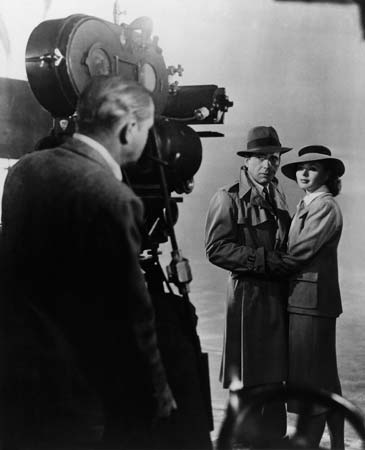
Bogart and Bergman filming Casablanca
If that sort of stilted dialogue trying to pass as "oral history" sounds interesting to you, then by all means, go ahead. There's 501 more pages of this shit (a word Porter claims Bogart hated and refused to use). At the end of the book the publisher, Blood Moon Productions, is described as "publishing that applies the tabloid standards of today to the tinseltown scandals of yesterday." That pretty much sums it up. How convenient to write about the dead, too. Porter has also written salacious biographies of Merv Griffin, Michael Jackson, Steve McQueen, Marlon Brando, Howard Hughes, Katharine Hepburn, and Paul Newman.

I was hoping for a fun, even trashy read about one of the great actors in the movies. But by the time the book gets to when he made Casablanca, long before he finally met Lauren Bacall, I was pretty worn out. And strangely, once Bogie starts getting successful, the typos in the book escalate. Maybe spell-check doesn't work so well when one cuts-and-pastes from too many celebrity biographies. It might be worth skipping through the pages of this mess if you see it in a bookstore or the library (where I should have left it) if you want some completely unsubstantiated gossip about people who have been dead for decades. But if you want to read a biography about Humphrey Bogart, this ain't the book.

Enhanced by Zemanta