Showing posts with label Rita Hayworth. Show all posts

Friday, September 15, 2017

spring and summer reads: horror and autobiography

I have been so busy the past few months with my own book and now assorted hurricanes, that I didn't have a chance to post reviews of all of the books I have been reading. The first bunch is a combination of horror and autobiography, which pretty much sums up my interests of late. Anyone have a good horror autobiography to recommend?

In the meantime, here are a few titles from my recent reading list:

The Men in My Life: A Memoir of Love and Art in 1950s Manhattan - Patricia Bosworth

This is a fascinating glimpse into a woman's life in the art and theater world of 1950s New York. Patricia Bosworth was born into a wealthy San Francisco family. Her father, attorney Bartley Crum, saw his career and fortunes dive after he defended the Hollywood Ten (Hollywood directors and writers who were blacklisted as Communists during Senator Joseph McCarthy's Red Scare fear campaign - Dalton Trumbo, Edward Dmytryk, Herbert J. Biberman, Lester Cole, Alvah Bessie, Ring Lardner Jr., John Howard Lawson, Albert Maltz, Samuel Ornitz, and Adrian Scott.) Crum moved the family to what he hoped was a more open and understanding New York, but he never really bounced back.

Complicating matters was his drug and alcohol abuse, which landed him in multiple unsuccessful dry-out attempts. He did manage to acquire a few  high-profile clients, including actors Rita Hayworth and Montgomery Clift, who would visit the house and gave young Patricia a glimpse into Manhattan's film and theater world. She would later join the famed Actor's Studio and work with, or at least brush up against, actors and artists like Steve McQueen, Marilyn Monroe, Diane Arbus, Gore Vidal, and Helen Hayes, among many others. Her most notable film role was a small part in The Nun's Story, starring Audrey Hepburn. But Bosworth's tale of that time on a movie set in Rome was far from glamorous, coinciding with a harrowing personal and physical event that shines a light on how far women have come since the 1950s and how we need to keep it that way.

Family tragedy was compounded when Patricia's younger brother, Bart Jr., committed suicide. It is clear to the reader that Bart was homosexual. After he and a friend were found in a compromising position at school and the friend subsequently killed himself, Bart sank into a deeper and deeper depression until he ultimately chose to take his own life.The family seemed helpless or oblivious to Bart's plight. Although Bosworth doesn't address issues of homophobia and mental illness directly, there are echoes of depression, addictive behavior, and denial of true self between both the father and son. What is even more tragic is that young people in Bart's position sometimes still feel compelled to take their own lives today.

Bosworth ultimately gave up acting to pursue her real passion, writing, and she has become well known for insightful biographies of Marlon Brando, Montgomery Clift, Jane Fonda, and Diane Arbus, as well as writing in more detail about her father and the Hollywood Ten (Anything Your Little Heart Desires: An American Family Story, 1997).

I found her story fascinating and am eager to now try some of her other biographies.
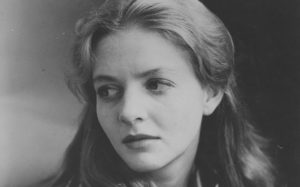
Patricia Bosworth in her Actors Studio days

Echoes From the Macabre - Daphne Du Maurier

I have always loved Du Maurier's Rebecca and have read Don't Look Now before in some other edition, but I don't think I had ever read the original version of The Birds, which was the basis for the classic Alfred Hitchcock horror film. Set in England the story is just as scary, and even more bleak, if that is possible. The rest of the stories are also very good, in a suspenseful, and in some cases, very creepy kind of way. They include: The Apple Tree, The Pool, The Blue Lenses, Kiss Me Again, Stranger, The Chamois, Not After Midnight, and The Old Man. I honestly don't want to even give a summary for any of these, as I think it is best to read them with no preconceptions. It is clear to see why Hitchcock loved Du Maurier's sometimes twisted take on life.

The Haunting of Hill House - Shirley Jackson

A true classic of horror, which tells the tale of four paranormal researchers who decide to spend some time in one of the most horrible-looking and possibly -acting houses of all time - Hill House. Dr. Montague, an erudite ghost chaser, enlists the help of three young people to prove that Hill House is truly haunted and evil. What could go wrong? Luke, who is a descendent of the original owner and builder of the terrible manse, chooses to treat the experiment as a joke. The beautiful and mysterious Theodora's motives to being there are unclear, but it is likely that she approaches the situation as a thrill seeker. Eleanor, an unhappy and possibly unstable young woman, hopes that Hill House will be the exciting new chapter in a previously dull and uninteresting life. When the cook and her husband tell the guests that they won't stay after sundown that should be the quartet's first clue that something is very wrong about Hill House.

I Shock Myself - The Autobiography of Beatrice Wood

To end things on an up note, I am including this wonderful autobiography of the little-known artist and ceramicist Beatrice Wood. Sometimes called "The Mama of Dada," she died in 1995 at the age of 105. During her long and eventful life she associated with some very interesting people, including Marcel Duchamp, Francis Picabia, J. Krishnamurti, and the art collectors Louise and Walter Arensberg. Wood is also considered to be the inspiration for the the woman who is loved by two men in Jules et Jim, which was written by Henri-Pierre Roché, who she was involved with. Their mutual close friend Marcel Duchamp fills out the third side of the eternal triangle. What was Wood's secret to her long and storied life? "I owe it all to chocolate and young men." Check her out. She was pretty amazing.

The colorful Beatrice Wood in her studio

Thursday, April 26, 2012

name dropper

In Frank Langella's new book, Dropped Names: Famous Men and Women As I Knew Them, the stage and screen actor does just that. The actor, who is perhaps best known for his sexy version of Count Dracula in Dracula and his recent turn as Richard Nixon in Frost/Nixon (he won a Tony for the play and was nominated for an Oscar for the film) has not only had a varied career, but spent it with some interesting and unexpected people.

Dropped Names has its share of bitchy moments — Langella doesn't like everyone he writes about (cough, cough, Lee Strasberg), but it's not a mean book. Because the majority of the subjects have passed on, it feels more like a series of tributes. As Langella is concentrating on his impressions of other people, it isn't strictly biography, either. Facts about his life and career as an actor can be pieced together from the disparate stories, but the book is (mostly) free of ego, which is remarkable for an actor's memoir.

In the role that made him a star, Dracula
Each chapter is in the order of the actor or entertainment figure's passing, so the chapters jump about a bit in chronology. This adds to the feeling of just sitting around with Langella and listening to him drop names, one story leading to another. It makes for an entertaining read, and as the author suggests in his preface, the reader could hop around the book, from subject to subject. There is a kaleidoscope effect at times, as certain profiles overlap, as if Langella, by focusing on a different person at the same event, is telling the same story from a slightly different perspective.

The gossip and anecdotes flow freely. The chapters that prove the most interesting are usually about people Langella knew well, such as his close friend Raul Julia. He includes a touching tribute to a fellow actor who started as a man-crush and then turned into a deep, loving friendship, "In this era when young male stars seem a sexless set of store-bought muscles set below interchangeable screw-top heads with faces of epic blandness — sheep trying to look like bulls — Raul defined real masculinity."

His chapter on Julia crosses over with ones on Jill Clayburgh and George C. Scott. The three actors were appearing in a play together in 1984, Noel Coward's Design for Living, directed by Scott. In quite a few instances Langella proves himself to be on the touchy side, as friendships flounder, "For a year or more afterward Jill and I stayed in contact ... But an incident so small and petty; a series of unreturned phone calls not worth the ink to explain, caused us to drift apart. I will forever regret the loss of those irretrievable years." We have all had similar experiences. You don't need to be a temperamental actor to throw a hissy fit that you regret later.

Al Hirschfeld's illustration of Jill Clayburgh, Raul Julia, and Langella in Design for Living
Sometimes he just hints at an actor's identity, as he does in a passage with George C. Scott, who shares his disdain for The Method. "I had worked recently with one star who was on the rise. A street-smart wise guy and Actors Studio devotee. I mentioned his name. 'An asshole,' said George, 'a talentless fucking asshole. The guy wouldn't know syntax if it came up and bit him. You need brains to be an actor.'" Most likely the actor, who the reader can have fun trying to guess his identity, is still alive, and Langella doesn't want to drop his particular name just yet.

Dropped Names can be best enjoyed if you have a love and knowledge of Old Hollywood and a passing knowledge of New York theater. Langella is as much of a fan of actors as his audience, which makes him especially endearing. He can be bitchy, too — frustrated with their egos, alcoholism, and tantrums. His glimpses into behind-the-scenes film and the theater convey how especially hard Hollywood can be on an older actor or actress:
Miss [Ida] Lupino's need was of no matter to our director and his producers. When I asked him why they had let her go, he said: "Oh she's brilliant, but we just don't have time for her." 
It is generally true in my profession that a faulty camera or an incorrect prop will often be given more attention and time than a worthy actor in need. And also true that idiot actors who come on the set stoned or drunk with petty or moronic demands are far more indulged than ones who calmly ask intelligent questions. Management likes to feel superior to actors and Miss Lupino's searching mind was clearly intimidating to them.
He also gives a knowing peek into Hollywood filmmaking at its most excessive:
Cutthroat Island … remains, in my film experience, the single most egregious example of excess I have ever witnessed in the movie world. Writers being paid $100,000 a week to punch up horrible dialogue with inane jokes, private cooks serving gourmet food to the Harlins under a cozy tent while hundreds of extras being paid less than minimum-wage stood in the freezing rain for hours ...
As Richard Nixon in Frost/Nixon
And that was just for starters. Langella is most amusing about his own perceived failures. About a film called The Wrath of God, which co-starred film legends Robert Mitchum and Rita Hayworth, he says, "The worst is my performance, terrible dialogue, and a horse who hated me." He did enjoy the deadpan cool and wit of Robert Mitchum, "Get out your pencil, Frank, and take this down. Herewith a list of the ten dullest actors in Hollywood. They are: Gregory Peck." I have to say I agree with Mitch 100% on that one. Langella also managed a brief liaison with Hayworth, who was in the early stages of Alzheimers, although he didn't know it at the time.

Movie buffs will be interested to hear about his close encounters with Elizabeth Taylor, Laurence Olivier, Tony Curtis, etc. Some of his interactions are not much more than fan encounters, which is refreshing. What may be surprising to some is how he came in close proximity to Jackie O and her friends, the wealthy high society family the Mellons, through a youthful theater apprenticeship and friendship with Bunny Mellon's daughter Liza. This opened up an entire lifestyle, and even a brief relationship with the former First Lady.

Langella is not afraid to name names — as long as the subject is deceased. But after reading Dropped Names it's impossible not to wonder how many more stories he could tell, if he included people who are still living.
Enhanced by Zemanta

Saturday, December 31, 2011

have a bubbly new year's eve

Clark Gable, Van Heflin, Gary Cooper and Jimmy Stewart raise a glass
Jack Lemmon jams with his warlock friends at the Zodiac Club in Bell, Book, and Candle
Cary Grant watches Katherine Hepburn's back in Bringing Up Baby
Rita Hayworth with Glenn Ford in Gilda
Gloria Grahame and Humphrey Bogart out on the town in In A Lonely Place

Enhanced by Zemanta

Tuesday, November 22, 2011

time to trim the tree ...

... with Rita Hayworth


I'm not sure I'm ready to do our actual tree yet. Maybe after the holiday weekend.
Enhanced by Zemanta