Showing posts with label Sherlock Holmes. Show all posts

Monday, January 20, 2014

he's back .... sherlock, season three

Sherlock Holmes (Benedict Cumberbatch) may call himself a sociopath, but last night's episode of Sherlock, "The Empty Hearse," pretty much disproved that hypothesis. As the detective returned to London, and in some ways, the land of the living, after an absence of two years spent putting an end to arch-criminal Moriarty's (Andrew Scott) global crime network, he discovered exactly how connected to the world, and to certain people living in it, that he really is. One of the most amusing scenes in the episode featured some fraternal bickering between Sherlock and his "smarter brother" Mycroft (Mark Gatiss, who is also the creator and co-writer of the show, with Dr. Who's Stephen Moffatt), where it became abundantly clear that between the two of them, Sherlock is comparatively downright social. Mycroft expressed disdain, possibly even disgust, that his younger brother deigns to have friends. He could hardly bring himself to utter the "f" word.

Sibling rivalry, from Rebloggy

As Sherlock returned to 221B Baker Street and renewed contact with his friends and associates — Inspector Lestrade (Rupert Graves), Mrs Hudson (Una Stubbs), Molly Hooper (Louise Brealey) —they were all delighted to see him — all except his closest friend, John Watson (Martin Freeman). After some retributional scuffling and head-butting from Watson a bewildered Sherlock began to understand just how much his friend had missed him. The ice sculpture began to thaw. He graciously accepted Watson's new fiancĂ©e Mary (Amanda Abbington), and the pair lost no time teaming up to rescue a kidnapped Watson from an as-yet undisclosed new enemy.

There are only three episodes in this new series of Sherlock, so fans must savor them. "The Empty Hearse" seemed designed for multiple viewings, with its alternate depictions of how Sherlock survived the fall off the high rise at the end of the second season and its nod to an obsessed fan base that thrives on the internet. The series has always had humor, but this season started off with some laugh-out-loud moments — Sherlock's use of disguise to reintroduce himself to Watson, and a super-hero-like imagining of how he survived the fall, to name a few.

Is that a deerstalker on your head, or are we just happy to see you?

In the hiatus between the last series and this one Benedict Cumberbatch, much like his alter ego Sherlock, has been quite busy, with multiple movie roles (Star Trek Into Darkness, The Hobbit, Tinker, Tailor, Soldier, Spy, War Horse, 12 Years a Slave), as well as acquiring a dedicated fan base that have dubbed themselves Cumberbitches. He has requested they refer to themselves instead as Cumberbabes, to no avail. Cumberbatch has always been an excellent Sherlock, but he really owned the part in this episode. Both actor and character seemed glad, even giddy, to be back, and the camera loved him for it — showering him with tons of close-ups and clever dialogue. Sherlock is back, the eponymous detective and his faithful sidekick Watson once again a team, and woe to any villain who stands in their way. I can't help wondering if the mysterious Big Bad might end up being Mycroft, the only other character who seemed less than thrilled at Sherlock's return.

Tuesday, June 11, 2013

of all the sherlocks i've loved before

Sherlock Holmes, the master detective, was created by Sir Arthur Conan Doyle in 1887. Conan Doyle featured this most famous of London's consulting detectives in four novels (A Study in Scarlet, The Sign of the Four, The Hound of the Baskervilles, The Valley of Fear) and 56 short stories. Holmes was a decidedly quirky but engaging character. His incredible powers of observation, his enormous ego, his attention to the most minute details, his love of disguise, his pipe smoking and cocaine habit — all add to this most well-rounded of fictional characters.

Holmes is so well-known that even his address, 221B, Baker Street, London, seems familiar to most. But what really makes the reader connect with the detective is how they get to know him through his friend and colleague, Dr. John H. Watson, who assists him on his cases and keeps a record of them and a subsequent biography of Holmes and his methods.

Basil Rathbone made the deerstalker and pipe look good
The first filmed version of Sherlock Holmes was in 1900, but most people have probably first encountered the detective as played by Basil Rathbone, with Nigel Bruce as his sidekick Dr. Watson. The duo appeared in in fourteen Hollywood productions, from 1939-46:

The Hound of the Baskervilles, The Adventures of Sherlock Holmes, Sherlock Holmes and the Voice of Terror, Sherlock Holmes and the Secret Weapon, Sherlock Holmes in Washington, Sherlock Holmes Faces Death, The Spider Woman, The Scarlet Claw, The Pearl of Death, The House of Fear, The Woman in Green, Pursuit to Algiers, Terror by Night, Dressed to Kill


Jeremy Brett practices violin to hone his mental powers

Rathbone, with his eloquent delivery, made for a dashing, impressive Holmes. But his interpretation was supplanted by what many consider to be the definitive version as played by Jeremy Brett, for Granada Television (from 1984-94). Two actors, David Burke and Edward Hardwicke, played Watson opposite Brett in the series. Brett's Holmes is supercilious, brilliant, but also human. The stories were all kept in their original Victorian London setting, although Holmes and Watson go farther afield when the case calls for it. I've seen other actors try their hand at Holmes — Peter Cushing (The Hound of the Baskervilles), Christopher Lee (Sherlock Holmes and the Leading Lady), Christopher Plummer (Murder By Decree), Nicol Williamson (The Seven-Per-Cent Solution), but Brett, more than any of them, seems to have captured the essence of the character.

Robert Downey, Jr. considers his next move
But Sherlock Holmes need not stay rooted in the past. Recently there has been a sudden renewal of interest in portraying a character that most are either overly familiar with — a Victorian-era armchair detective. In director Guy Ritchie's version, Holmes is a kick-ass, take-charge master of deduction, with the wry humor of Robert Downey, Jr. Downey, Jr. is paired with a fractious but devoted friend in Jude Law's Watson. They have so far appeared in two very high-powered entertaining films together, Sherlock Holmes and Sherlock Holmes: A Game of Shadows, and in all likelihood, considering the films' success at the box office, will team up again, if Downey, Jr.'s other alter-ego, Iron Man, doesn't get in the way. Ritchie keeps Holmes in the Victorian era, although with a modern sensibility.

Benedict Cumberbatch considers his latest clue
There have been two other recent interpretations of Holmes, both updating the detective and his cases to the 20th century, while always keeping a nod to the original source material. The most critically acclaimed has been Sherlock, from BBC One, starring Benedict Cumberbatch as the famous detective, with Martin Freeman as John Watson. Created by Dr. Who veterans Mark Gatiss and Steven Moffat, the focus is on an extremely anti-social Holmes, who utilizes the internet and other modern technology to physically separate himself from the world, while enabling him to cerebrally engage from the safety of his rooms and solve difficult cases. Cumberbatch manages to make his Holmes a little creepy and off-putting, and yet a little sexy, too. It's a fine balance, but he really pulls it off. Brilliantly.

Jonny Lee Miller utilizes varying techniques to aid his powers of deduction
On American television, on CBS, there is also now Elementary, featuring Jonny Lee Miller as Holmes. Watson, played by Lucy Liu, has been assigned to Holmes to help him overcome his drug addiction. They are invariably called in to solve some of modern day New York's most puzzling cases. Miller and Liu have a nice chemistry, and while it is not as over-the-top as Sherlock, it is also an entertaining interpretation.

Whatever your poison, Cumberbatch or Downey, Jr. or Brett or Miller or Rathbone, what all of these interpretations of Conan Doyle's master detective prove is that maybe there is always room for a new Sherlock Holmes.
Enhanced by Zemanta

Friday, February 01, 2013

tommy and tuppence are a blast from the past

Article first published as DVD Review: Agatha Christie's Partners in Crime: The Tommy & Tuppence Mysteries on Blogcritics.

This week sees Acorn Media's release of Agatha Christie's Partners in Crime: The Tommy & Tuppence Mysteries. Originally aired on television in 1983, the series was based on Agatha Christie's "other detectives" — 1920s-era Tommy and Tuppence Beresford. The DVD set includes all 11 mysteries from the series on three discs, with a approximate total running time of over 620 minutes.

The first mystery on the DVD is The Secret Adversary, a feature-length film which introduces sleuths and adventurers Tommy (James Warwick, Lillie, Bergerac) and Prudence 'Tuppence' Cowley (Francesca Annis, Lillie, Cranford). The always stylish and clever Tuppence and the ready-for-anything Tommy team up to solve a series of mysteries, all of which keep leading them inevitably to a formidable adversary - the mysterious Mr. Brown. As Tommy and Tuppence grow closer, Tuppence also considers a marriage proposal from their friend Julius (Gavan O'Herlihy). Also appearing are Honor Blackman, George Baker, and Reece Dinsdale as Albert.

Francesca Annis as Tuppence and James Warwick as Tommy
The Secret Adversary introduced Tommy and Tuppence to 1980s television audiences and was quickly followed by the Agatha Christie's Partners in Crime series. In Agatha Christie's Partners in Crime, Tommy and Tuppence are now married, and together run the Blunt Detective Agency. The fun-loving duo solve a variety of cases, sometimes adopting the mannerisms of other well-known detectives, such as Sherlock Holmes. The episodes, which all run around 50 minutes in length, include:
"The Affair of the Pink Pearl" - A bored Tommy and Tuppence take on the first case for the Blunt Detective Agency when they try to find a stolen pearl. Graham Crowden and Charles Shaughnessy costar. 
"The House of Lurking Death" - A poisoned box of chocolates is the pair's first clue in what may be a series of murders. 
"The Sunningdale Mystery" - Tommy and Tuppence must solve the murder of a man on a golf course. 
"The Clergyman's Daughter" - A Christie staple, an English country house mystery, serves as the backdrop for this episode, but with a twist — the house may be haunted. 
"Finessing the King" - Tommy and Tuppence attend a ball in costume as Sherlock Holmes and Doctor Watson, and find a murdered woman among the guests. 
"The Ambassador's Boots" - A seemingly innocent bag swap leads to a much deeper mystery. 
"The Man in the Mist" - The murder at a posh hotel of a well-known actress keeps the pair busy. 
"The Unbreakable Alibi" - Can Tommy and Tuppence help a young man marry the girl of his dreams (by breaking her alibi)? 
"The Case of the Missing Lady" - Tommy and Tuppence search for a polar explorer's missing fiancee — has the girl been kidnapped? 
"The Crackler" - The pair aid Scotland Yard in cracking a band of counterfeiters.
The DVD presents all of the episodes in the original order in which they were aired. SDH subtitles are available and the image is 4:3 fullscreen. The series does have a more "filmed in studio" look to it than the film The Secret Adversary. Acorn includes a disclaimer: "Due to the age of these programs and the improved resolution that DVD provides, you may notice occasional flaws in the image or audio on this DVD presentation that were beyond our ability to correct from the original materials." The image is certainly not as crystal-clear as we may have become accustomed to in this age of high-definition television, but the series does still look good on a large-scale HD television screen. The period details, sparkling and humorous dialogue, fabulous costumes, and stellar acting make Agatha Christie's Partners in Crime: The Tommy & Tuppence Mysteries a very enjoyable viewing experience.
Enhanced by Zemanta

Wednesday, December 28, 2011

sherlock holmes and the cult of personality

How much of our love of movies and television is based on some indefinable desire, or connection, with certain actors? We may get excited by certain themes and characters and genres, but usually what gets us into the seats are the actors.

Holmes and Watson share a drink
I really enjoyed the latest Sherlock Holmes movie, Sherlock Holmes: A Game of Shadows with Robert Downey, Jr. He is more over-the-top than ever in this steampunky, semi-anachronistic, but always fun action movie mash-up. The camera loves him, whether he is in drag or sporting a completely (deliberately) transparent disguise. There are some great action sequences and snappy dialogue. The other actors are all top-notch, too. Jude Law returns as Dr. Watson and he and Downey, Jr. still have a wonderful rapport. Director Guy Ritchie is happy to give them plenty of opportunity to banter between and during the highly choreographed fight sequences.
Watson watches Holmes take a drink, "You're drinking embalming fluid?"
Holmes, "Yes. Care for a drop?"
Watson, "You do seem ..."
Holmes, "Excited?"
Watson, "Manic."
Holmes, "I am."
Watson, "Verging on ..."
Holmes, "Ecstatic?"
Watson, "Psychotic. I should've brought you a sedative."
Rachel McAdams is also back, albeit too briefly, as Holmes's bad girl love interest, Irene Adler. Stephen Fry gives Downey, Jr. a run for his scene-stealing money with his version of Holmes's smarter (and apparently nudist) brother Mycroft, who calls his brother "Sherly." Noomi Rapace is appealing as the Gypsy Simza and Jared Harris is excellent as a very sinister and sociopathic Moriarty. But what is best about the film, what the film is truly about, is Downey's performance. That is what brings the most joy, why tickets and popcorn were purchased.

"You know, he's nothing like as slow witted as you've been leading me to believe, Sherly. "

Downey Jr. is not only helping to give Ritchie the directing career he has always wanted and for which he showed promise, but his surprise success as Ironman has also revitalized (for better or worse) super heroes at the movies. It's as if the world has finally discovered this charismatic and humorous actor, although he has been doing impressive work for years (Chaplin, Restoration, The Soloist, Kiss Kiss Bang Bang, Due Date, Tropic Thunder, etc.) He is comfortable in both leading and supporting roles, but there is no denying that Downey Jr. is an actor that people will go to the movies expressly to see. Ritchie has cannily combined Downey Jr's watchability with a character that also has a built-in audience, Sherlock Holmes — jackpot.

Downey Jr. as Iron Man
So how much of watching and loving movies and television is tied up with the cult of personality? When I think of some of my favorite actors I have to admit that although they are different from role to role, there is something, some element of their personality, that is also always there, and that I just like. I like them. And if the movie or television show or theater piece that they are appearing in sounds halfway decent (or even if it doesn't) they are usually enough to get me there. I would watch Derek Jacobi in anything. Or John Hurt, Gary Oldman, Meryl Streep, Sean Bean or Steve Buscemi. Luckily for me, they have showing up in some amazing pieces lately, Game of Thrones (Bean), Boardwalk Empire (Buscemi), The Iron Lady (Streep), Tinker, Tailor, Soldier, Spy (Oldman and Hurt). I want to see Johnny Depp's new movies, even the awful misfires he's been making lately with best bud Tim Burton. I'm still trying to erase Willy Wonka and the Mad Hatter from my memory. They better not screw up Barnabas Collins in the upcoming Dark Shadows. Some other personalities that I keep an eye out for are Colin Farrell, Angelina Jolie, Peter Dinklage, Michelle Pfeiffer, Jonathan Rhys Meyers, Owen Wilson, Kate Winslet, Emma Thompson and Helen Mirren.

As Charlie Chaplin
My cult of personalities doesn't just apply to current actors. I grew up watching black and white movies on television with the old man, who loved all the '30s gangster movies. I inherited his love of Humphrey Bogart — I never quite got to like Jimmy Cagney or George Raft — sorry, dad. I still love Bogie, who was both a great actor and a great personality. His Rick Blaine is a very different man from his Sam Spade or Captain Queeg or Dixon Steele, and yet all of those characters are somehow still Bogie, too.

I don't think my liking of the actor or actress diminishes their talent. Likability is what makes an actor a star, versus just a good actor. There are plenty of very good, talented actors out there, some who have even had Hollywood careers, but maybe never became big stars. Actors like Jimmy Stewart, Paul Newman, Gene Kelly, Frank Sinatra are all talented, but they also have that something extra that makes us connect with them as people. We like looking at them. One of the reasons different projects keep trying to capture Marilyn Monroe and can't quite completely is that she, her personality, was unique and special. Michelle Williams may get close, but she can't help but bring her own Michelle William-ness to her depiction. This applies to Downey Jr.'s excellent portrayal of Charlie Chaplin, as well.

Robert Downey Jr., through the force of his personality and likability, has gone from being comic relief in early projects like Back to School and Johnny Be Good and "actor's actor" movies like Chaplin to become a bona fide movie star. There is already talk of a third movie in the works. Bravo, Downey Jr. Looking forward to wherever your personality takes you and us next.
Enhanced by Zemanta

Friday, April 01, 2011

i am hercule poirot ...

Article first published as I Am Hercule Poirot ... on Blogcritics.


... Or Miss Marple or Sherlock Holmes or Columbo or Ellery Queen. Fill in the blank with your favorite detective.

On a recent weekend excursion my mom knew that we would be near a place that was important to her and she wanted to hit it on the way back. She wrote the name of the town on a piece of paper and showed it to me. I asked her if she would be able to find the specific place in town. She said, "I hope so."


My mom has dementia and communication is always a challenge. She still at this point knows what is it she wants to say, but she can no longer always get the words to say it. It's beyond frustrating for her, as well as for me, who wants to help, but is not always aware of the context. It's like trying to do a crossword puzzle in a language you are only slightly familiar with. But I like puzzles, so I was happy to give it a shot. Maybe all those years of reading Agatha Christies, John D. McDonalds and Lawrence Blocks would finally pay off as I attempt to unravel this latest mystery.

In the 90s she was a very active member in her local historical society and was instrumental in helping preserve many local buildings and sites and having historical markers erected. She had talked every once in a while about wanting to go visit one of her "things," so I was pretty sure that was what we would be on the lookout for.

So as we were driving back home, I tried my best to find where I think it was that she wanted to go. I remembered on a previous trip about a month ago when we were driving through a quaint shopping district that she had wanted to stop. But as we circled around, looking for parking, it was clear that would be impossible. It was getting late, so I had promised that next time we were in the area we'd come back. I was sure she was referring to this trip and one of her markers. The only problem was that I am still unfamiliar with the area, as my daughter and I just moved here last summer, so I would have to figure out how to find not only the marker, but the street in the shopping district, as my mom wouldn't be able to direct me. But we both love an adventure.

Luckily Florida is mostly a rectangle, so if you drive in one direction long enough you will either be driving towards or away from water, and I knew this was on the ocean side. I got us to the town in question, but at a major intersection I could go north or south. I decided to bet on north, and luckily, after about ten or twelve intersections I was rewarded. Both my mom and my daughter in the back seat started to say that things looked familiar. At the next traffic light we all were sure. I found a parking spot after driving a few blocks and we got out and started to check out the shops. It's a great place for window shopping. There was a puppy store, plenty of nice restaurants, a cool-looking art supply store. We got to a corner and I was ready to cross the street when my mom said, "Well, that's that." "That's what?" "That was it." It was the art supply store, which was closed on Sunday. I was floored, because this wasn't what I was expecting, but I quickly shifted gears and we turned around and picked one of the restaurants for a late lunch.


After lunch we checked out the puppy store, which was open, and I escaped without an overpriced tiny dog, but I'm not sure how much longer I can hold out against the combined puppy love exhibited by my mom and daughter. We got in the car and I headed for home. I was feeling pretty happy with how things worked out. The store wasn't open, but we managed to find it and now we could go back when it was. I know the location and a way to make my mom happy.

As I drove out of the shopping district I heard from the back seat, "Oh!" "What?" "I thought you were going to stop." "Where?" At one of those things that I did." Wait a minute ... "You mean a historical marker?" "Yes." I was floored. Again. Had I been right all along? Was that her original objective? Or were there two? Is this just proof that as "right" as I may get what she is trying to say, I will always miss something? But I just smiled and enjoyed  the irony. After all, we'll be going back.
Enhanced by Zemanta

Wednesday, February 16, 2011

detectives don't wear seatbelts

Article first published as Book Review: Detectives Don't Wear Seat Belts: True Adventures of a Female P.I. by Cici McNair on Blogcritics.

Cici McNair's Detectives Don't Wear Seatbelts is a fun and fast read. You careen along with the author through her exotic travels and attempts to become a female private eye in a profession mainly inhabited and ruled by men. When I think of a detective it's the brilliant yet introspective Sherlock Holmes, or the laconic hero of a noir classic like Humphrey Bogart in The Big Sleep, or the fast-talking private eye who won't let anyone stop him from getting to the truth about who killed his partner—like Bogie again in The Maltese Falcon. So it's refreshing to learn how a woman was able to join the ranks of this traditionally masculine profession. McNair's writing fits the fast-talker detective profile to a T. She decides one day to become a detective and sets off full-steam, without a clue, but with energy and desire to spare.

She is definitely fearless, whether it's stepping off a plane countless times in some remote location, or stepping off a creepy dark elevator in a New York counterfeit handbag factory, wearing a wire and with a hidden camera, to spy on the goings-on. But even with all her rapid-fire anecdotes we never fully understand why she has gone on her latest journey or taken on yet another part-time job. Is it because she couldn't sit still for long? Or is she running from her dark family secrets?

As she becomes a crack investigator, McNair realizes that she loves hanging out with the boys and sketches their colorful personalities, while never resorting to caricature. And that's no mean feat, as some of the detectives seem to court caricature, or at least have modeled themselves after Bugs Bunny's Bugs and Thugs version of a tough-talking private eye, "Bugs Bunny, Private Eyeball—Thugs Thwarted, Arsonists Arrested, Bandits Booked, Forgers Found, Counterfeiters Caught, and Chiselers Chiseled."

I think it's because she has a great affection for her colleagues, and an almost photographic memory of spending time with them, even after working with some for just a few short months. While I was reading, I tried to remember all the interesting and unusual folks I have crossed paths with in short-term jobs I've held over the years. It's not that easy. McNair not only has a great memory, but also must feel a duty to do everyone justice. She does and she's also pretty funny while she's doing it.

McNair talks about her childhood and abusive, distant father, but somehow leaves a mystery in the air—did he really try to murder her mother and her? What about her other siblings? She has quite a few and they don't seem to have much of a part in her life or have experienced the same upbringing and issues—she does mention briefly that one brother committed suicide. She seems devoted to her octogenarian mother, but maintains her distance from her and her Mississippi roots.

She is observant and diligent when it comes to detecting. Why does she avoid the obvious hints from a local Mississipi private eye that investigating her father's life might help answer many of her questions and put some of her issues to rest? McNair's whirlwind travels around the world, multiple relationships, and avoidance of marriage seem to always be tied back to the one big relationship in her life—her parents' marriage. That's a book I would have liked to read—her in-depth investigation of her parents' past. It might be intrusive, even creepy, to investigate one's family, but wouldn't a true detective also find it irresistible?

McNair does bring up the emotional debris that comes with taking a peek into others' lives. Although her investigating does seem to help many—she reunites lost relatives, helps innocent and impoverished people avoid jail—she doesn't always get to see how their story ends. She may produce all the facts that a person needs to contact their lost relative, but she has to hand over the paperwork and leave before the final scene is played. Did the client eventually contact their missing family member? McNair usually never finds out.

Detectives Don't Wear Seatbelts is a memoir, but it also reads as a bit of a mystery. For all of its author's desire to take us along on her breakneck pace through her life, the reader never gets to go too far below the surface. Maybe that's how McNair wants it. Like the boss of the detective agency who she never really gets to know with the assortment of different hats for undercover work—cowboy, baseball, fedora, etc.—it probably isn't in a born detective's nature to want to reveal too much of themselves. They are in the business of staying in the shadows and turning up facts about others.


Book #9 in reading challenge Cannonball Read 3, sponsored by Pajiba

Full disclosure: This book was sent to me to review. I'm very thankful to be considered a critic of books, movies and other pop culture and I will continue to be fair in my reviews.

Enhanced by Zemanta

Friday, November 12, 2010

remembering josh

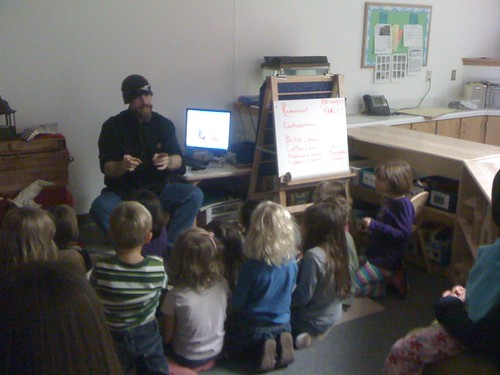
I recently found out that a dear man I know died unexpectedly. Joshua Beasley was not only a wonderful guy, but he was a wonderful teacher. He was part of a team of teachers at the Smithsonian Early Enrichment Center. Josh was primarily the center's afternoon enrichment teacher, but he would also fill-in as needed, in all the classes, from infants on up. My daughter started out in the Center's infant care at the age of seven months and graduated from the kindergarten last year, so she knew Josh most of her life. She always liked Mr. Beasley, but last year, when he was her teacher every afternoon, she grew to love him.

iphone 1442

Talking about Beowulf, swordsmanship, the Bodleian Library and the Bayeux Tapestry
My daughter has always bonded with her teachers and has loved them all, but I think that Mr. Beasley was her favorite. He touched something in her, and in me, too. I was able to participate in a few of his lessons last year and was amazed at his ability to deftly include my show-and-tell of the Bayeux Tapestry into his ongoing lesson on Beowulf. Yes, Beowulf, for kindergartners. Josh interpreted classics like Beowulf, Hamlet and Sherlock Holmes for five and six-year-olds and he made them always fun, brilliant, and exciting. He was so excited himself about learning and transmitted his joy and enthusiasm so well that I know my daughter will take that excitement for learning with her throughout her life.

iphone 1415

Lessons learned
We moved away from the area last year—moved on to first grade, so it was unlikely that we were going to see Mr. Beasley anytime soon. But I feel so bereft to know that not only will we never see him now, but that his wonderful magic with learning, his interactive method of teaching children, and his own personal pursuit of knowledge is at an end. There is no explaining or understanding something like this. It is just tragic.
At kindergarten graduation
I see no reason at this point to tell my daughter about Josh. What purpose would that serve? If we were still in the area, and there was a chance she might see him while visiting me at work, then that would make sense. My heart goes out to all the on-the-spot parents and children and colleagues of Josh who have to deal more directly with his loss. My daughter still talks about him a lot, whenever she sees or hears something that reminds her of him. With his love of Tigger, and expertise at drawing Disney characters, that can be quite often. She has wonderful memories and associations, and right now I do not need to taint them with sadness and regret. We've had enough sadness for a while. When she's a little older, if he comes up in conversation, maybe I will tell her. Maybe. Maybe someday she will read this.

I do know that when we walk through a bookstore and her voice suddenly rises to a delighted, excited,squeak as she says, "Oh! Mr. Beasley had that book!" or, "Mr. Beasley drew that picture for us!", I am happy, too. I know that Josh would be pleased to know that he had such an impact. And I hope that my daughter will continue to remember and enjoy what Josh taught her, sharing what she's learned, and realizing how fortunate she was to have had such a great teacher. A teacher in a lifetime.
Enhanced by Zemanta

Monday, October 25, 2010

the game's afoot ... and on

Sherlock debuted on Masterpiece Mystery last night and it was up to all the hype (it debuted in Britain earlier this summer). The updating of the famous sleuth worked quite seamlessly. The gadgetry that is an essential part of our modern lives seemed like old hat for Benedict Cumberbatch's Sherlock, who just needs to close his eyes and he can visualize a Google-map of London streets in order to chase down a perpetrator. Cumberbatch is pale and kinetic—a wax sculpture come to life—in a good way. Martin Freeman's Dr. Watson, a vet from the Afghanistan War was doubtful, for just a moment, before being swept into the adventure and Sherlock's strange world.


Like Watson, I am already signed on for the ride. I also liked Rupert Graves's Inspector Lestrade, who was less of a pain in the ass here, than in the Conan Doyle tradition (they left that role to his underlings), and more of a resigned collaborator. The first episode, A Study in Pink, was a nice combination of the Brit-procedural we have come to recognize and love, a la Prime Suspect—a tad grittier and more depressing than American detective shows, which only seem able to try, ad nauseum,  to get the camera inside a wound—and the long line of Sherlock Holmes mysteries, from the wonderful Basil Rathbone to the inimitable Jeremy Brett, and especially, Robert Downey Jr.'s recent portrayal.


In fact, the camera-work and pace seemed to echo a tad the Downey Jr. film, as we and the cameras raced to keep up with Sherlock's brilliant deductions. The film was a little more playful with Sherlock, introducing Irene Adler and giving her a kick-ass attitude as she flirts and subverts the hero at every turn. This television Sherlock is "married to his work" in the tradition of the books, but the pilot couldn't help but flirt itself a bit with the Holmes/Watson relationship. A scene in a diner played with the characters—two grown men that have chosen to be flatmates—a situation that might mean something quite different to a modern 2010 audience than one at the turn of the century—and then moved on. It was a skillful sidelining of something that could have been distractingly commented on in an updated version. Their partnership is sealed not with a kiss, but a gunshot, and to paraphrase from Casablanca, "Watson, I think this is the beginning of a beautiful friendship."
Enhanced by Zemanta