Tuesday, December 17, 2019

ronan farrow’s catch and kill

Ronan Farrow’s Catch and Kill reads like a spy novel. The full title is Catch and Kill: Lies, Spies, and a Conspiracy to Protect Predators. And Farrow lays out quite a conspiracy. He takes the reader inside the world of investigative reporting – in his case for NBC News. Not only does NBC prove to ultimately be hostile towards allowing Farrow to tell the full story of his investigation into allegation of sexual abuse by Harvey Weinstein, but it is also a hotbed of abuse culture, including its main asset at the time, Matt Lauer.
“Catch and Kill” is a term used to describe a media outlet purchasing a controversial story and then burying it. It is standard practice with tabloids, as Farrow recounts how it had been used frequently by the National Enquirer over the years to protect well-known, powerful figures like Weinstein, Donald Trump, and others from salacious stories about them.
Ronan Farrow, author of Catch and Kill
The bulk of Catch and Kill is about Farrow’s unrelenting quest to give voice to the victims of Hollywood mogul and alleged serial sexual predator Harvey Weinstein. This is the real core of the book and it is fascinating. Farrow writes very engagingly, and the reader feels his urgency as he not only faces opposition from the higher-ups at NBC to tell the stories of Rose MacGowan and other women who have come forward to relate their experiences with Weinstein, but how he was also under surveillance from Weinstein’s minions, including an Israeli intelligence service dubbed Black Cube. Creepy stuff. Interestingly, it is print journalism that comes to the rescue, as Farrow, fed up and shut out from NBC, takes his findings to the New Yorker, where his story is ultimately published, helping to give a bigger voice to the #MeToo movement.
The weakest part of the book is actually the Matt Lauer section. Although it must have seemed like a good idea to include it, with Lauer’s  link to NBC and the underlining of seemingly sanctioned toxic behavior by powerful men in the entertainment industry, I think it would have worked better as a New Yorker article or another book. The Weinstein story is huge and the Lauer chapter seems like a digression from the main plot. But that quibble aside, I can still highly recommend Catch and Kill.
Farrow is clearly dedicated to championing the vulnerable and bringing their stories to light. It is shocking and discouraging  to read how deep the conspiracy was to silence all of Weinstein’s accusers, particularly Rose MacGowan. Hopefully Farrow’s book can help to not only corroborate her story but ultimately bring her some sense of peace and justice. Farrow (sometimes working with Jane Mayer) has reported on predatory behavior by Les Moonves at CBS, New York State Attorney General Eric Schneiderman, and Supreme Court nominee Brett Kavanaugh. He also exposed the link between the MIT Media Lab and Jeffrey Epstein. And this top researcher never stops researching. Farrow has a Catch and Kill podcast with expanded reporting on the topics covered in the book. I can’t wait to read about where he sets his sights next.

This story first appeared on Cannonball Read 11

demi moore, inside out


Reading Demi Moore’s memoir Inside Out is like having a seat in the room while she is undergoing therapy. And yoga. And flirting with Bruce Willis. And being abused by her parents. And, strangest of all, not spending much time in Hollywood. But you do get a pretty good picture of her home and life in Hailey, Idaho, which she clearly loves, an oasis she has created for her family and herself.


Demi Moore, Inside Out: A Memoir

Inside Out flows, but it is not exactly an easy book to read. Real pain and trauma is spread throughout its pages. Moore had an extremely difficult childhood, raised by parents (mostly her mother) who at best ignored her, at worst practically pimped her out as a young girl. It is amazing to think how far she has come, considering her rough start. Moore is unflinchingly honest in her revelations and discoveries about her family’s and her own weaknesses. She tends to downplay her own achievements, certainly as an actress, so it is hard for the reader who might want to learn some more details behind how she got her role in Ghost as much as how Joel Schumacher helped her kick her booze and cocaine habit during the filming of St. Elmo’s Fire. She was successful at both, and stayed sober for years. Her substance abuse issues would crop up again later in her life, in her 40s, when she was married to Ashton Kutcher, who apparently enabled bad choices and then chose to look away when things got to be too much for her to handle.
Where Moore allows herself to feel proud of herself and crow a bit are when she talks about her love of being pregnant, a mother, and her love for her daughters. She also toots her own horn a little when she discusses her iconic Vanity Fair (August 1991) cover shoot by Annie Liebovitz, taken when she was seven months pregnant. The cover was quite controversial at the time, and paved the way for women to celebrate their “baby bumps” – wearing more form-conscious fashion, something we take for granted now. Moore also was one of the first actresses to earn $10 million for a single film in Hollywood. She starred in numerous blockbusters in the 90s: Ghost, A Few Good Men, Indecent Proposal, Disclosure, as well as producing If These Walls Could Talk and the Austin Powers movies.

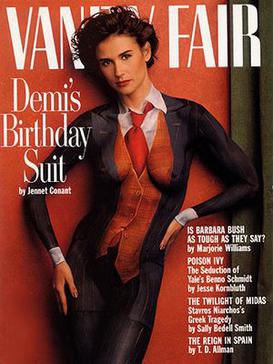
“Demi’s Birthday Suit” Vanity Fair, August 1992

She appeared nude again for Vanity Fair, photographed by Liebovitz, covered in body paint, a year later. The photo was a testament to bouncing back from pregnancy weight as well as highlighting Moore’s intense workout regimen, which was highlighted throughout her movie career, most notably in G.I. Jane and Striptease. Moore describes herself as an obsessive personality, who has not just battled drugs and an eating disorder, but also working out too much, to the point of making herself ill. It is hard to determine how much Hollywood’s fixation with women’s bodies and her own trauma from childhood sexual abuse played a part in her feelings about herself and her body. But she is not afraid to ask the question or try to find the answer.
What might have been the most gossipy part of the book – her relationships with high-profile men like Emilio Estevez, Bruce Willis, and Ashton Kutcher – are less about fun times than highlighting her or their inability to connect. At the end of Inside Out I don’t feel sorry for Moore, but I do feel empathy. And maybe a little hope, as she continues on her path to self-discovery.

This review first appeared on Cannonball Read 11
Tuesday, September 24, 2019

books to film: pal joey and BUtterfield 8

After recently reading Truman Capote's Breakfast at Tiffany's, I decided that I not only wanted to continue with my book-to-film theme, but keep it centered in New York City, too. That led me to John O'Hara's  Pal Joey and BUtterfield 8.

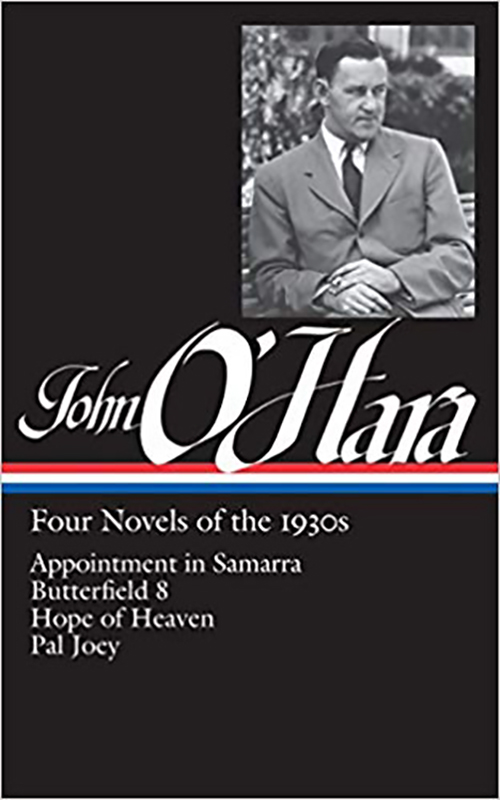
John O'Hara - Four Novels of the 1930s

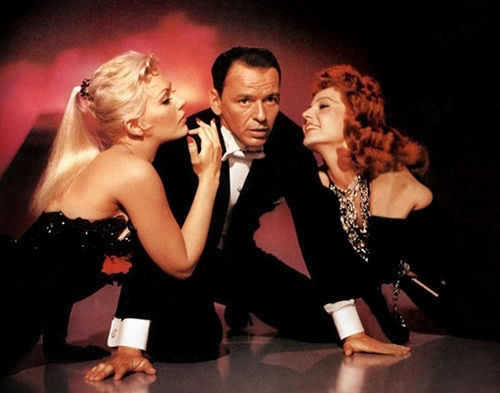
I had heard for years that the 1957 film version of Pal Joey was nothing like the 1940 Rodgers and Hart Broadway musical - Gene Kelly apparently portrayed him as a genuine no-good crumb (as Joey would say). In the film Frank Sinatra isn't exactly an angel, but he has enough of the proverbial heart of gold to win the love of sweet Kim Novak. Not only does the original O'Hara text outline Joey's not-so-nice persona, but it is an epistolary novel, including a series of Joey Evans' missives to his "dear pal Ted." Down on his luck nightclub MC and singer Joey Evans is always trying to get his more successful friend Ted to help him get a job in New York, where Ted seems to be doing very well in his own musical career, but clearly Ted isn't biting. The novel started as a story that O'Hara submitted to The New Yorker, first published in 1938. It was so popular he wrote more and more, until they were compiled published as a novel in 1940. To the delight of the reader, your pal Joey writes like he talks, which, a la Derek Zoolander, is not too good:
Dear Friend Ted
That is if I can call you friend after the last two weeks for it is a hard thing to do considering. I do not know if you realize what has happen to me oweing to your lack of consideration. Maybe it is not lack of consideration. Maybe it is on purpose. Well if it is on purpose all I have to say is maybe you are the one that will be the loser and not me as I was going to do certan things for you but now it does not look like I will be able to do them.
From the 1957 film, Frank Sinatra as your pal Joey with mice Kim Novak and Rita Hayworth

Pal Joey is a mostly funny read. Joey is grasping, but mostly clueless. He does seem to have a pretty good talent for the music and jazz of the time, but his human relations skills are less than zero, especially with the "mice" (Joey's slang for girls) that he encounters along the way. Joey doesn't seem to be doing much better with his career by the end of the novel than he did when it started, which adds to the realism, and even humor of the piece. Joey may have been a heel, but his persona has lived on entertainingly in print, stage, and screen.

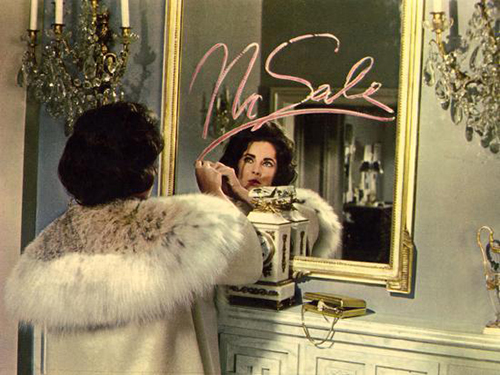
1935's BUtterfield 8 was made into a successful film in 1960, starring Elizabeth Taylor (who won the Oscar for Best Actress) and then-husband Eddie Fisher, right before she went on to make the blockbuster Cleopatra. The story centers on Gloria Wandrous, a young woman who lives her life freely - sleeping with men that she likes, while searching for a meaningful life. Gloria is a complicated person. It is revealed, midway through the novel, that she was a victim of child sexual abuse. She is quite frank and flirtatious with her closest friend, commercial artist Eddie, who seems to be her only true friend. Gloria is getting tired of her itinerant life and believes that she has fallen in love with her latest lover, married man Weston Liggett. But will she be able to get past her malaise and open herself to love and a life with Liggett?

From the 1960 film, Elizabeth Taylor in her Oscar-winning turn as Gloria Wandrous in BUtterfield 8
“On this Sunday morning in May, this girl who later was to be the cause of a sensation in New York, awoke much too early for her night before. One minute she was asleep, the next she was completely awake and dumped into despair. It was the kind of despair that she had known perhaps two thousand times before, there being 365 mornings in a calendar year.”
The book, although interesting to read and progressive for its time, has problems. Gloria is racist and abusive to her mother's black maid as a matter of course. She is the recipient of sexist behavior, which is not surprising, considering the time the story takes place, but that same sexism is also ultimately worked into the plot. Why is Gloria made to "pay" for her choices and behavior while her partner, Liggett, seems to get off scot free? That can happen frequently in life, but did the reader in 1935 accept her fate as unjust or inevitable? Events in the 1960 film may have been depicted as tragic, but seemed equally cliché. BUtterfield 8 seems a precursor, almost a companion story to Breakfast at Tiffany's. The authors each presented interesting, free-spirited women as their protagonists, but in the end, don't seem to know what to do with them.


This post also appears on Cannonball Read 11

Monday, September 23, 2019

free spirit holly golightly, forever a cipher

Breakfast at Tiffany's the book shares a lot of the same traits as Breakfast at Tiffany's the film: charming in places, predictable in others, with some questionable and unnecessary ethnic and racist slurs. Truman Capote wrote it in 1958, but the story is set in 1943 as a young, unnamed writer (Capote's stand-in) moves into a brownstone on the upper east side of Manhattan. He soon encounters his 19 year-old enigmatic neighbor, Holly Golightly. She proceeds to charm and repel him at intervals, while remaining oblivious to his roller coaster-like reactions to her.

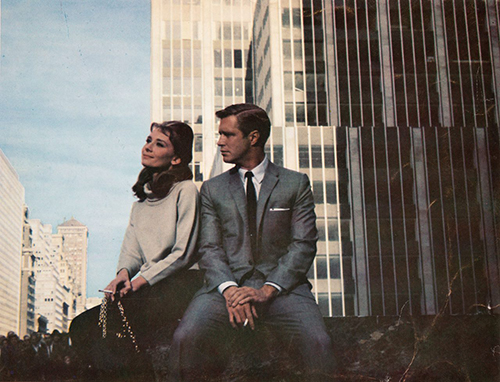
Holly (Audrey Hepburn) and Paul (George Peppard) spend a day in Manhattan in Breakfast At Tiffany's

Holly is definitely the most interesting character in the story, although she ultimately remains a cipher. What makes the book truly delightful is Capote's way with words. His descriptions of Holly and her antics are a joy to read, even if his humble narrator doesn't seem to ever really grasp her true character or what motivates her.
She was still hugging the cat. "Poor slob," she said, tickling his head, "Poor slob without a name. It's a little inconvenient, his not having a name. But I haven't any right to give him one: he'll have to wait until he belongs to somebody. We just sort of took up by the river one day, we don't belong to each other: he's an independent, and so am I. I don't want to own anything until I know I've found the place where me and things belong together. I'm not quite sure where that is just yet. But I know what it's like." She smiled, and let the cat drop to the floor. "It's like Tiffany's . . . nothing very bad could happen to you there, not with those kind men in their nice suits, and that lovely smell of silver and alligator wallets. If I could find a real-life place that made me feel like Tiffany's, then I'd buy some furniture and give the cat a name.”
Breakfast At Tiffany's, by Truman Capote

As fun and quick a read as it is, Breakfast at Tiffany's shows a dark side of New York, whether that was Capote's intention or not. Holly has been around - since a very young age. She may be mature beyond her years, but she is still a teenager who is being fawned over by a series of much older men, the narrator included. All these men want something from Holly - to love her, sleep with her, tame her. But she manages to evade their grasp. A young woman living independently, on her own terms, in 1940s New York was an anomaly. Holly as a character makes for interesting reading, but in the end Capote has her leave New York, leave the country, with no explanation, no resolution. Maybe he just didn't know how to deal with such a free spirit. She eluded him, too.

This post also appears on Cannonball Read 11