Showing posts with label Alfred Hitchcock. Show all posts

Monday, May 10, 2021

some great, some not so, some not even suspense

 A Century of Great Suspense Stories

I got this one to listen to on drives more than thirty minutes. You can basically hear one short story each way. It is a mixed bag, both in quality and presentation. It should be noted that the audible version of this book only includes seventeen stories, the first half of the book. The rest of the book’s nineteen tales are missing. Maybe the second half is also available as a book on tape. Maybe I’ll check.

The stories have been gathered by author Jeffrey Deaver (The Bone Collector). Many of the stories were previously published in Alfred Hitchcock’s Mystery Magazine. A lot of the stories have that twist ending reminiscent of The Twilight Zone, Alfred Hitchcock Presents and similar anthology shows. Deaver includes one of his own short stories, “The Weekender,” which also happens to be one of the best ones. Other highlights include “Missing: Page Thirteen” by Anna Katharine Green and “The Gentleman in the Lake,” by Robert Barnard. The absolute highlight of the collection is “Quitters Inc.” by Stephen King, which rounds out the collection.
A Century of Great Suspense Stories
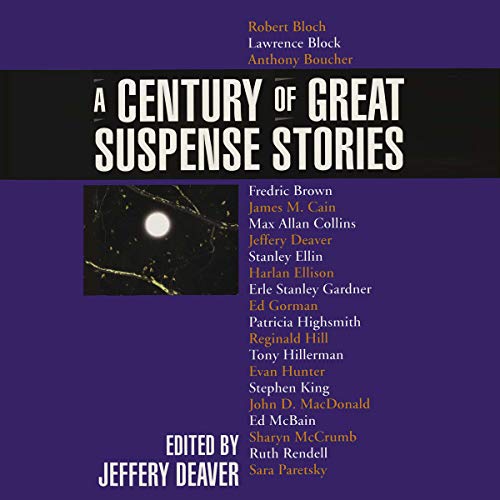
A Century of Great Suspense Stories, edited by Jeffrey Deaver (warning, a lot of the authors listed here aren’t in this truncated collection)

What is especially difficult is the inability to search through the collection as you’re listening to find a story or skip a story. You can fast forward, but it is a very clunky presentation. The readers of each story were mostly good. Some of the more detective noir-ish readings were a bit much, maybe, but that could have been the stories, too. I found the classic American detective stories to be the most dated. The Erle Stanley Gardner was especially tough going.

It took a lot of hunting online, as there is no complete list of authors and stories with the book on tape, but here is the complete list of the contents:

“Gentleman in the Lake” Robert Barnard
“Life in Our Time” Robert Bloch
“Batman’s Helpers” Lawrence Block
“Girl Who Married a Monster” Anthony Boucher
“Wench is Dead” Fredric Brown
“Cigarette Girl” James M. Cain
“Matter of Principal” Max Allan Collins
“The Weekender” Jeffery Deaver
“Reasons Unknown” Stanley Ellin
“Killing Bernstein” Harlan Ellison
“Leg Man” Erle Stanley Gardner
“One of Those Days, One of Those Nights” Ed Gorman
“Missing: Page Thirteen” Anna Katharine Green
“Voir Dire” Jeremaih Healy
“Chee’s Witch” Tony Hillerman
“Interpol: The Case of the Modern Medusa” Edward D. Hoch
“Quitters, Inc.” Stephen King

Review on Cannonball Read 13

strangers on a train - stranger and strangerer

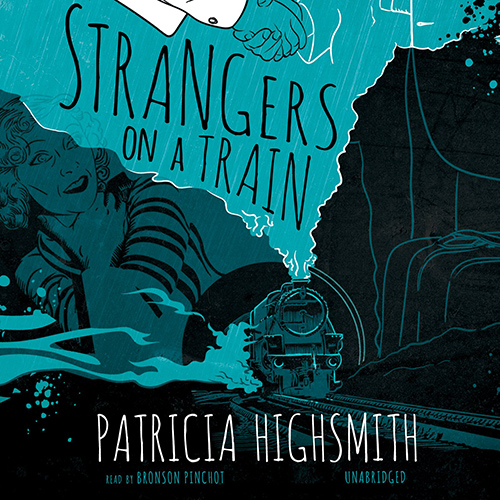
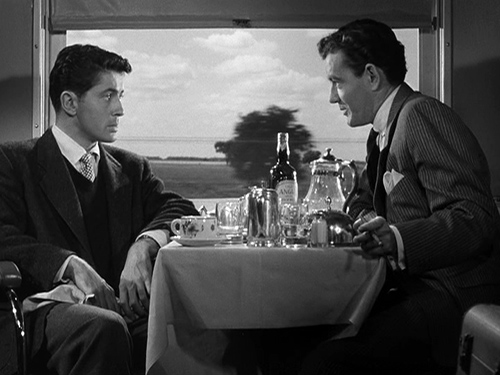
Every once in a while I get a yen to read the source novel for one of my favorite classic movies. My most recent read (actually listen) is Strangers On A Train, by Patricia Highsmith. I have seen the classic Alfred Hitchcock film, featuring Robert Walker and Farley Granger, many times. There are some indelible, memorable scenes in that movie – the two men crossing legs and crossing lives on the train, the gold lighter which incriminates and absolves, the final deadly and hair-raising sequence on the merry-go-round at the amusement park. Apart from their initial meeting on the train, Hitchcock fans should know that none of those set pieces are in the book.

Strangers On A Train
Strangers On A Train, directed by Alfred Hitchcock, with Farley Granger and Robert Walker.

That doesn’t mean that the book isn’t interesting, however. It was Highsmith’s first novel, published five years before her successful The Talented Mr. Ripley. It could be viewed as a precursor of some of the themes that appear in that novel, like the doubling effect of two male protagonists. Charles Bruno is a charming sociopath. He wants to “trade murders” with a random man he meets on a train, Guy Haines, an up-and-coming architect (Hitch made him a tennis pro). Guy doesn’t take Bruno seriously, but he doesn’t condemn him that forcefully, either. Guy’s got his own problems. His estranged wife Miriam is now pregnant by her new boyfriend and he’s hoping she will agree to a divorce so that he can marry his (very rich) sweetheart Anne. But Miriam is not known for being agreeable.

Strangers On A Train is a psychological thriller. Highsmith is most interested in Guy’s mental journey and collapse as Bruno continually pressures him to hold up his end of the bargain. Written in 1950, the undercurrents of homosexuality between the two men must have seemed shocking. Highsmith isn’t exactly sympathetic to the almost perpetually drunken Bruno, but she lets his character grow through his actions and how people react to him, which makes him more interesting than broody Guy. In fact, “hero” Guy becomes more and more unlikable as the story progresses. Highsmith does not do a very good job with her lone female character, Anne, who seems to only exist to be devoted to Guy, but we are never given a reason why she likes the increasingly unpleasant fellow. The story is told at times from both Guy’s and Bruno’s perspectives. The book would have definitely benefited if we had more of Anne’s perspective, too.

Strangers On A Train
Strangers On A Train, written by Patricia Highsmith, read by Bronson Pinchot

Ultimately Strangers On A Train is an interesting read, but I prefer how Alfred Hitchcock streamlined some of the action and themes and certainly brought his visual flair to Highsmith’s clever plot idea. I “read” the audible version of this book, read by Bronson Pinchot.


Featured on Cannonball Read Instagram and on Cannonball Read

Tuesday, October 23, 2018

favorite movie #83 - halloween edition: the birds

Favorite movies that have had an impact on me - #83 - The Birds (1963) - Hitchcock based this innovative film on a short story by Daphne Du Maurier. But apart from the seemingly random and ever-building attacks by birds, which featured in the original story, this film is all Hitch. Screenwriter Evan Hunter (aka Ed McBain) expanded the story at the director's request, to feature a Hitchcock cool blonde, Melanie Daniels (Tippi Hedren), as the heroine of the piece. Hitchcock, as we have learned many years later, crossed all sorts of boundaries with actress Tippi Hedren, but it should be noted that for all of his films featuring enigmatic blondes, they were never in the leading role. They were always the focus of the leading man in the film (North By Northwest, Rear Window, Vertigo, To Catch A Thief, Psycho, etc.) But for this film, and the subsequent film he made with Hedren, Marnie, her character is the protagonist. That is significant. If he hadn't pushed her to a point where she refused to work with him again, one wonders what other female-driven stories he might have told.

But  I digress. Back to the film: San Francisco socialite Melanie Daniels decides to pursue Mitch Brenner (Rod Taylor) from San Francisco where they had a meet-cute in a pet shop, all the way upstate to his Bodega Bay weekend/family home. Her arrival seems to coincide with a series of vicious bird attacks on the town residents. The movie has no musical score, but does include bird sound effects, which add to the terror as the frequency and level of the attacks increase. Mitch is surrounded by women: his mother (Jessica Tandy), who initially resents Melanie's presence, his much younger sister (Veronica Cartwright), who immediately loves Melanie, and an old flame, Annie Hayworth (Suzanne Pleshette, in one of the most touching performances in a Hitchcock film), who welcomes Melanie, in a sad, world-weary way. No one in Bodega Bay is safe — from the birds or the director's special effects. Truly one of the all-time great films.


As Melanie arrives she is poised, confident - but she and her iconic green suit will get battered during her visit 


Related:

happy alfred hitchcock day!

hitchcock's true romance

the girl does not impress

spring and summer reads: horror and autobiography

Friday, October 19, 2018

favorite movie #79 - halloween edition: the city of the dead/horror hotel (u.s.)

Favorite movies that have had an impact on me - #79 - The City of the Dead/Horror Hotel (U.S.) (1960) - This is a British movie, but everyone speaks with an American accent, as the story is set in Massachusetts and references the burning of a witch in (fictional) Whitewood, Mass. in 1692 (the same year many of the "witches" of Salem were first executed.) Of course the difference between the film's Elizabeth Selwyn (a very creepy Patricia Jessel) and the innocent women in Salem is that she is a real witch, and has been granted eternal life by the devil as long as she promises to continue her wicked ways. College professor Alan Driscoll (Christopher Lee) sends one of his students, Nan Barlow (Venetia Stevenson), who is fascinated by the history of witchcraft, to Whitewood to complete her research. Maybe she should have considered changing hr major from occult studies. The movie has the production values of a classic Avengers episode, but it is still quite effective. The atmosphere is spooky and the story isn't afraid to take a gruesome turn or two. What I found really interesting about the film while I was watching was its similarity to another popular black and white horror film from 1960, Alfred Hitchcock's Psycho. A pretty young blonde arrives alone, in a car, at an eerie old hotel. The hotel owner is strange, but friendly. The girl disappears halfway through the film causing a family member (in this case her brother and boyfriend) to set out to find her. But it's unlikely that City of the Dead was inspired or influenced by Psycho. It was originally intended as a TV show, a vehicle for Boris Karloff, but the story was expanded to feature film length. It went into production before Psycho, and filmed at Shepperton Studios in England, while Psycho was filmed at Universal Studios and various locations in California and Arizona. Maybe there was something in the air in the winter of 1960 ...

You can do a lot with a low budget and some well-placed fog ...
Christopher Lee plays a not evil college professor at all
Maybe one shouldn't pick up hitchhikers on a dark and misty night?
Mrs. Bates, I mean, Newless, bears a striking resemblance to Whitewood's most famous witch
I didn't know New England could get so misty on Candlemas Eve
Road hazard ahead
What all the occult researchers are wearing this year
A trap door leading to a basement grotto full of cobwebs - let's check it out!
Note to self: Avoid graveyards on the Witches Sabbath

Monday, September 24, 2018

favorite movie #53: bell, book, and candle

Favorite movies that have had an impact on me - #53 - Bell, Book, and Candle (1958) - A middle-aged Jimmy Stewart may seem a strange choice for a romantic lead, but he was, like Cary Grant, still the go-to star for such films in the 1950s. For his two most romantic roles of this era his co-star and object of his affections was the lovely Kim Novak — in Vertigo and Bell, Book, and Candle, both released in 1958 — in May and November, respectively. While Vertigo is a mystery about obsessive, voyeuristic love told only the way Alfred Hitchcock could tell it,  Bell, Book, and Candle is a light-hearted comedic romance about a witch who falls for her upstairs neighbor — it was one of the inspirations for the long-running television show Bewitched. Stewart and Novak have great chemistry here, as they did in their previous film. Jack Lemmon, Elsa Lanchester, Hermione Gingold, and Ernie Kovacs are all fun in supporting roles. One wonders if Jack Lemmon's trick with the street lamps of Greenwich Village might have inspired author J.K. Rowling almost forty years later ...

Novak poses with her familiar, Pyewacket

It's also an Xmas movie!
Kim Novak wears bewitching costumes by Jean Louis


Sunday, September 23, 2018

favorite movie #52: vertigo

Favorite movies that have had an impact on me - #52 - Vertigo (1958) - I saw Vertigo for the first time, and in a theater during its 1983 restoration/re-release. Wow.


I still remember to this day the hypnotic scene when Jimmy Stewart's Scottie is following Kim Novak's Madeleine and she walks into a flower shop from an alley back door. The alley is dark and dirty and the door is made of wood. I can swear when voyeuristic Scottie opens the wooden for a crack to see Madeleine surrounded by beautiful, colorful lush blooms I got a whiff of fragrant flowers myself.
Scottie (James Stewart) spies on Madeleine (Kim Novak)

Vertigo is Hitchcock's most person film and undoubtedly his masterpiece.


Judy (Kim Novak): If I let you change me, will that do it? If I do what you tell me, will you love me?


Related:

happy alfred hitchcock day!

Sunday, August 26, 2018

favorite movie #3: rear window


Favorite movies that have had an impact on me - #3 - Rear Window (1954): I love all of Alfred Hitchcock's films, but this is probably my favorite. There is so much here. Great acting by Jimmy Stewart, Grace Kelly and Thelma Ritter. A suspenseful murder mystery. Amazing set design. But what really makes the movie great is the exploration of voyeurism, an activity that is at the very core of viewing movies.


Thursday, March 06, 2014

throw-back thursday: best movies ever — rear window

The recent Academy Awards have gotten me thinking about my all-time favorite films and that list inevitably includes more than a few titles by Alfred Hitchcock. It's hard to pick a favorite from so many great movies, but Rear Window has always been at the top of the list. Thinking about Hitchcock and Kim Novak makes me realize that I need to write about Vertigo, soon. But in the meantime, here is a post from 2012, one of Hitch's (and any) best movies ever — Rear Window.


I've always been a huge fan of Alfred Hitchcock's movies. Vertigo is probably the ultimate expression of his recurring themes of mistaken identity and the ultimate unattainable female. The Birds and Psycho are both terrific horror movies, depicting monsters from without and within. But Rear Window is not only a great artistic achievement, but it is also one of his most entertaining films.

Thelma Ritter, Grace Kelly and Jimmy Stewart look out the window, "I'm not much on rear window ethics."

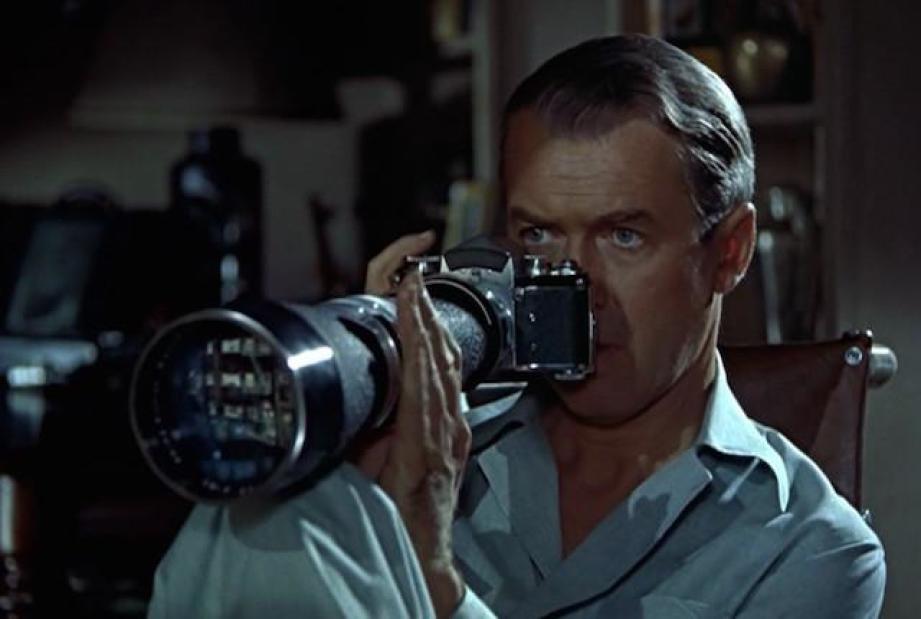
The blatant voyeurism in Rear Window is the perfect metaphor for what it is to go to the movies. Hitchcock's hero, Jimmy Stewart, plays L. B. "Jeff" Jeffries, a photographer who specializes in far-flung travel and exciting assignments — the more remote and dangerous the better. But after deciding to shoot a high-speed auto race from within the track (and being hit by a race car and sidelined with a broken leg), the itinerant photographer is stuck, going stir crazy in his New York City one-bedroom apartment, during a long hot summer with nothing to do. He begins passing his time by spying on his neighbors for entertainment, through the zoom lens on his camera.

His visiting nurse Stella, played by Thelma Ritter, tells Jeff, "We've become a race of Peeping Toms." She is initially bothered by Jeff's curiosity, but luckily for the audience her own desire to know what's happening across Jeff's courtyard matches ours. She joins Jeff in watching the neighbors and even gives them nicknames, like "Miss Torso" and "Miss Lonelyhearts". Tuned in regularly to everyone's daily routines, Jeff begins to notice that one of the couples, a middle-aged husband and his bedridden wife, may be acting in a peculiar manner. "I've seen bickering and family quarrels and mysterious trips at night, and knives and saws and ropes, and now since last evening, not a sign of the wife. How do you explain that?"

Miss Lonelyhearts is an unhappy single woman who Jeff watches go on unsuccessful dates

Miss Torso

Stella and Jeff's girlfriend, Lisa Fremont, played to the hilt of 1950s allure by Grace Kelly, at first try to persuade Jeff that he is imagining things, but they can't help looking and getting caught up in all of the rear window dramas. It's all fun for Jeff, Lisa and Stella to play a guessing game of unraveling the mysteries of their neighbor's lives — until they realize that they have stumbled upon a murder, and then the game becomes deadly serious.
Middle-aged couple with dog they treat like a child


Middle-aged couple without dog or child - the Thorwalds


Hitchcock captures the close quarters that come with city living - the proximity, the curiosity, and the assumptions we make about our neighbors - the feeling that we "know" people that we have never spoken to simply because we see them every day. He created the entire apartment complex in a single set, complete with action on the street beyond Jeff's camera's line of sight. It's an amazing achievement. As he toldFrançois Truffaut, "It was a possibility of doing a purely cinematic film. You have an immobilized man looking out. That's one part of the film. The second part shows what he sees and the third part shows how he reacts. This is actually the purest expression of a cinematic idea."

Jeff's summer is spent sweltering while he watches his neighbors in the heat and intimacy of their lives. Lisa gently presses him to heat up their own relationship, while he continues to push her away, afraid of commitment and losing his life of adventure. In Jeff's eyes Lisa and he are completely mis-matched. Anyone looking out their rear window and in at them would see that she is perfect for him. Stewart and Kelly have wonderful chemistry.
The Sculptor

The Composer (with Hitchcock making his cameo, winding a clock)

The movie could be viewed as simply a suspense thriller with a romantic subplot and it would still be top-notch. But I see Rear Window as an elaborate mating ritual between Lisa and Jeff, with the emphasis on their romance and Jeff's fears about their future. I think Hitchcock is most interested in the interplay between all the couples, with the thriller plot a perfect structure to tell their stories of loneliness and search for love. Jeff is not only watching his neighbors from his window but trying on each of their identities as a possible outcome with Lisa.

"Miss Torso" and "Miss Lonelyhearts" are two extremes of the lives led by single women. A male songwriter and a female sculptor are each channeling their romantic energies into their art. There are three couples - the young sex-crazed newlyweds; a couple, not far from the age of Jeff and Lisa, but whose lives are distinctly less glamorous, with a dog they treat as their baby; and Lars Thorwald (Raymond Burr) and his nagging, bedridden wife - the couple no one would want to become but Jeff fears he and Lisa might.

The Newlyweds
As Jeff tries to decide which of these scenarios best fit his romance with Lisa, she decides to toss out all of Jeff's potential relationship stereotypes, and goes into action. She enters his view by leaving the apartment and their theorizing behind and crossing the courtyard to actually investigate. "Why would Thorwald want to kill a little dog? Because it knew too much?" She proves herself as adventurous and risk-taking (if not more so) than Jeff, by sneaking into Thorwald's apartment and stealing Mrs. Thorwald's wedding ring, helping to prove Jeff's theories about the woman's murder and symbolically securing a ring for herself and Jeff.

Jeff becomes so wrapped up in watching the drama being played out, so excited by her audacity, that even when Lisa puts herself in an extremely dangerous situation, he can't keep himself from looking. And neither can we. The only thing that finally breaks his view out the window is when Thorwald himself comes over for a visit ...

Rear Window is just as thrilling to watch today as it must have been when it was initially released in 1954. Hitchcock uses the murder mystery format to tell deeper stories about loneliness, city life, fears of intimacy, and the good and bad places where love might lead. No matter what your views are on "rear window ethics" as Lisa refers to them, the viewer will be immensely grateful that Alfred Hitchcock created this glimpse into others' lives, before the neighbors got wise and pulled the curtains.


François Truffaut, Alfred Hitchcock, Helen G. Scott, "Hitchcock", Google Books


This is the another in a series on some of my all-time favorite movies. Feel free to comment or share some of your favorites in the comments.