Showing posts with label film noir. Show all posts

Monday, September 23, 2019

i loved laura, except for . . .

Another book from my personal challenge of reading the source material for favorite classic movies: Laura, by Vera Caspary. This book is a detective noir, as hard-boiled and cynical as any of the genre, but written by a woman. It was originally published, a la Dickens, as a serial, "Ring Twice for Laura," in Colliers Magazine in 1942/43. The  classic film noir, starring Gene Tierney as Laura and Dana Andrews as a detective who finds himself falling in love with a dead woman as he investigates her murder, came out a year later—so Hollywood was right on this as the perfect tale for a hit movie.

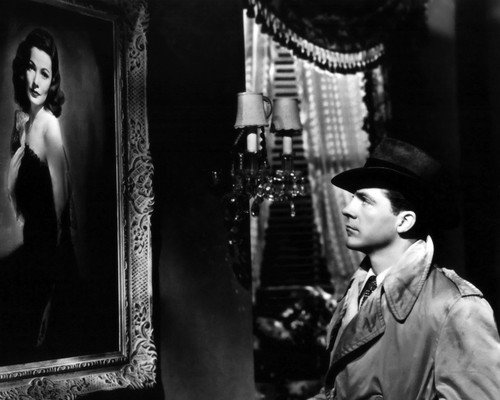
Detective Mark MacPherson (Dana Andrews) contemplates a portrait of Laura Hunt (Gene Tierney)

The story is told from the viewpoint of several main characters, including Detective Mark MacPherson, esthete and friend of the deceased Waldo Lydecker, and Laura's unfaithful fiancĂ© Shelby Carpenter. It is up to the reader to piece together the stories about this fascinating woman and race along with Mark to solve the crime. The murder is actually a quite brutal one—ostensibly Laura went to answer her doorbell and was killed with a shotgun blast to the face. The method of the crime is in stark contrast to the glamorous New York City apartments and surroundings of Laura's life as an advertising executive, an impressive job for a young woman in 1942. We learn quite a bit about Mark, Waldo, and Shelby, too. Laura, a romantic thriller, is a great book with great characters, and I loved it - with one major caveat. Spoiler alert—read no further if you haven't seen the movie . . .


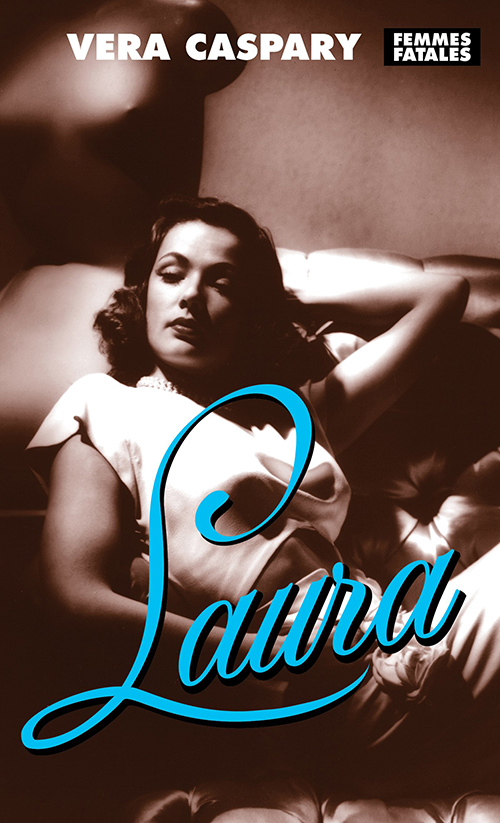
Laura, by Vera Caspary

SPOILER:

It is discovered more than halfway through the book that the body of the murdered woman in Laura's apartment was not Laura, so the reader finally gets to meet her and see if other's descriptions of her square with the genuine article. And at first, she does, beautifully. She is honest, earnest and even shows some interest in Mark, so things seem to be going quite smoothly to a romantic finish—as long as Laura isn't the murderer. But the real problem for me is that Caspary has Laura casually drop the "N" word in conversation and it completely soured my interest in her character. I understand that such casual racism was probably quite common in the 1940s, but . . . yuk.

I did a little research on the author, who led a quite interesting life, but found no clues as to her thoughts about race. She dabbled in Socialism and Communism, even going so far as visiting Russia to see if the country lived up to her expectations. She lived openly with her married British lover for years before finally marrying in 1948. She led an unusual life, like her protagonist, for a woman of the time.

Apparently the publisher of this reprint series, actually subtitled Femmes Fatales, and published by The Feminist Press at CUNY, didn't see any reason to add an editor's note about Laura's outburst. It's a single, strange event that happens and never occurs again in the text, by her or any other character.
Sigh. It's best to be honest about our past to go forward into the future. This is not the only instance of racist language that I have encountered in my recent book-to-film adventures. So far the 40s and 50s American popular literature is proving quite problematic.

This post also appears on Cannonball Read 11

Sunday, September 23, 2018

favorite movie #52: vertigo

Favorite movies that have had an impact on me - #52 - Vertigo (1958) - I saw Vertigo for the first time, and in a theater during its 1983 restoration/re-release. Wow.


I still remember to this day the hypnotic scene when Jimmy Stewart's Scottie is following Kim Novak's Madeleine and she walks into a flower shop from an alley back door. The alley is dark and dirty and the door is made of wood. I can swear when voyeuristic Scottie opens the wooden for a crack to see Madeleine surrounded by beautiful, colorful lush blooms I got a whiff of fragrant flowers myself.
Scottie (James Stewart) spies on Madeleine (Kim Novak)

Vertigo is Hitchcock's most person film and undoubtedly his masterpiece.


Judy (Kim Novak): If I let you change me, will that do it? If I do what you tell me, will you love me?


Related:

happy alfred hitchcock day!

Friday, September 21, 2018

favorite movie #50: dark passage

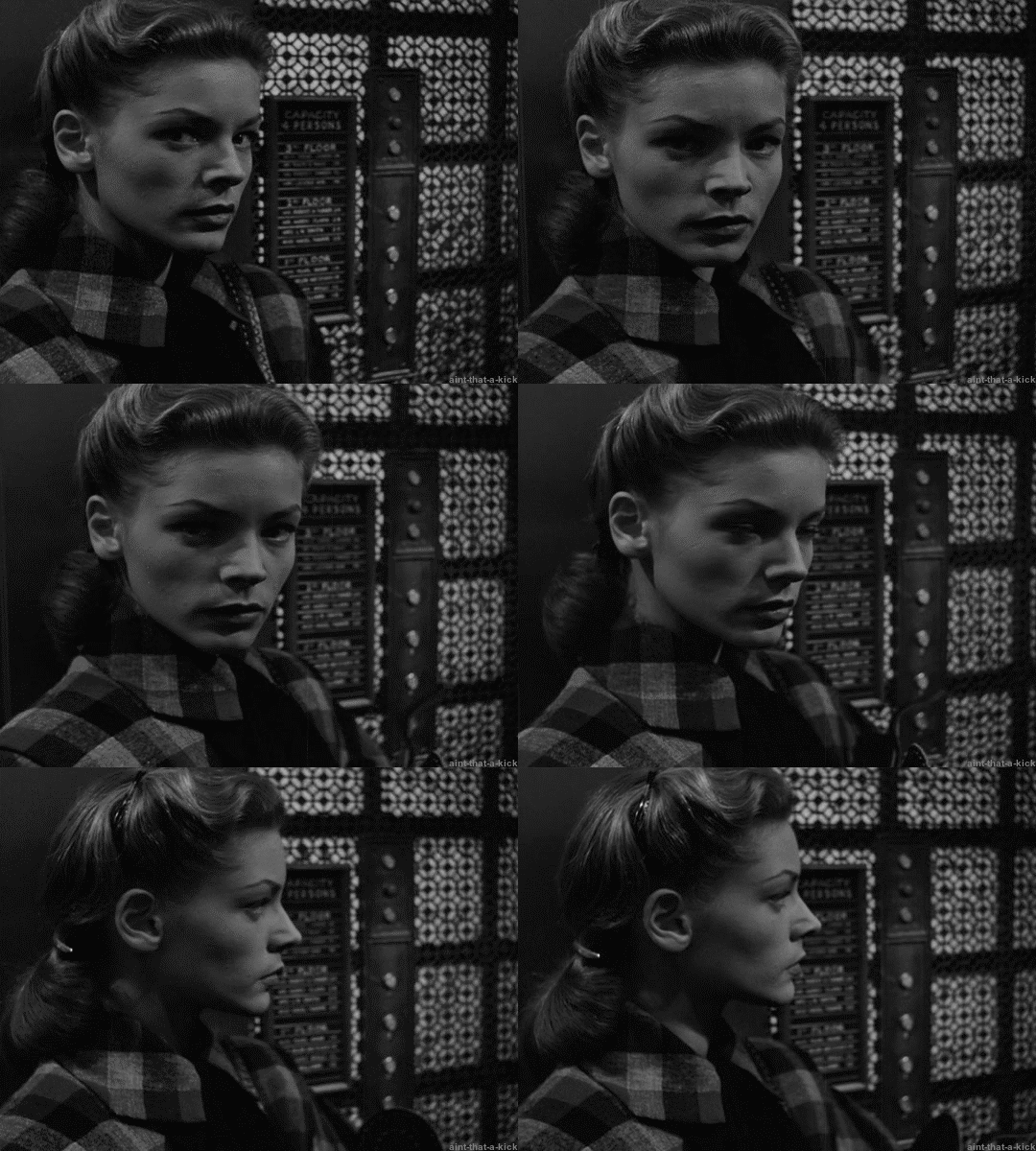
Favorite movies that have had an impact on me - #50 - Dark Passage (1947) - Bogart and Bacall in their third film together. It's a bit of a gimmick film — the first half is filmed through Bogart's eyes — but because of Bogie's familiar voice it works. Bacall holds her own as she carries the early part of the film, while the camera keeps her in close-up as she talks to Bogart. Dark Passage is a brightly-lit film noir, set in San Francisco. Bogart's Vincent Parry has been wrongly accused of murdering his wife. The story begins as he escapes from San Quentin and hitches a ride into the city. He is immediately recognized, but saved from having to go back to prison by Good Samaritan Irene Jansen (Bacall), who has always believed in his innocence. She is an artist, so is presented as an 'unconventional' girl. There are some other people sympathetic to his cause, like a cabby (Tom D'Andrea), his friend George (Rory Mallinson), and a doctor of plastic surgery (Houseley Stevenson), who gives Vincent a new face, one with which movie fans are quite familiar. Agnes Moorehead shows up to keep things interesting as woman scorned Madge, in leopard print and looking to cause trouble.


A couple weeks ago I picked up a dame in my cab, she musta had her face lifted by one of them quacks. She got caught in the rain, and the whole thing dropped down to here. She shoulda left it unlifted.


Same eyes. Same nose. Same hair. Everthing else seems to be in a different place. I sure look older. That's all right, I'm not. If it's all right with me, it ought to be all right with you.
AI thought I had a good life here... but your going away doesn't make it seem good anymore. I've sort of joined your team and... and I don't look forward to being without you.

Friday, October 02, 2015

waking up at the nursing home ...

When I arrived, Mom was sleeping soundly.

Untitled

Victor Mature and Betty Grable were the feature item, in "I Wake Up Screaming."

Untitled

Untitled

It's film noir, so Elisha Cook, Jr. was on hand too, of course.

Untitled

Happily, Mom woke up smiling : )

Untitled

And it was smiles all around.

Untitled

Tuesday, May 06, 2014

the maltese falcon on blu-ray

Continuing my Humphrey Bogart film watching ...

The Maltese Falcon has just been released by Warner Home Video on Blu-ray, and Bogie and classic move fans will not be disappointed.

Set in 1941 San Francisco, this classic film noir follows detective Sam Spade (Humphrey Bogart) who gets mixed up with a group of adventurers who are in search of a treasure - the eponymous Maltese Falcon, which the opening credits tell the audience was "... a Golden Falcon encrusted from beak to claw with rarest jewels ..." On the trail of this priceless and mythical artifact are some wonderful characters: Sydney Greenstreet (in his first screen appearance) as "the Fat Man" Kasper Gutman, Mary Astor as the unforgettably lethal femme fatale Brigid O'Shaughnessy, Peter Lorre as the smelling of gardenias Joel Cairo, and Elisha Cook, Jr. as Gutman's gunsel Wilmer. Character actors Ward Bond and Barton McLane show up as two cops who aren't sure how involved Spade may be in his partner Miles Archer's (Jerome Cowan) demise.

Bogie and "The Black Bird"

John Huston's directorial debut, The Maltese Falcon was made for black and white, and the dramatic lighting and creative camera angles, many of them low-angle, all look great on a high-definition, large scale television screen. The clarity and picture quality is great - you can almost read the title on the spine of a book on Sam Spade's bedside table when the detective takes the call about his partner Miles being found dead. Huston keeps the compositions simple and effective, but includes details like a newspaper clipping tacked to the wall of his apartment and other paraphernalia of Spade's help flesh out his no-nonsense character. But it's Humphrey Bogart's portrayal of Spade that really resonates. It was not only a career-changer, elevating him once and for all into lead parts, but he made Dashiell Hammett's tough-talking private eye his own, a screen classic and the blueprint for movie dicks forever more.
Sam Spade, "When a man's partner is killed, he's supposed to do something about it. It doesn't make any difference what you thought of him. He was your partner and you're supposed to do something about it. And it happens we're in the detective business. Well, when one of your organization gets killed, it's ... it's bad business to let the killer get away with it, bad all around, bad for every detective everywhere."
The film is full screen format and has an aspect ratio of 1.37:1 and resolution of 1080p and looks great on a large-scale high-definition television screen. It has a running time of 101 minutes. The Dolby sound (English: DTS-HD High Res Audio and Spanish, German, and Portuguese: Dolby Digital 1.0) is also crisp and clear. Subtitles are available in multiple languages: English, French, Spanish, Portuguese, German, Danish, Finnish, Greek, Norwegian, and Swedish.

The Maltese Falcon Blu-ray is on one disc, but it has a host of extras, including:
"Warner Night at the Movies" from 1941: a newsreel, the musical short The Gay Parisian, and cartoons "Hiawatha's Rabbit Hunt" and "Meet John Doughboy" 
"The Maltese Falcon: One Magnificent Bird" 
"The Trailers of Humphrey Bogart," featuring TCM's Robert Osborne 
"Breakdowns of 1941," a blooper reel 
Radio show adaptations of The Maltese Falcon: the piece, two with the film's stars, one with Edward G. Robinson 
Commentary by Bogart biographer Eric Lax 
Makeup tests 
Movie trailers for The Maltese Falcon, Sergeant York, and Satan Met a Lady
Sam Spade considers Brigid O'Shaugnessy. Does he love her? Can he believe her?

As much of a tough guy as Bogie is, Sam Spade also has a lot of humor. And fans of Ren and Stimpy will recognize the origin of one of their favorite cartoon characters in Peter Lorre's Joel Cairo, especially when he berates Sidney Greenstreet's Kasper Gutman for letting the Falcon slip through their grasp:
Joel Cairo, "You ... you bungled it. You and your stupid attempt to buy it. Kemedov found out how valuable it was, no wonder we had such an easy time stealing it. You ... you imbecile. You bloated idiot. You stupid fat-head you. [He breaks down crying]."
The Maltese Falcon is the first in a longtime collaboration between the star actor and director, who went on to make Across the Pacific in 1942, The Treasure of the Sierra Madre and Key Largo in 1948, The African Queen in 1951, and Beat the Devil in 1953. Huston wrote the screenplay, based on Hammet's novel, and the third time must have been the charm for a story that had already been turned into unsuccessful movies twice before (The Maltese Falcon in 1931 and Satan Met a Lady in 1936), as it was nominated for three Academy Awards; Best Picture, Screenplay, and Supporting Actor (Greenstreet). When Huston and Bogart and Astor and the rest of the crew got together it was movie magic. As Sam Spade says at the end of the film, "The stuff dreams are made of."

Tuesday, May 01, 2012

film noir: the directors

Article first published as Book Review: Film Noir: The Directors, Edited by Alain Silver and James Ursini on Blogcritics.

Film Noir, The Directors, edited by Alain Silver and James Ursini, is a compendium chock-full of wonderful black and white film stills and production shots film (noir) buffs are sure to enjoy. Film historians Silver and Ursini certainly know their stuff. They have both written or contributed to numerous other titles on the subject of film noir.

This weighty paperback volume (over 470 pages) includes an introduction by Silver and essays on 28 directors the pair consider to be crucial to film noir. The essays are written by the editors and a host of over 20 other historians and filmmakers, with brief bios of all the contributors included at the back of the book.

Each essay on a director includes an overview of films deemed to be the director's best and most important films in the genre; a biography; and a list of their noir films or films with noir elements made during their career.
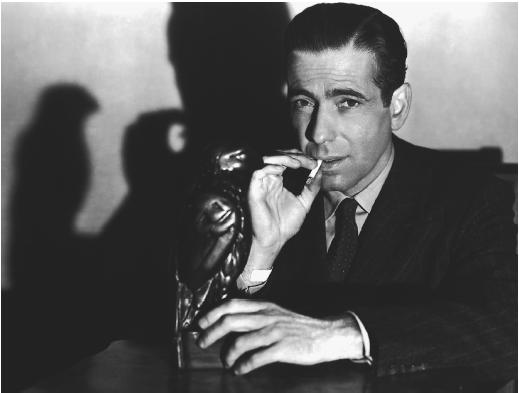
Humphrey Bogart in John Huston's The Maltese Falcon

Hollywood's classic era of film noir lasted mostly from the early 1940s to the late 1950s. But film noir is not limited to American-made films or solely that era. The most common elements of film noir are crime, drama, chiaroscuro lighting effects, shadows, seedy locations, and themes of sex and violence. The term film noir, which literally means "black film" in French, was coined in 1946 by French film critic Nino Frank.

Directors included in Film Noir: The Directors: Robert Aldrich, John Brahm, Jules Dassin, Andre de Toth, Edward Dmytryk, John Farrow, Felix Feist, Samuel Fuller, Henry Hathaway, Alfred Hitchcock, John Huston, Fritz Lang, Joseph H. Lewis, Joseph Losey, Ida Lupino, Anthony Mann, Max Ophuls, Gerd Oswald, Otto Preminger, Nicholas Ray, Don Siegel, Robert Siodmak, Jacques Tourneur, Edgar C. Ulmer, Raoul Walsh, Orson Welles, Billy Wilder, and Robert Wise.

Many of the films highlighted should be familiar to readers, whether they realized they were considered film noir. William Covey writes about John Huston's The Maltese Falcon, where Humphrey Bogart's Sam Spade became an iconic noir hero. Huston and Bogart also worked together on the noir classic Key Largo, and did a more comedic take on the form in Beat the Devil.

Barbara Stanwyck and Fred MacMurray in Billy Wilder's Double Indemnity

Billy Wilder's Double Indemnity is perhaps the most famous film noir of all time, with Barbara Stanwyck's gorgeous but deadly Phyllis Dietrichson as the ultimate femme fatale. Contributor Sheri Chinen Biesen makes a case for also including Wilder's Sunset Boulevard and The Lost Weekend as noir. William Holden's seedy protagonist Joe Gillis and his voiceover narration (a classic staple of noir films) qualifies, but The Lost Weekend may be more of a stretch. Sometimes the desire to include films that share certain elements with noir classics may dilute how audiences view film noir.

An interesting essay by Jans Wagner on Ida lupino details her various production companies, and how she was able to combine her roles as actress, writer, producer, and director throughout her long Hollywood career. In The Bigamist she became "the first woman in classical Hollywood to direct herself in a starring role." The film was produced by Lupino and ex-husband Collier Young and starred Lupino and Young's second wife, Joan Fontaine. There was probably enough material behind-the-scenes for Lupino to create many more noir intrigues.

Dana Andrews falls in love with a painting of Gene Tierney in Otto Preminger's Laura

Chris D. had another great essay on Otto Preminger's Laura. All of the behind-the-scenes confusion and contention about casting, story, and the ultimate ending of the film, creates its own story of suspense. Luckily none of the possible alterations and producer's arguments were ultimately visible on this glossy noir's surface. Reading about Preminger's later film, Bunny Lake is Missing, helped point out some unexpected similarities to Laura — like Laura, for a good portion of the movie the audience is unsure whether the titular character is a phantom or not.

Film Noir: The Directors also includes some directors whose films may not immediately be associated with noir. Geoff Fordham's essay on Alfred Hitchcock points out how the already-deceased-before-the-credits-even-roll Rebecca may be one of film noir's most lethal femme fatales. Hitchcock's movies usually have too much humor to be consider true film noir, but his style, born through his early work in Germany and love of Expressionist films, showcase many elements of the genre — the blurry lines between good and evil, femme fatales and wronged men, as well as stylish and dramatic lighting.

Judith Anderson and Joan Fontaine in Alfred Hitchcock's Rebecca

There were a few noir inclusions that may create a little controversy with genre aficionados — Don Siegel's Invasion of the Body Snatchers, Orson Welles's Citizen Kane, and Jacques Tourneur's Cat People, "a supernatural version of the noir femme fatales," although it is undeniable that these films utilize noir elements like flashbacks, voice-over narratiion, and atmospheric lighting.

Film Noir: The Directors is an excellent introduction to the work of some great directors and great films. It certainly makes a perfect resource to study the subject, and a reference of must-see films. An index of all of the films included in the text would have been a welcome inclusion. That is the only element lacking in this otherwise meaty and fascinating look at the work of directors who frequently or occasionally made film noir.
Enhanced by Zemanta

Tuesday, August 09, 2011

catching an old classic — the big heat

At first glance The Big Heat may seem like a standard crime drama, if a bit on the grim side. But if you stick with it, you will soon realize that you're seeing something akin to Shakespearean-noir. As the movie progresses, bodies are dropping right and left, and the hero, Dave Bannion, a police sergeant played by Glenn Ford, like Hamlet has learned that all was not well in the fictitious city of Kenport.

Ford plays the last honest cop, maybe last honest man around, who gets the case of a fellow cop, Tom Duncan, who has committed suicide. Duncan's wife (Jeanette Nolan), seems distraught and tells Bannion that her husband was fatally ill. It seems an open-and-shut case — at first. But Bannion, a family man with a wife and young daughter, is soon pulled into a web of corruption that goes all the way to the top of the police department and the town of Kenport.

The Bannions, when life is still (briefly) idyllic

Bannion is honest, but he is also rigid, and can't see how his denunciation of the evil around him might impact himself and his family. In a real twist, the "hero," rather than aiding or rescuing, brings destruction to every woman who comes across him in his investigation. Although we know he is morally on the side of the right, it is hard to get behind him as we watch the women around him die. He views women as either a madonna, like his wife (and mistakenly, Mrs. Duncan) or whore (pretty much every other woman he meets.)

The Big Heat features a series of strong women. They are all probably stronger and even smarter than Bannion. Mrs. Duncan is a tough cookie and not to be trifled with. Duncan's mistress Lucy (Dorothy Green), is the first to try and clue Bannion into the case being more than a simple suicide, but our hero dismisses her as a "barfly" only out for a shakedown. Unfortunately for Lucy his interview with her draws the wrong kind of attention — she soon turns up murdered.

A mobster named Lagana (Alexander Scourby), who runs the town and the police department and lives in luxury together with his psychotically violent henchman, Vince Stone (a brutal Lee Marvin) are behind all the crime in Kenport. Vince has a girlfriend, Debby (Gloria Graham), who seems to be treating her affair with a gangster as a lark, making fun of him and his pals every chance she can get.
Vince: Hey, that's nice perfume.
Debby: Something new. It attracts mosquitoes and repels men.

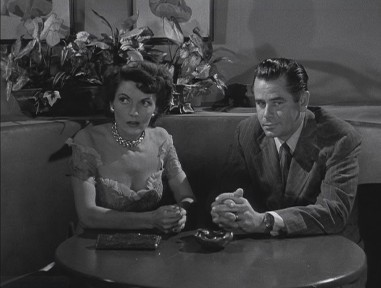
Lucy tries to tell Bannion the score, but he's not listening 


The movie, which came out in 1953, was pretty violent for its day. Director Fritz Lang (Metropolis, M, Ministry of Fear),  pulls no punches and practically all of them are directed at the many women in the film. This isn't gory violence, to which current audiences have been anesthetized. The movie code in the '50s wouldn't have allowed that. But the violence is powerful nonetheless, and steadily escalates.

The first incident, a body found dumped by the side of the road, is Lucy, the woman Bannion had questioned earlier. It occurs off-screen, but is described, callously, and in detail, by the medical examiner, making both the hero and the audience cringe, "Trouble automatically catches up with girls like her. Looks like a sex crime to me ... I'd say pretty definitely it was psychopathic. You saw those cigarette burns on her body." 

When Bannion hears about Lucy and that she was not just found dead but was tortured, he finally believes her story, puts two and two together, and goes after Lagana. But Lagana is not the kind of man who puts up with being threatened. Bannion's idyllic home life is blown to bits when the next incident occurs while the hero isn't looking — his innocent wife Katie (Jocelyn Brando), just like in The Godfather, dies from a car bomb that was meant for him.

Carolyn Jones in a cameo as a barfly that runs up against a crazed Lee Marvin
Bannion understandably loses it, and sees that even the police commissioner is part of Lagana's sphere of influence. Hell-bent on revenge, he goes against Lagana and anyone connected with him, with justice taking second place. He traces Vince to the same hangout Lucy used to frequent when another incident occurs — onscreen, but just out of the frame — when Vince "disciplines" barfly Doris (Carolyn Jones) by putting his cigar out on her hand before Bannion can intervene. Debby watches Bannion stand up to Vince and run him out of the bar after he hurts Doris and decides that she might want to start hanging out with a different fellow.
Debby lets Bannion know she's eager to help, "Well, you're about as romantic as a pair of handcuffs."


The most shocking and famous scene of the movie, indeed one of the most famous in film noir, happens right before our eyes, brutal and unnecessary. Vince attacks Debby for just talking to Bannion by throwing a pot of scalding hot coffee in her face. It is still alarming and upsetting. Lang treats the audience to a view of Debby's disfigured face later in the film, in case anyone might hold any hope that she wasn't too badly burned.

Ford may be the official hero of the piece, but Graham's character quickly moves into the role of avenging angel. She becomes a one-woman assassination squad, enacting retribution on Duncan's wife and Vince, all the while being sure to protect Bannion's reputation. He may not ever be able to go back to his old happy home life, but thanks to Debby he can go back to being a cop without anyone's blood (no matter how deserved) on his hands. She's kept him honest.

After Debby throws her retaliatory hot coffee at Vince, he fatally shoots her, but she has bought Bannion enough time to close in and close the case. Bannion tells her a bit about his wife as she is dying, something he didn't feel that he could do before, "You and Katie would have gotten along fine." In their own way Debby and Bannion have also had a full relationship in the short time they have known each other. And maybe now Bannion will treat and take women a little more seriously, a little less judgmentally. He still has a young daughter to raise.

Fun trivia: when Lee Marvin first sees Glenn Ford face to face, the music in the background is "Put the Blame on Mame," a reference to Ford's performance in Gilda.
Enhanced by Zemanta

Saturday, April 16, 2011