Showing posts with label Spencer Tracy. Show all posts

Wednesday, December 05, 2018

favorite movie #100 - holiday edition: desk set

Favorite movies that have had an impact on me - #100 - Desk Set (1957) - Tracy and Hepburn. Librarians. New York City at Christmas. The early integration of computers (super-computer EMERAC) into the working world. Desk Set is just fun, fun, fun. Gig Young plays his usual leading-lady's-second-choice role and Joan Blondell and Dina Merrill get a few snappy lines as Katharine Hepburn's friends and research library assistants. Desk Set is Tracy and Hepburn's first color outing and their eighth and penultimate film together. They are always a wonderful screen duo, but this is my favorite of their teamings.

Richard Sumner (Spencer Tracy) introduces Bunny Watson (Katharine Hepburn) to EMERAC
The gals check out EMERAC (L-R: Joan Blondell, Dina Merrill, Sue Randall, Katharine Hepburn
Richard Sumner takes Bunny Watson "out" for lunch
Bunny Watson (Katharine Hepburn): Just for kicks. You don't have to answer it if you don't want to. I mean, don't dwell on the question, but I warn you there's a trick in it: If six Chinamen get off a train at Las Vegas, and two of them are found floating face down in a goldfish bowl, and the only thing they can find to identify them are two telephone numbers - one, Plaza Oh-Oh-Oh-Oh-Oh, and the other, Columbus Oh-1492 - what time did the train get to Palm Springs? 
Richard Sumner (Spencer Tracy): Nine o'clock. 
Bunny Watson: Now, would you mind telling me how you happened to get that? 
Richard Sumner: Well, there are eleven letters in Palm Springs. You take away two Chinamen, that leaves nine. 
Bunny Watson: You're a sketch, Mr. Sumner. 
Richard Sumner: You're not so bad yourself.

Link to Christmas: It's holiday season in New York, right before the Christmas break

p.s. It's got a 100% rating on Rotten Tomatoes!

Tuesday, January 13, 2015

it's a mad, mad, mad, mad world

The kid and I just watched this the other day and it never gets old. What other film can boast so many wonderful, funny, fun people? The cream of the crop of comedy are all on hand — Milton Berle, Sid Caesar, Buddy Hackett, Dick Shawn, Phil Silvers, Terry-Thomas, Jonathan Winters, Edie Adams. Actors like Spencer Tracy, Mickey Rooney, Dorothy Provine, and Ethel Merman although not known primarily as comics, are hysterical, too. Even the smaller roles are impressively cast — Eddie "Rochester" Anderson, Peter Falk, Jimmy Durante, Jim Backus, Carl Reiner — the list goes on an on.

A lot of the humor is slapstick and action-oriented, but there is some pretty funny dialogue too.

From Terry-Thomas, as J. Algernon Hawthorne: 
"As far as I can see, American men have been totally emasculated — they're like slaves! They die like flies from coronary thrombosis while their women sit under hairdryers eating chocolates and arranging for every second Tuesday to be some sort of Mother's Day! And this infantile preoccupation with bosoms. In all my time in this godforsaken country, the one thing that has appalled me most of all is this preposterous preoccupation with bosoms. Don't you realize they have become the dominant theme in American culture: in literature, advertising and all fields of entertainment. I'll wager you anything you like that if American women stopped wearing brassieres, your whole national economy would collapse overnight." 
From Ethel Merman, as Mrs. Marcus, describing her son, Sylvester, played by Dick Shawn: 
"Exactly like your father: a big, stupid, muscle-headed moron!"

Untitled

Untitled

Untitled

In the '80s I worked briefly for Troma Films and one of my coworkers brought in an a reel from the film and we watched it on lunch break. It was a blast seeing it in such large-scale, and in fairly close quarters. It's A Mad, Mad, Mad, Mad World is one of director Stanley Kramer's, who was known more for dramatic movies (Guess Who's Coming to Dinner, Ship of Fools, Judgment at Nuremberg, On the Beach) best-known films. It never fails to make me laugh out loud, which is the entire point of the film, and a real treasure, indeed.

Monday, June 27, 2011

here's not looking at you, kid

Article first published as Book Review: Humphrey Bogart: The Making of A Legend by Darwin Porter on Blogcritics.

Humphrey Bogart, The Making of A Legend could possibly be the worst book ever written. The only reason I hesitate calling it definitely the worst is because Porter has written so many other books based on dead movie stars who can't defend themselves or their reputations that I'm sure there are some other contenders for the title.

Porter cites no sources, but has a handy dandy paragraph at the beginning of the book claiming that every conversation can be cited — although he incudes no citations, but merely a list of books on Hollywood in the bibliography at the back of the book that he may or may not have read and taken stories from. He writes the book in the present tense, with full-blown conversations and details as to what Bogie, or "Hump," as he claims he was called for most of his early life, was eating for breakfast lunch and dinner on a particular day — practically always ham and eggs. Bogie was in as endless a pursuit to find a plate of ham and eggs as he was a drink in a speakeasy or nightclub, but Porter rarely mentions what specific alcohol he was swilling, or his smoking, which he was supposed to have been doing in as much abundance.

Boring meals inventory aside, what the book is truly about is sex, sex, sex. The "making" of Humphrey Bogart — get it? According to Porter, not only did Bogart "ball" every actress he met, but they all came on to him, as well as every other actor he met. From his tender years growing up in Connecticut and even before he got kicked out of Andover, everyone he encountered was sex-obsessed and bisexual or gay, including his old man. His father and all of Hollywood may or may not have been bisexual. That doesn't matter. It's Porter's prurient way of portraying every other person Bogie comes across, his implication that what they were doing was sleazy, that becomes distasteful.

Supposedly Bogie's first wife, Helen Menken, was bisexual, as was almost every starlet he had an affair with and every actor he worked with once he got to Hollywood — Barbara Stanwyck, Spencer Tracy, Gary Cooper, George Raft, etc., etc. Porter throws in more well-documented gay actors, such as Tallulah Bankhead and Marlene Dietrich to add credibility to his "everybody's gay" motif. I'm not sure why he feels so compelled to out stars from so long ago. Does he really think anyone would be surprised or even titillated to know that actors and actresses, people on the stage and attracted to the arts, would be gay? Outing frequently appears a very short step from self-loathing.

Menken and Bogart, c. 1926
When he isn't outing actors Porters's cataloging sexual trysts that occurred over 80 years ago. If he was revealing something that everyone didn't already know about Hollywood, that many actors and actresses had to (and still have to, or choose to) sleep with someone to get ahead, it might be more interesting. But the sheer purported volume of Bogie's liaisons, true or not, becomes numbing. By the time he had supposedly fallen in love with co-star Ingrid Bergman during Casablanca I had long ceased to care. Lauren Bacall is strangely given short-shrift, treated as not a great romance, but a side note, as Porter instead concentrates on Bogie's hairdresser (who supplied hairpieces and wigs in the '40s and '50s to conceal his rapidly receding hairline) and alleged mistress Verita Thompson, going so far as to include two images of covers of her highly suspect tell-all, Bogie and Me.

Bogie himself doesn't indulge in the Hollywood bisexual parade, except to get constantly propositioned by handsome actors and confided in by pal Spencer Tracy about his latest boy toy. But all of these revelations soon lose any impact they might have had as long bogus conversations soon make the book read like fiction rather than biography or even gossip. Except Humphrey Bogart, The Making of A Legend is not even on par with a trashy romance novel, as everyone only talks about one thing — how to get laid or how they just got laid. I have no doubt that Broadway in the '20s and Hollywood in the '30s and '40s was a bawdy place, but surely the conversations were more interesting than this purported post-coital one between Bogie and Barbara Stanwyck:
"It was Mae Clarke who taught me the joy of lesbian love. But, as you also know from tonight, I'm not completely weaned from men either. I don't want to deny myself any pleasure. Too much was denied me as a girl. As a woman, I'll go after what I want. If I want to get fucked by a man, you know I can go for that the way I bagged you tonight. If I want a woman, I'll chase her down and get her. I've already set my sights on that blonde German bitch, Dietrich. Who knows? Marlene and me might become a thing."
"Invite me over," Hump said. "From what I've seen of Dietrich I'd go for her in a minute. ..." 
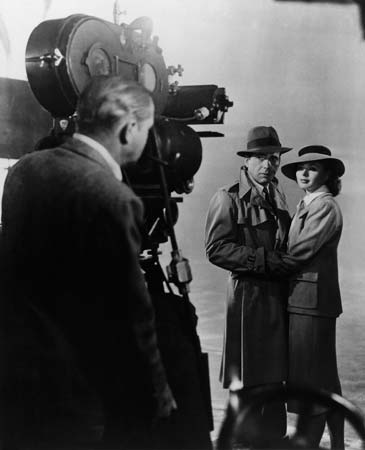
Bogart and Bergman filming Casablanca
If that sort of stilted dialogue trying to pass as "oral history" sounds interesting to you, then by all means, go ahead. There's 501 more pages of this shit (a word Porter claims Bogart hated and refused to use). At the end of the book the publisher, Blood Moon Productions, is described as "publishing that applies the tabloid standards of today to the tinseltown scandals of yesterday." That pretty much sums it up. How convenient to write about the dead, too. Porter has also written salacious biographies of Merv Griffin, Michael Jackson, Steve McQueen, Marlon Brando, Howard Hughes, Katharine Hepburn, and Paul Newman.

I was hoping for a fun, even trashy read about one of the great actors in the movies. But by the time the book gets to when he made Casablanca, long before he finally met Lauren Bacall, I was pretty worn out. And strangely, once Bogie starts getting successful, the typos in the book escalate. Maybe spell-check doesn't work so well when one cuts-and-pastes from too many celebrity biographies. It might be worth skipping through the pages of this mess if you see it in a bookstore or the library (where I should have left it) if you want some completely unsubstantiated gossip about people who have been dead for decades. But if you want to read a biography about Humphrey Bogart, this ain't the book.

Enhanced by Zemanta

Tuesday, June 07, 2011

she knew where she was going

Article first published as Book Review: I Know Where I'm Going: Katherine Hepburn, A Personal Biography by Charlotte Chandler on Blogcritics.


I Know Where I'm Going: Katharine Hepburn, A Personal Biography by Charlotte Chandler is an entertaining read. The author seems to have made a career compiling celebrity biographies, including ones about Marlene Dietrich, Bette Davis, Ingrid Bergman and Mae West. The interviews with Hepburn that fill the book were supposed to have been conducted throughout the space of two years. There are also excerpts from other celebrities who talk about Hepburn, including director George Cukor and actors Ginger Rogers and Christopher Reeve. It's sometimes a bit repetitive, like visiting your aunt who tells you some of the same stories each time you meet. So much of the book is constructed of quotes, with no sense of exactly when the actual conversation took place. But no matter where Chandler got her quotes, the reader can hear Hepburn's voice, especially in phrases such as, "I've had every advantage. Isn't that ducky?" and "I was never a girl who considered herself clever about men, because I wasn't."


The Hepburn family, clockwise, from top: Tom, Dick, Peggy, Marion, Katharine, Bob and mother Kit. Father Tom Sr. must have been behind the camera.

As much as the book jumps around quite a bit and the interviews don't seem to be anchored in a specific time in Hepburn's life, it still centers around Kathrine Hepburn, so it can't help but be interesting. The great actress is a straight-shooter and quite frank about past relationships. She had quite a few affairs, and one marriage before she met and began her most significant relationship with fellow actor Spencer Tracy. Her first marriage and lover was Ludlow "Luddy" Smith, who would have loved her to ditch acting and assume a more traditional, wifely role, but was also understanding when that was clearly never going to be the case. After a quickie Mexican divorce, Hepburn embarked full-time on her career in the theater and in Hollywood.

Hepburn's genuine love for Spencer Tracy shines through all the quotes, no matter when or where they come from. The Tracy/Hepburn relationship has always been described as having to have been kept secret, as Spencer Tracy was Catholic and devout and didn't want to break up his family and humiliate his wife. Tracy and his wife had been living apart for years before he met Hepburn — and he had already had quite a few affairs with co-stars. Hepburn never wanted to marry. Their situation may have been unique, but it was in many ways ideal for her.

As much as she talks about "Spence" quite frankly, there is still much that seems murky, such a their living arrangements. They were apparently together the night he died and she heard him fall down in the kitchen, but later in the book she states they never lived together. It doesn't add up, but it also doesn't really matter. Hepburn was a very private person and doesn't owe anyone the details.


Tracy was the love of her life and Hepburn loved being one of the boys. She worshipped her urologist father, had affairs and/or lasting friendships with many of her leading men, including Douglas Fairbanks, Jr. She was also involved with super-agent Leland Hayward and had a long-term affair with mogul Howard Hughes, who she describes as the best lover she ever had. She had an uncanny ability to remain friends with all of her previous loves. And also to receive marriage proposals from them, which she always refused. Hepburn knew that she never wanted to remarry. Once had been more than enough.
The most significant relationship in her life seems to have been with her older brother Tom, who inexplicably took his own life when he and Hepburn were visiting family friends in Greenwich Village, just shy of his 16th birthday. Just two years his junior, she found him. He had strangled himself with a bed sheet.

Hepburn went into a deep depression and had to be pulled from school. Her parents continued her education from home after the incident. But more significantly, her father forbade anyone to mention Tom in the family circle (there were four younger siblings, all two years younger or more than Katharine.) He effectively wanted to erase Tom, erase the event from their lives: "… we were not just told not to talk about Tom, but not to think about him. It was to be as if he'd never been part of our family. …My father had said it, and no one, not even my mother, ever questioned my father's absolute authority."

But you can't erase something like that. Hepburn idolized her older brother and secretly defied her father, refusing to forget him. She took his birthday as her own. The family tried to make sense of what might have led to Tom's tragic death, but no one seemed to have any answers. Hepburn theorized that he had been experimenting, doing a sort of "prank," trying to perform a Houdini-like trick that made someone appear as if they were hanging when they weren't. This is highly unlikely, but it helped her to get on with her life and her family was more than willing to accept the theory that his death was an accident.

Her descriptions of her family throughout I Know Where I'm Going are frequently punctuated with phrases like, "Wasn't I lucky?" as she describes her parents' great relationship or some rule or regulation that her father imposed. He was a tough cookie, who didn't believe in failure and drove his children to excel in all things, especially sports. She mentions casually that Tom wasn't a natural athlete like herself, and that her father wanted his two eldest children to follow in his doctor's footsteps. Young Tom was obviously under a lot of pressure, "[Dr. Hepburn] wanted to register Tom for medical school even before he was born."


Being older than Katharine, and more sensitive, it is easy to see how he might have had feelings of inadequacy and not being able to cope. His death occurred the night before the two were supposed to return home to Connecticut from their Manhattan visit. It is very possible that there was something Tom dreaded back at home, some deadline relating to his father that she had no knowledge of. And after his death, her father wasn't talking.

She worshipped her father, but she was able to avoid his pressures to influence her career choices and pursued her own interests in acting. But her father never praised her or supported her in what he deemed a silly profession. Their family life seems like something right out of Eugene O'Neill's Long Day's Journey Into Night, in which she starred, in 1962.

Hepburn mentions that after her mother died, she was shocked when her father turned right around and married his long-time nurse/assistant. She was very hurt by this, as she had always considered her parents' marriage perfect. She may have never actually known her father. Many family stories are included in I Know Where I'm Going, but it is odd that in all the interviews culled by the author there is rarely a discussion of any of her other four siblings, as she was so family-oriented. It seems a strange omission.

After reading these disembodied quotes, one gets the sense that Hepburn had arranged her life so that she never really had to completely grow up. She realized early on that she wasn't suited to marriage and motherhood, and wisely decided to avoid them. She was an independent woman with a strong mind, but Hollywood and her stage career also functioned in a parental capacity for her, by shielding her from the day-to-day slog of what it means to be a grown-up in the world.


Her long-time friend George Cukor not only served as her favorite director on many of her movies throughout her long career (A Bill of Divorcement [1932], Little Women [1933], Sylvia Scarlett [1936], Holiday [1938], The Philadelphia Story [1940], Keeper of the Flame [1942], Adam's Rib [1949], Pat and Mike [1952], Love Among the Ruins [1975]), but also rented her a cottage on his property, where she lived for many years. She even described him as someone she might have liked to have as a father. "If I could have chosen anyone in the world to be my father except my own father, it would have been George. … He was the person in my life I was most comfortable with, besides Spencer."

She was able to indulge in things that interested her — sports, men, going to the theater, ice cream, avoiding fans and signing autographs, and making brownies. She could, for the most part, do exactly as she wanted, like an indulged child. As she says herself, she was going to live life for both her and her brother Tom. "I decided I had to live my life for two. … I decided I would share my life with my brother. The real date of his death would not be until the date I died."

As important as Tom was to Hepburn, and as much as Chandler uses his story to bookend I Know Where I'm Going, Hepburn does seem to have moved beyond the tragedy, possibly the most significant event in her life. She always embraced life full-tilt and her film roles also reflect a woman who is full of conviction, whether the audience would agree with her convictions or not. I Know Where I'm Going may be less a biography and more a Hepburn collage, but its subject still fascinates. And happily, her films are available, to enjoy and enrich our understanding of this unique woman.
Enhanced by Zemanta