Showing posts with label The Birds. Show all posts

Friday, September 15, 2017

spring and summer reads: horror and autobiography

I have been so busy the past few months with my own book and now assorted hurricanes, that I didn't have a chance to post reviews of all of the books I have been reading. The first bunch is a combination of horror and autobiography, which pretty much sums up my interests of late. Anyone have a good horror autobiography to recommend?

In the meantime, here are a few titles from my recent reading list:

The Men in My Life: A Memoir of Love and Art in 1950s Manhattan - Patricia Bosworth

This is a fascinating glimpse into a woman's life in the art and theater world of 1950s New York. Patricia Bosworth was born into a wealthy San Francisco family. Her father, attorney Bartley Crum, saw his career and fortunes dive after he defended the Hollywood Ten (Hollywood directors and writers who were blacklisted as Communists during Senator Joseph McCarthy's Red Scare fear campaign - Dalton Trumbo, Edward Dmytryk, Herbert J. Biberman, Lester Cole, Alvah Bessie, Ring Lardner Jr., John Howard Lawson, Albert Maltz, Samuel Ornitz, and Adrian Scott.) Crum moved the family to what he hoped was a more open and understanding New York, but he never really bounced back.

Complicating matters was his drug and alcohol abuse, which landed him in multiple unsuccessful dry-out attempts. He did manage to acquire a few  high-profile clients, including actors Rita Hayworth and Montgomery Clift, who would visit the house and gave young Patricia a glimpse into Manhattan's film and theater world. She would later join the famed Actor's Studio and work with, or at least brush up against, actors and artists like Steve McQueen, Marilyn Monroe, Diane Arbus, Gore Vidal, and Helen Hayes, among many others. Her most notable film role was a small part in The Nun's Story, starring Audrey Hepburn. But Bosworth's tale of that time on a movie set in Rome was far from glamorous, coinciding with a harrowing personal and physical event that shines a light on how far women have come since the 1950s and how we need to keep it that way.

Family tragedy was compounded when Patricia's younger brother, Bart Jr., committed suicide. It is clear to the reader that Bart was homosexual. After he and a friend were found in a compromising position at school and the friend subsequently killed himself, Bart sank into a deeper and deeper depression until he ultimately chose to take his own life.The family seemed helpless or oblivious to Bart's plight. Although Bosworth doesn't address issues of homophobia and mental illness directly, there are echoes of depression, addictive behavior, and denial of true self between both the father and son. What is even more tragic is that young people in Bart's position sometimes still feel compelled to take their own lives today.

Bosworth ultimately gave up acting to pursue her real passion, writing, and she has become well known for insightful biographies of Marlon Brando, Montgomery Clift, Jane Fonda, and Diane Arbus, as well as writing in more detail about her father and the Hollywood Ten (Anything Your Little Heart Desires: An American Family Story, 1997).

I found her story fascinating and am eager to now try some of her other biographies.
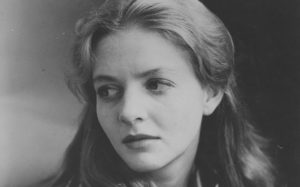
Patricia Bosworth in her Actors Studio days

Echoes From the Macabre - Daphne Du Maurier

I have always loved Du Maurier's Rebecca and have read Don't Look Now before in some other edition, but I don't think I had ever read the original version of The Birds, which was the basis for the classic Alfred Hitchcock horror film. Set in England the story is just as scary, and even more bleak, if that is possible. The rest of the stories are also very good, in a suspenseful, and in some cases, very creepy kind of way. They include: The Apple Tree, The Pool, The Blue Lenses, Kiss Me Again, Stranger, The Chamois, Not After Midnight, and The Old Man. I honestly don't want to even give a summary for any of these, as I think it is best to read them with no preconceptions. It is clear to see why Hitchcock loved Du Maurier's sometimes twisted take on life.

The Haunting of Hill House - Shirley Jackson

A true classic of horror, which tells the tale of four paranormal researchers who decide to spend some time in one of the most horrible-looking and possibly -acting houses of all time - Hill House. Dr. Montague, an erudite ghost chaser, enlists the help of three young people to prove that Hill House is truly haunted and evil. What could go wrong? Luke, who is a descendent of the original owner and builder of the terrible manse, chooses to treat the experiment as a joke. The beautiful and mysterious Theodora's motives to being there are unclear, but it is likely that she approaches the situation as a thrill seeker. Eleanor, an unhappy and possibly unstable young woman, hopes that Hill House will be the exciting new chapter in a previously dull and uninteresting life. When the cook and her husband tell the guests that they won't stay after sundown that should be the quartet's first clue that something is very wrong about Hill House.

I Shock Myself - The Autobiography of Beatrice Wood

To end things on an up note, I am including this wonderful autobiography of the little-known artist and ceramicist Beatrice Wood. Sometimes called "The Mama of Dada," she died in 1995 at the age of 105. During her long and eventful life she associated with some very interesting people, including Marcel Duchamp, Francis Picabia, J. Krishnamurti, and the art collectors Louise and Walter Arensberg. Wood is also considered to be the inspiration for the the woman who is loved by two men in Jules et Jim, which was written by Henri-Pierre Roché, who she was involved with. Their mutual close friend Marcel Duchamp fills out the third side of the eternal triangle. What was Wood's secret to her long and storied life? "I owe it all to chocolate and young men." Check her out. She was pretty amazing.

The colorful Beatrice Wood in her studio

Tuesday, August 13, 2013

happy birthday, alfred hitchcock

The master of suspense — and twisted humor, too.

A promo for my favorite film of his, The Birds


Wednesday, March 13, 2013

for those of you who think the birds is fiction ...

... witness our now-regular evening guests — some local, noisy, wild green parrots.

Cocktail hour, Palm Beach style.

Monday, October 22, 2012

the girl does not impress

HBO's film The Girl, about the "relationship" between the director Alfred Hitchcock and his protégé, model-turned actress Tippi Hedren, was truly a missed opportunity. Unfortunately, as with most made-for-television biopics, more attention was paid to trying to get the sets, cars, wardrobe, and make-up correct than worrying about such trivial matters as character and dramatic arc. The fact that a film about Hitchcock could be made without the least little bit of creative camera-work, aside from an intrusive and unnecessary shower scene homage, was mind-boggling. Whatever Hitch may have been like as a man, he was a consummate artist, and he would have been appalled at the lack-luster framed shots in so many of The Girl's scenes.

Sienna Miller as Tippi Hedren and Tobey Jones as Alfred Hitchcock in The Girl
It is no secret that Hitch had a thing for blondes, and was possessed of a twisted sense of humor, and some might say, sexuality. He worked a lot of his obsessions out on film. He used most actors as props for his own ideas, but if he liked an actor he would use them again and again. Favorites included Cary Grant, who Hitch claimed was "the only actor I ever loved in my whole life," Jimmy Stewart, Ingrid Bergman, and the ultimate hot and cold blonde, Grace Kelly. When Kelly retired from show business to become the Princess of Monaco Hitch was in a quandary to find a new leading lady. He had tried to groom Vera Miles to be his next muse, complete with a five-year personal contract that included her appearing in the first episode of his television anthology series Alfred Hitchcock Presents, "Revenge,"in 1955, and in the feature film The Wrong Man in 1956 with Henry Fonda. But Miles upset the director by becoming pregnant, and he gave the plum role he had been grooming her for, in Vertigo in 1958, to Kim Novak. Miles did appear in Psycho, in 1960, as Janet Leigh's sister Lila Crane, but it was hardly a showcase role.

He was unable to cast Kelly and Grant, both unwilling to come out of retirement, in his next project The Birds, which was based on a story by Daphne du Maurier. He spotted Tippi Hedren in a television commercial and she reminded him of Kelly. Hitchcock quickly signed her to an exclusive personal contract and then began an intensive grooming process, and, as Hedren herself has confessed to many since, proceeded to fall in love with his leading lady. Hitch had most likely been in love with his female stars before, but they were more seasoned in show business than Hedren, who was just starting out in films. Hitch could mold Hedren, and, he must have hoped, control her. The Girl does depict the grooming process, and how Hitch taught Hedren how to walk and stand and emote in his meticulously planned-out shots. But the focus of the film is clearly to show the director behaving like a dirty old man. Without much background to his motivations or characterization it becomes not much more than a peep show.

Hitch and Hedren in a publicity shot for The Birds
Hedren obviously was scarred from her experience. On the one hand, she was handed a leading lady career on a silver platter. That doesn't happen in Hollywood. But she also had to endure Hitch's intensive psychological, and in the case of some of the arduous filming conditions on The Birds, even physically threatening challenges. Hedren, who most know only from her two films with Hitchcock, has never been considered much of an actress. Her presence in The Birds and Marnie is rather bland. She was a blank slate that he projected his desires upon. But she was definitely a strong woman. She was a single mother (to daughter and later actress Melanie Griffith). She stood up to the advances of a powerful man and was willing to risk her career to preserve her self-esteem and -respect. Hedren didn't have much of a career post-Marnie. She refused to work again with Hitchcock and he had exclusive control of her career for many years.

The Girl could have worked a feminist angle, but instead chose to present Sienna Miller as an attractive stand-in for Hedren, but ultimately just as blank, if pretty, a slate. Tobey Jones does a masterful vocal impression of the inimitable Hitchcock, but his motivations, creative and sexual, are only hinted at. Imelda Staunton is wasted as his (supposedly) long-suffering wife Alma Reville, who any Hitchcock buff knows was his right hand on most of his films. They were a tight unit.

Hitch directs Hedren and Sean Connery in Marnie
There is no denying that Hedren suffered while making The Birds. But it is also one of Hitchcock's best films. As he aged, his films edged more towards horror than mystery or romance, and The Birds is a true horror film.

Marnie, which The Girl's makers claim as his last great masterpiece is far from that (Actually, that would be Frenzy). Marnie is a mess of psychological mumbo-jumbo. Like all Hitchcock films it is watchable, but its attempts to be sexually daring, with Hedren cast as a frigid compulsive thief, and Connery as the man to give her what she needs, just come off as cold and sad and distant. It's an unsuccessful update of his 1945 pscyhological thriller Spellbound. Is Marnie the celluloid expression of Hitch's frustration with not finally being able to meld his leading lady on film with his own life? Maybe. But The Girl is just able to gloss over the surface of such questions. Ultimately it is just a blip. The Birds will always impress.


Note: if you haven't seen the Hitchcock films mentioned in this post, run, don't walk, to check out the master and draw your own conclusions.

Spellbound - Psychoanalyst Ingrid Bergman tries to help patient Gregory Peck — while falling in love with him. Is he a crazed murder or a wronged man?

"Revenge," Alfred Hitchcock Presents - Carl's (Ralph Meeker) wife Elsa (Vera Miles) has suffered a nervous breakdown and must stay at home. One day after Carl returns she tells him that a man has broken into their house and assaulted her. Carl decides to take the law into his own hands. He takes her out in the car and they drive around, hoping to identify her assailant, with tragic consequences.

The Wrong Man - Based on a true story, Henry Fonda plays a man wrongly accused of a crime. Whether he is found ultimately innocent or not becomes less important to him as he watches the effect the ordeal is having upon his wife, played by Vera Miles, who is slowly unraveling from the pressure.

Vertigo - James Stewart plays a former police detective who suffers from vertigo who is hired to trail a rich man's wife. It doesn't take long for Stewart to fall for his client's wife, played by Kim Novak, and to also fear for her safety. Hitchcock's masterpiece of obsession and identity has San Francisco and its nearby landmarks as not just a location but another character in the film.

Psycho - Janet Leigh is in a bind and on the run, but her troubles are just starting when she chooses to stay at the Bates Motel, run by a quiet young man (Anthony Perkins) and his domineering mother.

The Birds - Melanie Daniels (Tippi Hedren) impulsively follows a man she has just met, Mitch Brenner (Rod Taylor), to his weekend home. What starts as simple flirtation soon takes on a dangerous note as they witness escalating attacks on Mitch's neighbors by larger and larger groups of birds. Is Melanie somehow the catalyst for these deadly attacks?

Marnie - Tippi Hedren plays Marnie, a thief who has a series of psychological hang-ups, which include the color red, thunder, and any man touching her. Sean Connery wants to marry her and cure all her demons.

Frenzy - A serial killer, a rapist-strangler, is on the loose in London. In a twist, Hitchcock reveals the identity of the killer (Barry Foster) early on in the film. The audience must helplessly watch and wonder if the hero, Richard Blaney, played by Jon Finch, will be blamed for the crime and the real villain go scot-free.
Enhanced by Zemanta