Showing posts with label Audrey Hepburn. Show all posts

Friday, August 10, 2012

cameraman: the life and work of jack cardiff

Jack Cardiff on giving autographs at the 1998 Cannes film festival: "They must be wondering who is this guy? I told them I used to be a stand-in for Humphrey Bogart."
In the documentary film Cameraman: The Life and Work of Jack Cardiff, made when he was 91, Cardiff is proud of his many accomplishments, but somehow manages to stay modest. And he has so much to be proud of. He was one of the first camera operators in Europe to be trained in the Technicolor process, after he impressed Technicolor with his knowledge and his love of chiaroscuro, color, and light in painting. He worked on the first color film shot in Europe, as he was the only one trained in Technicolor photography at the time. Martin Scorsese, Charlton Heston, Kim Hunter, Michael Powell, Lauren Bacall, and Kirk Douglas are among the many actors and filmmakers who talk to director Craig McCall about working with Cardiff.

The child of actors, he had started as a child actor in 1918 at the age of four. As a young man he moved behind the camera, as first a "runner boy" (gofer), then a clapper boy, and eventually a camera operator, in 1936, on As You Like It, starring Laurence Olivier. He worked with all of the greats and wasn't afraid to learn from them:
"[Marlene] Dietrich put gold dust in her hair ... she would have made a great cameraman ... she was in charge of the lighting."
He didn't restrict his work to studio films, however, but also made color travel films, traveling all over the world, to India, Egypt, and even filmed an erupting Mount Vesuvius. His first feature film and big break as a director of photography came from director/producer Michael Powell, with his fantasy film A Matter of Life and Death (also known as Stairway to Heaven), starring David Niven, Raymond Massey, and Kim Hunter.

Moira Shearer in The Red Shoes
Ava Gardner, a goddess, in Pandora and the Flying Dutchman
Marilyn Monroe, in a "Renoir hat"
This led to his work on films like Powell's Black Narcissus, which, incredibly, was all shot at Pinewood Studios, despite its open vistas — all special effects done by Cardiff and his crew. He tells McCall that he was thinking of the painter Johannes Vermeer when he was lighting and shooting the film. He worked again with Powell on The Red Shoes. Scorsese sheds some insight into the film and how he was inspired to use some of Cardiff's techniques in his own films, including Raging Bull. Cardiff's love of painting comes through loud and clear throughout the 90-minute documentary, "If Turner was alive today he'd be the best cameraman that ever lived ... I learned a lot from Turner."

In many of his 1950s films he worked out innovative techniques to achieve what a director wanted. On Alfred Hitchcock's Under Capricorn they worked out the first camera running on tracks, running through different rooms, without stopping, for ten minute (or even longer) takes.

Cameraman: The Life and Work of Jack Cardiff also includes clips from his 16mm home movies — Sophia Loren and John Wayne during the filming of Legend of the Lost, Bogie and Hepburn on the set of The African Queen. Cardiff would also, during the lunch break on a film, take wonderful still photographs of actresses — Audrey Hepburn, Sophia Loren, Janet Leigh, Anita Ekberg, and Marilyn Monroe. There is a extra on the DVD with a more detailed feature on his actress still photographs which includes an entertaining anecdote from when he was working with Marilyn Monroe during the filming of The Prince and the Showgirl in London. They made a date to get together on one of their days off, and he went to see her at the house where she was staying with newlywed husband Arthur Miller. He arrived at 9:30 a.m., the time of their appointment, but husband Miller informed him she was still sleeping. They had tea, played tennis, and she finally showed up at 6:30 in the evening. He had a half hour to photograph her in "Renoir hats" — he always thought she had a Renoir face.

The documentary includes some great clips from his most well-known movies as well as behind-the-scenes images, including The Vikings, Pandora and the Flying Dutchman, The African Queen, and The Barefoot Contessa. He tried his hand at directing in the 1970s and his film Sons and Lovers won an Oscar for cinematography — Freddie Francis was his cinematographer on the film. He went back to cinematography in the late 70s, early 80s, working n a wide range of projects, including Death on the Nile, Rambo First Blood Part II, The Far Pavilions, and Conan the Destroyer.

The movies had changed, and he would no longer create effects as he did on The Red Shoes. Modern films would add all the special effects later. But he doesn't live in the past or feel that things are worse, "The standard of [film] photography has improved enormously." Cardiff had an amazing career. He was the first cinematographer to receive an honorary Oscar in 2001. After viewing Cameraman: The Life and Work of Jack Cardiff  it is impossible not to want to check out his wonderful work. I've never seen Black Narcissus, and I think it's about time that I did.

Related articles
Enhanced by Zemanta

Wednesday, November 16, 2011

ponytail


Why are ponytails on little girls and young women cute, but on women of a certain age (when worn  in public somewhere besides the gym or while doing laundry) just a sign of giving up?


Who knew the ponytail could be such a controversial hairstyle?


Of course some women could pull off a ponytail or any hairstyle.


Enhanced by Zemanta

Monday, November 22, 2010

a thin line

While I won't challenge the evidence that actresses in Hollywood seem to be incredibly thinner than the rest of us, I am always a little amazed at the periodic outcry and finger-pointing that seems to single out a few particular actresses as "having a problem" or taking it too far."  Basically someone is calling someone else their idea of ugly based on how that person looks, and that is messed up and juvenile and unnecessary. What are we people? Stupid Marie Claire editors? I'd like to think we're better than that.

I'm not sure we can ever get over our size-obsession. It's hardly anything new. And in the age we live in, with the abundance of food (even in a recession) on most people's plates, it is extremely easy to go up on the scale, and as everyone who has ever tried knows, not so easy to go back down. So anyone who stays thin, or gets thinner, has appeared to win the "genetic lottery." And that creates resentment. Being thin in this country is connected to concepts of beauty, definitely, but also to ideas about health. The prevalent idea is that to be thin guarantees good health. Even if we know that's simplistic and not true, it's an idea that seems firmly ingrained in most American minds.
If we were living in ancient Rome or Greece, I would be considered sickly and unattractive. The times dictate that thin is better for some strange reason, which I think is foolish.—Gwyneth Paltrow
So why does the media keep telling us that "too thin" is a recent epidemic in Hollywood? Why are actresses like Angelina Jolie and all the other skinny gals (Keira Knightly, eg.) excoriated regularly? Why do we look to Hollywood as the gauge for a woman's size? Why not to the world of sports? Folks would rather criticize Venus Williams on her fashion sense than hold her as a model of physical health and beauty.

Case in point, Angelina Jolie. When she's not being internet-bashed for her relationship with Brad Pitt, or number of children, critics can always start pointing out her skinny arms. Jolie is skinny, maybe skinnier than a few years back. But there could be reasons for that beyond the only reason anyone thinks anyone should ever lose weight—to look better, i.e. thinner than the next guy. Angelina lost her mother recently. She's a UNHCR goodwill ambassador for children and refugees worldwide. I know that if I was traveling to Darfur, Pakistan, Cambodia and other places where children and adults are literally starving, I would not want to go home and stuff my face. But is she really so startlingly thinner these days?


She is very slender in this picture, taken when she was a young starlet


Angelina Jolie
Angelina Jolie (Photo credit: Wikipedia).
Angelina's lost any baby fat she may have had in the top photo, but I'd say that she has always been a skinny chick. What's really scary is how the publicity machine thinks that even this skinny chick isn't skinny enough and Photoshops her to within an inch of her life to make her even more skinny.
How can women be as thin as we are? We have personal trainers to work us out. We have specially prepared meals.—Sarah Michelle Gellar 
"Thin is in" is hardly a new concept, especially in the film industry. Some of the most famous faces (and bodies) of Old Hollywood aren't painfully thin, but boy are they skinny—all the better to show off those clingy bias-cut gowns, which would show off the tiniest bulge or curve.


Claudette Colbert, in Cleopatra


Universal style icon Audrey Hepburn, screen test from Roman Holiday


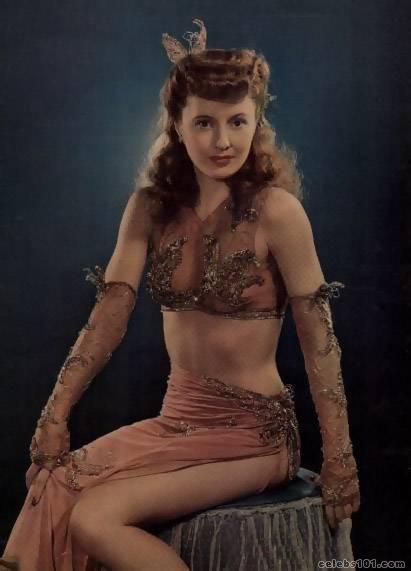
Barbara Stanwyck publicity photo

Fabulous actresses come in all shapes and sizes, just like fabulous people. The cult of skinny in show biz is nothing new. Every decade over the past 80 years Hollywood has promoted skinny, beautiful icons to an adoring public:

30s - Marlene Dietrich, Claudette Colbert
40s - Katharine Hepburn, Bette Davis
50s - Audrey Hepburn, Grace Kelly
60s - Julie Christie, Jane Fonda
70s - Diana Ross, Faye Dunaway (70s t.v. actresses are all pretty thin, too)
80s - Michelle Pfeiffer, Daryl Hannah
90s - Nicole Kidman, Julia Roberts
00s - Angelina Jolie, Keira Knightley
I was a scapegoat. The media had to put responsibility on somebody, and I was chosen. They felt free to say that because someone was thin they were anorexic, which is ridiculous.—Kate Moss
I'm not defending Hollywood's or any of our culture's insistence that actresses and women be and stay skinny. We all know how Judy Garland was tortured by pressures to lose weight.
From the time I was thirteen, there was a constant struggle between MGM and me—whether or not to eat, how much to eat, what to eat. I remember this more vividly than anything else about my childhood.—Judy Garland
I'd just like us all to stop commenting and snarking that Angelina should eat a burger. Or that Jessica Simpson should stop eating them. Let's all lighten up—figuratively speaking.
Enhanced by Zemanta