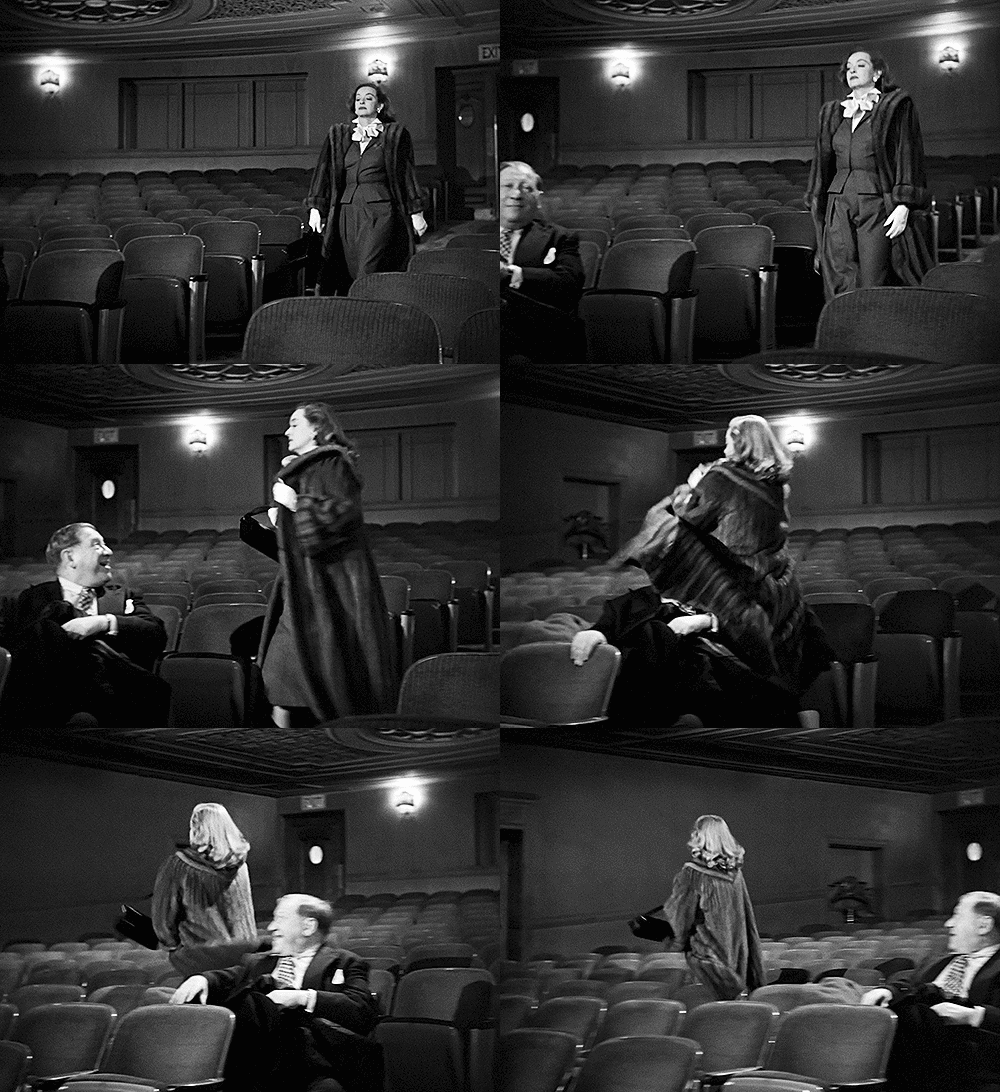
Favorite movies that have had an impact on me - #15 - All About Eve (1950) - the crackling dialogue in this movie never quits - everyone has something to say about the “theatah” and it’s usually catty and delicious. Bette Davis is amazing in this, I think, her best role. But the supporting cast is choice, too - Thelma Ritter, George Sanders, Celeste Holm, a very early Marilyn Monroe, and especially Anne Baxter as Eve (in the voice of Margo Channing): “There goes Eve. Eve evil, Little Miss Evil.”
Favorite movies that have had an impact on me - #1 Some Like It Hot (1959): This movie never fails to make me laugh. The snappy dialogue, the cross-dressing, MM’s radiance, all mixed together in a period gangster farce that just won’t quit. Maybe nobody’s perfect, but this movie sure is.
Why does Marilyn Monroe continue to be our iconic American goddess? A question explored in “Unfinished.” In words and pictures author and illustrator Elizabeth Periale brings a new perspective to Marilyn Monroe. "Unfinished” focuses on Marilyn from a female perspective, including touching on her many health issues. This graphic novel also shines a light on Marilyn's gifts as an actress, a talent that tends to be side-stepped in the many previous and sensational accounts of her life and death.
I am so excited to share that my graphic novel about the screen's most iconic goddess, Marilyn Monroe, is finally done — and available via Amazon's Kindle Store.
My first published book, Unfinished: A Graphic Novel of Marilyn Monroe, tells the actress's story from a feminine/feminist perspective. From the set of her last, uncompleted film, Something's Got to Give, Marilyn tells us her story, in words and pictures.
Here are a few images from the book, to give you an idea:
I hope you enjoy my unique take on this fascinating lady.
Her is one of my most popular posts, originally published in 2012. A recent Slate article by Simon Doonan on Marilyn Monroe, "Marilyn Monroe’s Two Secrets," aroused the ire of many readers for its hidden title, "Was Marilyn Monroe Fat?" Doonan claimed to know the answer (No) because he was on hand (as an employee of Christie's auction house) to view some of her last possessions, including clothing:
"Right away, I discovered that Marilyn was shockingly and unimaginably slender. She was sort of like Kate Moss but fleshier on top. Didn’t see that coming, did you?
When it came to finding mannequins to fit her dresses, I simply couldn’t. M.M.’s drag was too small for the average window dummy. Smaller “petite” mannequins existed, but I could not bring myself to place Marilyn’s iconic garments on these perky fiberglass dollies."
Doonan stacks the deck, because he writes about Marilyn being a size 12, but women's off-the-rack dress sizes have radically changed over the years. What he doesn't address is that most women, Marilyn included, are hardly the same dress size throughout their lives. We put on weight, lose weight, fill out, get pregnant, lose the baby weight, etc. Our teenage bodies are different from our 20s, 30s, 40s, 50s, etc. bodies. If Marilyn had lived past 36, she would have continued to fluctuate in weight as many women do, and most likely in an upward trajectory. Case in point — Elizabeth Taylor. The author implies that Marilyn's curvy Some Like It Hot body would have been wearing the same little black dress she wore when she as Mrs. DiMaggio entertained troops in Korea. Photos show that this probably wasn't the case.
"When you look at Marilyn on-screen and — armed with the information I have just provided — you realize that the busty, ample gal brimming over Tony Curtis in Some Like It Hot is literally one-third your size, you have every right to become suicidal. If she looks like that — zaftig, almost chubby — what on earth would you look like under similar circumstances?"
Way to reinforce body-shaming, Doonan. Just look at the black and white photo. She's gorgeous. Chubby? Why does that word even come up?
He also repeatedly calls her "tiny," based on the dresses he found among her belongings, but Monroe's measurements, according to her dressmaker, were 35-22-35 inches, with a bra size of 36D, and height of 5 feet, 5½ inches. I'm a shade under 5 feet 7 inches and people have always considered me medium height to tall. Marilyn was a classic hourglass, which would have been even more accentuated if she wore a girdle. The Fat Nutritionist has an interesting article about Marilyn, which points out that her "small" dresses might have been a bit of an illusion:
"Also, I’d like to note that a reason occurred to me why Marilyn’s dresses would seem so tiny when viewed in person: Marilyn’s dresses were often sewed onto her and, as Lena Pepitone asserts, her clothes were often so tight that they required regular mending of split seams and zippers. To get her clothing onto a dressform without ripping out seams and re-sewing them, they would have to choose smaller-than-Marilyn dressforms so that the dresses would maintain a normal amount of ‘ease’…though in Marilyn’s lifetime, she wore them without that ease. If you stuffed them as tight as sausage-casings, as she wore them, you could have an accurate 3-D depiction of her nude body size/shape (since it is reported that she didn’t even wear underwear [Lena Pepitone], let alone girdles and other shaping garments popular at the time.)"
But the real question about Marilyn is why oh why should it matter what size dress she wore when? Marilyn was beautiful, unique, and wonderful. No matter how many pounds this way or that. Why are so many people so concerned with the size of a woman instead of the shape? And why do we continue to put up with this sort of discourse? In the article Doonan talks about being gay, and generalizes on how gay men love tragic women, etc., etc. He also claims that gay men are just as obsessed with women being thin as women are. This isn't exactly news, as the fashion industry seems to push a thinner and thinner "ideal" woman every year. Why can't we ignore that pressure?
It is such a difficult situation. I have to admit to wanting to shed a few pounds myself. Who doesn't? We can never be too rich or too thin, right? But where does the simple desire to want to shed a few pounds to be able to get into some old jeans that are now feeling a bit tight, turn into looking at photos of actresses and models and feeling inadequate?
Hollywood and fashion have always favored thinner than thicker. Actresses have always been pressured to diet. Marilyn Monroe, who this year will have been gone 50 years, is still a female icon. She is being mimicked in magazine shoots and portrayed in current movies. Why it would matter to Doonan or anyone so many years after her death what dress size she wore shows how much the Marilyn mystique endures. And how much Marilyn is still viewed as an iconic female. She may really be the modern goddess.
As important as Monroe still is to us, her look, her hourglass figure, is not. Styles inevitably change, but we still seem stuck in the '60s. The fashion industry wants women to aspire to a Twiggy look, which is virtually impossible to achieve without the right bone structure. At the same time, we still seem endlessly fascinated by Marilyn, who had a look that can be more easily achieved — curves can be accentuated, waists can be cinched to approach an hourglass. Yet stick-thin is in, and people are talking about whether Marilyn Monroe was fat.
Love, Marilyn, directed by Liz Garbus and currently in rotation on HBO, tries to be something new and different from the many other documentary observations of the iconic star. It tries artfully to include some of Marilyn Monroe's "recently discovered" writings — poems and excerpts, including recipes and shopping lists from Marilyn's notebooks — read dramatically by an assortment of actors. This tactic is very hit or miss. In a few cases the actors actually add something to the proceedings, most notably Uma Thurman, Marisa Tomei, and Elizabeth Banks. But in some cases they seem downright ill-chosen (Evan Rachel Wood, Adrien Brody), or the excerpt being read seems a frivolous choice at best. For anyone who is familiar with Marilyn's life and some of her writings it also becomes clear through Love, Marilyn that many of the poems are read either out of context or out of chronological order, which is in opposition to the orderly time-frame of the star's life that the film otherwise follows, albeit in kaleidoscopic fashion.
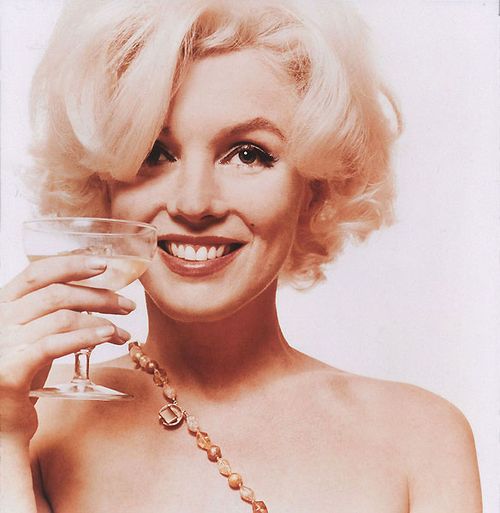
Marilyn Monroe, photographed by Milton Greene
There are the usual fabulous photos of Hollywood's most photogenic star, but the most entertaining person in Love, Marilyn is Marilyn's friend Amy Greene (the widow of Milton Greene, the photographer and Marilyn's former business partner), who is a straight-shooter. One wishes that she and Marilyn had been able to keep in closer touch in Marilyn's final years, as the actress could have benefited from someone who had no hesitation in telling it like it is.
Is there anything new in Love, Marilyn? Not really. Not as long as the only way to approach her life continues to be a step-by-step recitation of her struggle for fame and ultimate tragic demise. It's time for a new approach.
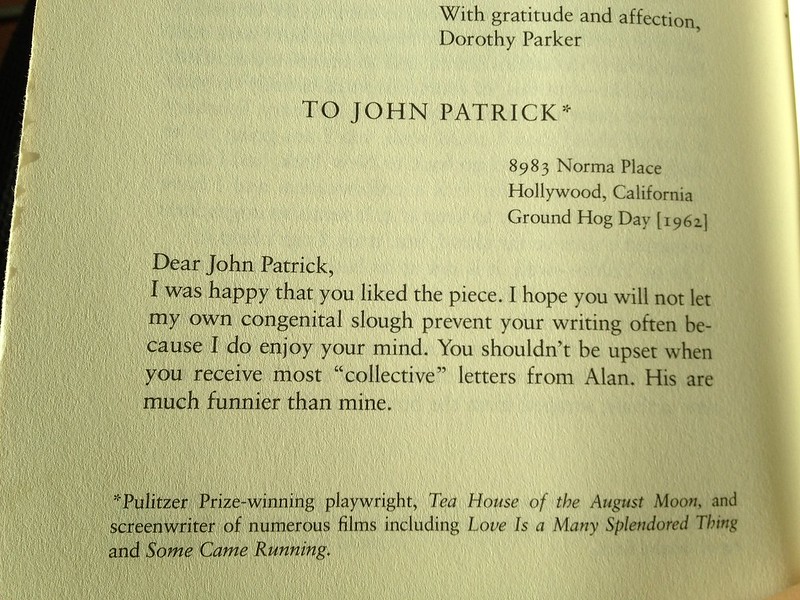
In my research on Marilyn Monroe I recently came across this letter written in February 1962 by Dorothy Parker to her friend, playwright John Patrick. In it she complains to him how Hollywood botched up a piece, "The Good Soup," a "nice little innocent French farce" that she had written for Marilyn. Another item to add to the "if only" list, as the lovely star was gone only six months later.
Parker was not only witty, but observant and wise. She writes of Marilyn, " ... [she] can't help her behavior. She's always in terror. Not so different from you and me, only much prettier!"
It was just a year ago that I wrote a post about Marilyn Monroe's weight, "Why Marilyn Monroe ('s size) Still Matters" — it was in response to an article written about her in Slate that I found to be generally clueless about Marilyn, women's weight, and the perception of women in our society. My post hit a nerve, generating over 23,500 views on my blog, and over 26,000 in its subsequent republishing on BlogHer to date. I felt that in taking a look at Marilyn from a different perspective I might be onto something. I have always been a fan of the actress, and knew the general details of her life and death, but I decided that if I was going to expand my piece I would need to take a deeper look at the lady.
Marilyn Monroe is such an iconic figure. She is our modern goddess. It is possible to be familiar with especially her image from The Seven Year Itch — the white pleated dress billowing skywards, exposing her lovely legs, without ever having seen one of her movies. I want to remedy that. I'd like to not only explore why I think Marilyn is an important female image, and has more than earned her goddess status, but why I also think she is important as an actress and a celebrity. She has shaped the perception and career paths of contemporary actresses.
Over the past year I have read tons of books and articles, good and bad, on Marilyn — on her films, her life, and her death. I have watched and rewatched many of her films. I still have quite a bit of reading and film viewing ahead of me. It hasn't been easy. Not just the sheer volume of of material to wade through, but the endless repetition of her path to oblivion. Most of the writing out there is only concerned with getting Marilyn and the reader to August 5, 1962, and usually in as seamy a way as possible. No one can change the facts of Marilyn's life, but there are other ways to look at her journey than such a negative, straight-line view. At least I think so. No one lives their life with the end moment in mind. Marilyn certainly did not.
I have to admit that reading, over and over, her hard times and final days took a toll. I had to take a break from the lady for a while. What I have been doing, instead of immersing myself in her life and troubles, is continue to look at the massive amount of images left of the lady. Marilyn was first a model, and then the ultimate Hollywood starlet. She posed for tons of publicity photos. She loved the camera and it loved her back. She seems to have been incapable of taking a bad picture. She always seemed to be willing to sit for multiple photos and loved working with photographers. She worked with some of the best during all phases of her career — Eve Arnold, Richard Avedon, Alfred Eisenstaedt, Milton Greene, Cecil Beaton, and many more. As many familiar photos as there are of Marilyn, it seems that every day I have run across one that I have never seen before, like these she did with Marlon Brando, publicizing an Actors Studio benefit.
This post is a bit of a progress report, and a note that you once again will be seeing some more Marilyn-related posts from me in the future. I continue to find Marilyn Monroe fascinating. As well-known as Marilyn may be, she is also completely under-appreciated and a bit misunderstood. I hope to be able to do something about that.
Here's another essay from the longer-format piece I'm working on about Marilyn Monroe.
There are countless stories of how difficult Marilyn Monroe was to work with and be around during the making of The Prince and the Showgirl. Many of them come from the her highly indiscreet co-star and director, Laurence Olivier. More recently the actress's behavior has been recounted in two books by Colin Clark, who worked as an assistant to Olivier during the filming: The Prince, the Showgirl and Me, which reads as a snipey yet entertaining diary of his time on the set, and My Week with Marilyn, his recounting of a "lost week" not included in the first book, which reads as a wish-fulfillment fantasy.The latter notably became a film starring Michelle Williams as Marilyn and Kenneth Branagh as Olivier.
When one views The Prince and the Showgirl none of the strife between the lead actors is evident. In fact, Marilyn comes off much more accessible and watchable than Olivier, who is stiff and boring. To be fair, his character may have been written that way. The staginess of playwright Terence Rattigan's play, The Sleeping Prince, was preserved in his screen adaptation. But Olivier's acting approach also seems old-fashioned and off-putting. Marilyn not only understood the camera, but the inherent comedy in the piece, aspects that seemed to elude the great British Actor with a capital A.
Marilyn, no matter the strife in her life or her personal demons, always seemed to manage to put them aside on screen. She is luminescent, sporting golden hair (a wig), rather than her trademark platinum blonde. She also looks great in the period costumes designed by Beatrice Dawson. She is still her seductive self, with just the right combination of innocence, as an American showgirl in London, Elsie Marina.
Marilyn and Miller in New York
So why would Marilyn have been in such a state during the filming? She was newlywed, just a few weeks, to playwright Arthur Miller, who accompanied her to London for the making of the movie. She should have been wallowing in domestic bliss. But that was not the case. Marilyn may have felt pressured to marry Miller (by Miller) — he announced their pending nuptials to the press before he bothered to ask the lady herself. Their wedding conveniently coincided with his hearing with the House Un-American Activities Committee. Having the biggest star in the world, Marilyn Monroe, on your side when you are being investigated to determine whether you are a Communist certainly helped Miller's image and case immeasurably.
"The Egghead and the Hourglass" wed quickly, and a week later found themselves ensconced in the tony surroundings of Parkside House in London. During their stay there Marilyn found some of Miller's notes for a project he was working on (which would later become his play After the Fall) — clearly inspired by her and undeniably unflattering. This was a major blow to her marriage fantasy of trust, protection, and hope. Such an incident easily kickstarted the cycle of lateness, forgetting lines, and generally difficult behavior that drove a professional working actor like Olivier mad. It didn't take much for Marilyn to slide into abusing the medications she took regularly. She was aided in these efforts by doctors who were only too willing to placate their celebrity client, and by her business partner and co-producer, photographer Milton Greene, who, along with Miller, Olivier, and countless others, was wrestling for control of the beautiful star.
Especially revealing is a poem she wrote during that time. She was already feeling insecure about the marriage:
I guess I have always been
deeply terrified to really be someone's wife
since I know from life
One cannot love another,
ever, really.
where his eyes rest with pleasure — I want to still be — but time has changed
the hold of that glance.
Alas how will I cope when I am
even less youthful —
Miller, very quickly in their marriage, was put in the role of caretaker, something he was highly unsuited for. It must have been an awakening, and an unpleasant one, for him, too. The responsibilities of being with Marilyn as his wife versus his lover were quite different. One can imagine when they were dating each other in New York that it would make no difference to Miller how long it took Marilyn to get herself together. He could work in the morning and see her in the evening. But sharing a house with a wife who was so addled from sleeping pills and painkillers, and who needed his help to get her up and going in the morning — with a new set of pills to achieve that effect — didn't leave much time for the strong-egoed Miller to concentrate on his own work. He wanted his time in England to bolster his own career. A production of his play A View from the Bridge was in production, and he hoped to cultivate Olivier's favor to his own advantage.
Milton Greene, Marilyn and Miller arrive at a London premiere
It makes one wonder about those "notes" he left lying around, a notebook left in plain sight, in which he called her a "bitch." Whether by mistake, subconscious, or purposeful needling, it was the wrong tack to take with her. With her fragile ego Marilyn needed someone who was unflinchingly supportive. A cheerleader. She needed the kind of unspoken support that one usually gets from a parent. Marilyn had neither a mother nor a father while she was growing up. That she was continually drawn to men with strong egos who didn't have the time or inclination to be nurturers was understandable, but also her mistake and tragedy. One could think of Hollywood in the late '40s and early '50s as a community of despotic fathers, and Marilyn was constantly put in the position if trying to please them, while simultaneously trying to rebel and shirk off their control.
The very plot of The Prince and the Showgirl reflects this. Set in 1911, Marilyn's Elsie, a beautiful and vivacious American chorus girl in a London review, catches the eye of an older visiting foreign dignitary, Grandduke Charles, the prince-regent of Carpathia. In town to attend the coronation of George V, but with seduction on his mind, he invites her for a late supper at the embassy. Elsie proves much smarter than anyone expects, and deftly dodges the Prince's clumsy attempts to seduce her, as well as interpret some political plotting being organized by his son, the King-regent. By the end of the film it is clear that Elsie has enchanted the Prince. They have both fallen in love, agreeing to reunite in 18 month's time, when both his regency and her music hall contract end.
Elsie is similar to Marilyn, who was attracted to powerful older men. Such men would fall in love with her beauty, and she in love with their intelligence and power. But they would ultimately prove unworthy of her, and she would once again feel crushed and disappointed and abandoned, as she had since she was a child, trying to please a series of foster families, but still inevitably being shuffled off, never having a permanent base to call her own.
A person as insecure as Marilyn must have been no picnic for Miller, but his lack of compassion for the weak cannot be isolated to their marriage. Years later, when married to his third wife, photographer Inge Morath, he insisted that their second child, Daniel, who was born with Down Syndrome, be institutionalized and not socialized with the family. His need to prove his intellectual power was one of his defining features.
Vivien Leigh, Laurence Olivier, Marilyn, and Miller at the theater,
Miller chose sides while he and Marilyn were in London, and shockingly to his wife, not hers. He championed Olivier's position, as he recounted in his autobiography Timebends: A Life,
"It was simply impossible to agree that he could be the cheap scene-stealer she was talking about. ... Marilyn verged on the belief that he [Olivier] had cast her only because he needed the money her presence would bring. I wanted to believe that this was only half the truth; I was sure he saw the legitimate dramatic contrast between their social and cultural types, and if his motives were indeed partly cynical, they did not cancel his valid artistic judgment in casting. ... inevitably, the time soon came when in order to keep reality from slipping away I occasionally had to defend Olivier or else reinforce the naïveté of her illusions; the result was that she began to question the absoluteness of my partisanship on her side of the deepening struggle."
Marilyn discovered that she was pregnant while she was in London. She suffered a miscarriage before filming wrapped. While married to Miller she later suffered an ectopic pregnancy, and yet another miscarriage after filming wrapped on Some Like it Hot in 1958. When they returned from England to their home in Roxbury, CT (a house mostly paid for by Marilyn, as Miller had not much money after his divorce), their married life hadn't improved much.
Starting tomorrow I will take care of myself for that's all I really have ever had. Roxbury — … I think I hate it here because there is no love here anymore. I regret the effort I desperately made here. ... what I could endure helped both of us and in a material way which means so much more to him than me. ... When one wants to stay alone as my love (Arthur) indicates the other must stay apart.
Marilyn and Miller, during the filming of The Misfits, photographed by Inge Morath
Miller repeated the pattern he started during the filming of The Prince and the Showgirl when he and Marilyn made The Misfits two years later, in 1960. He chose to align himself with director John Huston rather than his fragile wife. The Misfits was supposed to be Miller's "Valentine" to Marilyn, a screenplay and story that he had written especially to showcase her talents as an actress, but the character of Roslyn Tabor was not always shown in a positive light. This was not lost on Marilyn, who cringed as each subsequent re-write became successively more unflattering.
She was furious about a scene late in the film, where Roslyn pleads with Clark Gable's character Gay not to sell wild mustangs to a slaughterhouse.
"I convince them by throwing a fit, not by explaining anything. So I have a fit. A screaming crazy fit … And to think, Arthur did this to me … If that's what he thinks of me, well, and I'm not for him and he's not for me." — Marilyn to her maid Lena Pepitone, from Marilyn, by Gloria Steinem
Marilyn photographed by Inge Morath on the set of The Misfits
To add insult to injury, while their marriage was splintering, Miller befriended a young Magnum photographer, Inge Morath, who was assigned to take photos on the set of The Misfits. They married a month after his divorce from Marilyn was finalized in February 1962. Inge gave birth to their first child, Rebecca later that year, which must have been especially hard for Marilyn to hear.
When Marilyn first met Arthur Miller she was impressed with his intelligence and his integrity. As their relationship progressed she watched her idol fade, as he let some of his ideals slip for money (he crossed lines during a writer's strike in Hollywood to act as a script doctor on her film Let's Make Love), and her belief that she would finally be safe and loved turned out to be just a dream. Miller was not the sort of person to nurture and support a fragile actress or human being. His inability to prevent her dependence on doctors, drugs, and gurus is especially puzzling. Was he too weak to stand up to the people who wanted to control her, or was he just trying to protect his interests? The sad fact is that Marilyn's life, although always turbulent, was much worse after her time spent with Miller. She never really recovered after their divorce. One wonders what might have happened if she had either never met him, or moved on to someone else while she was in New York. We'll never know.
Here's another essay from the longer-format piece I'm working on about Marilyn Monroe.
In The Seven Year Itch Marilyn Monroe played The Girl, the object of fantasy for Tom Ewell. A character with no known (to the audience or Ewell) name. It didn't matter. A tad ironic, considering how her name, her many names, played such an important part in who she became.
Norma Jeane Mortenson, or Norma Jean Baker as she was also known, is frequently presented as if she was a completely different person from Marilyn Monroe — as Marilyn's alter ego. But Marilyn never really changed from the girl she was before she became a movie star. She was born with an identity crisis. Who was her father? Her mother Gladys Baker wasn't even sure, or at least she never said so definitively. She was separated from her second husband, Martin Mortensen, but soon changed Norma Jeane's surname to that of her first husband, Baker. Gladys was having an affair with fellow Consolidated Film Industries employee Charles Stanley Gifford, who is thought to be Marilyn's biological father. Gladys chose, probably for legitimacy's sake, to use her current husband's name on Marilyn's birth certificate. Except she spelled the last name wrong — Mortenson instead of Mortensen. How could her daughter not be confused about her murky origins.
Norma Jeane spent her childhood with practically nothing of her own, being shuttled through a series of foster homes from babyhood. A child who had trouble being noticed, one of many in a household of foster children, she grew up wanting to be adored, like the movie stars she idolized: Jean Harlow, Alice Faye, and Katherine Hepburn. She spent hours at the movies, the films acting as a sort of babysitter, while her guardians worked. From early childhood, inspired by her mother's job as a negative film cutter at Consolidated Film Industries and her family friend Grace McKee, who became her legal guardian when Gladys was institutionalized, Norma Jeane was encouraged to become not just an actress, but a star. Grace had some unrealized fantasies of stardom of her own, and endlessly promoted the young girl's dreams of becoming a movie star.
Norma Jeane Dougherty, 1945
Norma Jeane had an unfortunate youth, but she didn't want to escape it by getting married. But when Grace remarried and was preparing to move from California to Virginia, she tried to solve the "problem" of what to do with Norma Jeane, how to keep her from going back to the orphanage, by marrying her off at the age of 16 to a local neighbor, Jim Dougherty. The marriage was doomed from the start, with a reluctant groom who was always away in the Merchant Marine, and a bored Norma Jeane with major abandonment issues. While Jim was away, Norma Jeane worked at the Radioplane Munitions factory in Van Nuys, where she was soon discovered by U.S. Army photographer David Conover, who had been assigned to take some morale-boosting photographs for the Army's magazine, Yank. He urged her to pursue modeling. The young girl wasted no time in following his advice, seeing modeling as a road to acting, and more importantly, as an escape from the humdrum life of a teenage housewife. Norma Jeane was never cut out to be a housewife.
The marriage was dissolved and Norma Jeane began to model full-time, sometimes using the name Jean Norman. When she finally got a contract at Twentieth Century-Fox she was urged to changed her name from Norma Jeane Dougherty. Her grandmother's maiden name was Monroe, and something alliterative was suggested— she became Marilyn. But The Girl wasn't done changing. She had already lightened her hair color, as blondes got more modeling work than brunettes, but she was told to alter her hairline, raising it a bit. And then to make some slight improvements to her chin and nose. She was willing to do whatever it took. She knew that starlets were a dime a dozen and could be dropped at any moment. And Marilyn wanted, needed, to become a star.
"I am not interested in money. I just want to be wonderful"
Nothing ever came easily to Marilyn. Her road to stardom started, then stalled, and at times seemed in reverse. She was hired by Twentieth Century-Fox, only appearing in bit parts, and then dropped. She then was hired by Columbia, who dropped her when her six-moth contract was up. After a walk-on role in the Marx Brothers' Love Happy she caught the attention of Hollywood agent Johnny Hyde, who helped get her into two great movies, The Asphalt Jungle, where she impressively played the very young girlfriend of Louis Calhern; and as starlet-on-the-rise Miss Casswell, a "student of the Copacabana School of Dramatic Art," in All About Eve. Hyde was able to persuade Fox to not only rehire her but sign her to a seven-year contract.
Marilyn finally began to get steady work, appearing in mostly comedies until her breakthrough role in the noir-ish Niagara, costarring Joseph Cotten. It was around this time, in 1952, that she was also introduced to one of the most famous men in America, retired Yankee Joe DiMaggio, who had asked to meet her after seeing a publicity photo of her trying to hit a baseball.
"I was surprised to be so crazy about Joe. I expected a flashy New York sports type, and instead I met this reserved guy who didn't make a pass at me right away! He treated me like something special. Joe is a very decent man, and he makes other people feel decent, too."
They were soon an item. Marilyn and Joe's romance was documented by photographers in ways that would make modern paparazzi blush. They were the original "It" couple. There are many who still romanticize their "perfect" union. The truth, and their relationship, was of course much more complicated. They may have been great as lovers, even friends, together, but marriage was something neither of them were well-suited for. But their attraction for one another was instantaneous.
Joe and Marilyn with Cary Grant, Marilyn's costar in Monkey Business, 1952
In Canada during the filming of River of No Return
Marilyn was not a sports fan and may have not known who Yankee Joe DiMaggio was before they met, but clearly Joe really didn't know who she was, either. How else to explain how he might have ever entertained the fantasy that she would settle down to become the perfect housewife. Their pairing may still fascinate many today because it is so puzzling. Joe met her in 1952 and dated her for two years before they married. Marilyn was at the height of her career, with films Niagara, Gentleman Prefer Blondes, and How to Marry A Millionaire propelling her to the forefront of Hollywood. She agreed to marry him in 1954.
Newly married Norma Jeane DiMaggio's passport
The Girl, the number one female star in the world, may have been on top of the world, but she was still in the throes of an identity crisis. Once she was married to Joe (and gained yet another name, Norma Jeane DiMaggio), she had to contend with his fantasy of the sort of wife he wanted her to be. How could the Yankee slugger who had resisted retirement convinced himself that Marilyn would give up her Hollywood life to become a hausfrau in his preferred city of San Francisco at the pinnacle of her fame? After years of struggling to get small parts, Marilyn was finally a favorite of the bigwigs at the studio, and most importantly, the public. Joe wanted her to walk away from that? Not on her life. The real Marilyn was neither The Girl the world fantasized about, nor the wife Joe DiMaggio thought she should be. She was a complicated woman who wanted more from her career and her life.
The "It" couple of the mid-1950s
Joe and Marilyn on the town
Joe became increasingly uncomfortable with Hollywood and Marilyn's part in it. He was disgusted by the revealing outfits she wore to premieres, the endless publicity cheesecake shots she was always willing to do. The couple struggled from the start of their marriage, but the crowning blow came during the infamous night shoot of The Seven Year Itch, where The Girl stands over a subway grate on a hot New York City night with costar Tom Ewell and the breeze from the underground train lifts her skirt skyward. Director Billy Wilder's publicity stunt of filming the scene on the street at 52nd Street and Lexington Avenue (the scene that was ultimately used in the movie was filmed on a soundstage) sent Joe round the bend. The public display may have enraged DiMaggio, but probably what was hardest for the Yankee Clipper to take was that Marilyn didn't belong only to him. She belonged to her public, and she loved that. That night in 1954 Joe had a rude awakening.
There are some (unsubstantiated) reports that he dealt with his frustrations by batting her around. Marilyn may have endured that, but what she couldn't and didn't tolerate was his insistence that she give up her career. Joe didn't realize what Marilyn had gone through to become Marilyn.
Marilyn, "I didn't want to give up my career, and that's what Joe wanted me to do most of all."
Joe, "It’s no fun being married to an electric light."
When the New York location shooting of The Seven Year Itch was over, so, for the most part, was the nine month-long marriage. Joe didn't like failure, so their break-up must have been especially hard for him to take. Joe and Marilyn may have failed as a married couple, but their bond was strong, and they stayed close through the years. Joe was always someone Marilyn could rely on. He wasn't a hanger-on. He was one of the few people in her life that didn't want to suck off of her star persona. He went into therapy (possibly influenced by Marilyn) and seemed to mellow in many of his views. One of the most well-known stories of their post-divorce relationship was when Joe rescued Marilyn from the Payne Whitney Psychiatric Clinic. Marilyn, distraught after the filming of The Misfits and the dissolution of her third marriage to playwright Arthur Miller, thought she was going into the hospital for a rest cure. But her psychiatrist, Dr. Marianne Kris had her committed to the psychiatric ward. Marilyn reached out to Lee Strasberg to no avail. It was Joe who responded to her call for help.
Marilyn joined Joe in Florida for some much-needed R&R
Would Marilyn and Joe have gotten back together, even married? There are many who claim that they were planning to do just that, but Joe never said so and we will never know. It probably would have been foolish for them to remarry, but they did seem to need to be in each other's lives. After Marilyn died, Joe arranged for a dozen red roses to be sent regularly to her grave. Joe DiMaggio never remarried. The Girl was gone.
Joe sent Marilyn a birthday telegram on June1, 1962
An unfinished letter from Marilyn to Joe, found in her house after her death





 a deluxe 2006 edition, which added personal letters and other items.