The colorful cover of the book and its glitzy (and ditzy) Hollywood backdrop easily lure the reader in, for a quick beach or travel read. The chapters are set up as vignettes to showcase various Hollywood types and their messy lives – and how heroine Jane, a professional organizer (think a cross between a celebrity assistant and a devotee of lifestyle guru Marie Kondo), can brave the traffic of Los Angeles freeways and twisty/turny roads in the Hollywood Hills to save them all.
Mess, by Michael Chessler
Mess, by author Mike Chessler, does tell that story well – and that could have simply been it. But Mess also delivers a thoughtful, sometimes poignant story of a young woman trying to discover what she really wants in her life – what to keep, what to discard. Including (or not) a lackadaisical (to her tastes) boyfriend. Jane could stand to learn a bit about herself, as she sorts through discarded designer duds – and occasionally decides to slip a piece (or two or three) into her bag to add to her own collection.
The prose may seem a little highfalutin on occasion, but that actually suits the ultra-perfectionist protagonist Jane to a T. Do I make her sound a bit of a mess and difficult to like? She definitely is, at times. But Mess isn’t. The book and all its characters are highly enjoyable.
My dad was a huge fan of the prolific author Lawrence Block. Block is best known for two series of books, one following ex NYC cop Matthew Scudder and his battles with alcohol and guilt, as well as a light-hearted series about the charming burglar Bernie Rhodenbarr, who always seems to find himself on a job in a fabulous residence that also happens to contain a dead body. Most of the Scudder novels are included with my Audible subscription, so I have been enjoying revisiting a few that I read years ago and discovering some new (to me) ones. But mostly I have enjoyed time-traveling with Scudder to New York City in the 1970s and 1980s, a time before the internet and 24-hour cable news and so many other scourges of our times.
Matthew Scudder has a tragic backstory and spends a good deal of his time in coffee shops, ginmills, and walking the streets of Hell’s Kitchen, as he tries to “do favors” for friends. After he quit the force he started drinking – and also functioning as a quasi private eye. Even under an alcohol haze he can put his considerable talents to helping track down assorted murderers and ne’er-do-wells. Block loves to underline the day-to-day repetitiveness of city life as Matt drops numerous dimes in payphones, hops into cabs or rides subways and mass transit trains all over the boroughs of New York to solve a case – all while hitting his favorite watering holes several times a day to drink his favorite concoction – coffee with a shot of bourbon – it helps him keep his drunk on while also keeping him awake.
When the Sacred Ginmill Closes (1986) by Lawrence Block
What is most interesting about Scudder is his unapologetic manner – he doesn’t pretend or aspire to be a hero. He is dogged, determined, and sometimes enacts his own sense of justice. He is the first to talk of his many flaws. Most of the talk, the dialogue in these books, is first-rate. Block has a way with words, but especially with conversation between characters. This hits its apex in When the Sacred Ginmill Closes, a story the now sober Scudder tells while looking back on his hard-drinking days with his even harder-drinking buddies.
The best audio versions of these books are by readers who really seem to capture the character of Matthew Scudder, as well as being able to act out the other characters convincingly. Strangely, the weakest reader so far has been the author himself, who voices perhaps his best-known Scudder novel, Eight Million Ways to Die. It is a pivotal book in the series, as it chronicles Scudder hitting his lowest point with the booze and taking his first tentative steps towards quitting it and joining Alcoholics Anonymous. Block’s reading of the novel at the beginning is rote – but his delivery does seem to come alive as Matt sobers up. This may have been intentional, but frankly the other books are far more enjoyable for listeners, books where the voice actors can act, not just read.
That minor quibble aside, I am really enjoying my recent foray into nostalgic NYC noir. I’ve listened to the first seven books in the series. There are seventeen novels and numerous short stories featuring this classic detective (even if Matt wouldn’t call himself one). Favorite narrators in the series so far are Alan Sklar and Mark Hammer. There are numerous non-PC attitudes expressed by many characters, as to be expected of NYC low-lifes circa ’70s-’80s, but some readers/listeners might find the racial, homophobic and ethnic slurs offensive. Matt Scudder never projects such views, but runs across or spends time with characters who do.
The Sins of the Fathers (1976) – narrated by Alan Sklar
In the Midst of Death (1976) – narrated by Alan Sklar
Time to Murder and Create (1977) – narrated by Alan Sklar
A Stab in the Dark (1981) – narrated by William Roberts
Eight Million Ways to Die (1982) – narrated by Lawrence Block
When the Sacred Ginmill Closes (1986) – narrated by Mark Hammer
Out on the Cutting Edge (1989) – narrated by Dan Butler
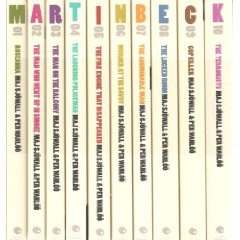
In 1965 writing partners (and partners in real life) Maj Sjöwall and Per Wahlöö embarked on a quest – to write and publish ten novels in ten years featuring Stockholm’s Martin Beck. The novels, police procedurals, were structured as not only mysteries, but reflections and commentary on modern Swedish society. The duo wore alternating chapters – but since I haven’t read any of their individual works I couldn’t guess who wrote which chapter in any given novel. The books are cohesive and follow policeman Martin Beck as he progresses through the ranks of the Swedish national police.
Although these books were written decades ago many of the issues and crimes depicted by Sjöwall and Wahlöö sound eerily familiar – violence against women and children, serial killers, terrorism. Their top detective Beck is an interesting character. We follow him through the ten years as his marriage implodes and he becomes more and more disillusioned with the growing militarism of the police and his superiors’ endless bureaucracy (and incompetence). But Beck doesn’t work alone. Equally interesting are his colleagues Lennart Kollberg and Gunvald Larsson and female detective Åsa Torell and Rhea Nielsen. I listened to these books on Audible and was grateful for the reader to pronounce all of the Swedish place names, but also surprised at the pronunciation of some of the characters names. If I had been reading it in paperback or Kindle I never would have guessed that Kollberg is pronounced Kahl-bree-yah in Sweden.
Sjöwall and Wahlöö are considered the origin and of modern Scandi-noir. They have influenced a great many writers, such as Henning Mankell (Wallander), Stieg Larsson (Girl with the Dragon Tattoo, etc.) and Jo Nesbø (The Snowman). I enjoyed all of the books and came to care about Beck and his compatriots. Not only was reading the series doable, it satisfied my completist mentality. I really enjoyed a glimpse into the swinging ’60s and ’70s Sweden. Maybe not so free-thinking as I might have thought. My favorites were probably The Man on the Balcony, The Laughing Policeman, The Abominable Man and The Locked Room, although I recommend checking out the entire series. Although I appreciate the authors’ discipline, I wish there were more Beck novels. Apparently there are a ton of movie and television adaptations of the books and the characters, although so far I haven’t found any on any of my streaming services.
Martin Beck detective novels, by Maj Sjöwall and Per Wahlöö
The books, in the order they were published (and how I read them) are as follows:
Roseanna (1965) – In this first novel of the series Martin Beck must determine the identity of the corpse of a young woman found in a canal. The solving of the case requires long-term and meticulous research and sometimes a little luck.
The Man Who Went Up in Smoke (1966) – Beck is sent to Budapest to find a missing journalist. Sixties Eastern Europe is an interesting backdrop and the reader gets to know more an=bout Beck’s home life and his quirks and attitudes.
The Man on the Balcony (1967) – The series takes a dark turn as Beck & Co. try to track down a serial pedophile/murder. Two bumbling cops, Kristiansson and Kvant, are introduced, as well as detective Gunvald Larsson to provide some subtle and wry comic relief.
The Laughing Policeman (1968) Maybe the most well-known of the series, this was adapted into a Hollywood movie starring Walter Matthau (which I haven’t been able to find streaming anywhere) and also won the Edgar Award for Best Novel in 1971. The opening, and the main crime to be investigated is stunning – on a snowy night a gunman, wielding a sub-machine gun, boards a commuter bus and systematically kills everyone aboard and then disappears. One of the passengers happens to be Beck’s young colleague detective Åke Stenström.
The Fire Engine That Disappeared (1969) – Gunvald Larsson is about to replace a fellow cop on a routine surveillance assignment when the building they are observing goes up in flames. He singlehandedly rescues many of the residents, but Beck must determine the cause and more importantly, the why of the conflagration.
Murder at the Savoy (1970) – During a fancy banquet at Stockholm’s Savoy Hotel a gunman walks in, shoots a man in the head and walks out. No one in the crowded room can offer much information on his identity. How will Beck track him down?
The Abominable Man (1971) – A former policeman is killed while in the hospital. Beck must not only track down the culprit but the motive. One of the most exciting books of the series, this involves a city-wide manhunt and a crazed sniper holding the city hostage.
The Locked Room (1972) – This book involves two separate crime investigations – a series of bank robberies (which was apparently a big problem in Sweden in the ’70s) and Beck trying to solve a classic locked room mystery.
Cop Killer (1974) – This book has a callback to first novel Roseanna as Beck investigates the disappearance of a young woman in southern Sweden.
The Terrorists (1975) – Beck and his team are tasked to protect a very unpopular U.S. senator on his visit to Sweden. The novel follows Beck and his team as well as the terrorist cell that is planning to disrupt the visit.
Happy Day of the Dead! The Gaiman-athon continues.
I really enjoy Neil Gaiman's writing. But this book, The Graveyard Book, is exceptional. It seemed at first a possibly odd choice for the Newbery Medal last year, but it was well-deserved. When one thinks about all of the grisly happenings in fairy tales, and how many things in the real world that can be sometimes perceived as frightening to children, a book like this is actually a balm.
Admittedly, it starts off with a bit of a shock, with a brutal murder of a family that unfortunately is not too far from the headlines of many local newspapers. The child that survives the attack, another "boy who lived," but with a distinctly different future in store, fortuitously crawls up the hill to a neighboring graveyard, where he is adopted by some kindly ghosts, and watched over by a young witch, a werewolf, and, although never blatantly stated, a guardian vampire.
The book of course has its fantasy aspects in featuring all of these creatures of the night and shadows. But what is its strong point, and what comes across most clearly in the reading, is how we, along with the graveyard's inhabitants, get the opportunity to watch little Nobody "Bod" Owens grow up, through all the struggles and childhood challenges he faces. He may be able to walk through walls and make himself disappear as long as he is under the protection of the magical Grey Lady and the graveyard, but when it comes down to it, he has many of the same issues as any sheltered child.
The world outside his graveyard home is dangerous—full of folks who may do him harm or, even worse, other children who may not want to be his friend, schools that teach things that may not be entirely accurate. We feel Bod's growing pains and his need to move beyond his supernatural family—all the time realizing that no one may ever love him as much as this family, but he will still have to go when the time is right. I could relate to Bod's need to break out of the protective cocoon. It brought back memories of my hitting the road for New York City as soon as I could fly out of the nest. But I also remember tearful nights in my new home and realizing that I couldn't go back—we can never really go back, even when we visit. Everything had changed. I had changed. I was in tears at the end of this book, both for my lost childhood and with the realization that I will sooner than I want to be living this timeless story from the other side, when my daughter is ready to leave home.
The other touching aspect of the novel are all of the dead characters. How many of us have lost someone, and wished or wondered if there was some sort of existence, similar to their living one, that might continue? Bod gets to know people from many different eras in his town's history. He gets a built-in history lesson as well as the reassurance that death is not final. He learns not to fear death or endings.
Gaiman may use a fantastic setting, but he is telling a true, heartfelt journey of growing up, for both child and parent.
The Graveyard Book is truly one of the most wonderful books that I have read in a long time.



 is truly one of the most wonderful books that I have read in a long time.
