Showing posts with label suspense. Show all posts

Friday, December 10, 2021

matt scudder – nostalgic nyc noir

 My dad was a huge fan of the prolific author Lawrence Block. Block is best known for two series of books, one following ex NYC cop Matthew Scudder and his battles with alcohol and guilt, as well as a light-hearted series about the charming burglar Bernie Rhodenbarr, who always seems to find himself on a job in a fabulous residence that also happens to contain a dead body. Most of the Scudder novels are included with my Audible subscription, so I have been enjoying revisiting a few that I read years ago and discovering some new (to me) ones. But mostly I have enjoyed time-traveling with Scudder to New York City in the 1970s and 1980s, a time before the internet and 24-hour cable news and so many other scourges of our times.

Matthew Scudder has a tragic backstory and spends a good deal of his time in coffee shops, ginmills, and walking the streets of Hell’s Kitchen, as he tries to “do favors” for friends. After he quit the force he started drinking – and also functioning as a quasi private eye. Even under an alcohol haze he can put his considerable talents to helping track down assorted murderers and ne’er-do-wells. Block loves to underline the day-to-day repetitiveness of city life as Matt drops numerous dimes in payphones, hops into cabs or rides subways and mass transit trains all over the boroughs of New York to solve a case – all while hitting his favorite watering holes several times a day to drink his favorite concoction – coffee with a shot of bourbon – it helps him keep his drunk on while also keeping him awake.

When the Sacred Ginmill Closes by Lawrence Block
When the Sacred Ginmill Closes (1986) by Lawrence Block

What is most interesting about Scudder is his unapologetic manner – he doesn’t pretend or aspire to be a hero. He is dogged, determined, and sometimes enacts his own sense of justice. He is the first to talk of his many flaws. Most of the talk, the dialogue in these books, is first-rate. Block has a way with words, but especially with conversation between characters. This hits its apex in When the Sacred Ginmill Closes, a story the now sober Scudder tells while looking back on his hard-drinking days with his even harder-drinking buddies.

The best audio versions of these books are by readers who really seem to capture the character of Matthew Scudder, as well as being able to act out the other characters convincingly. Strangely, the weakest reader so far has been the author himself, who voices perhaps his best-known Scudder novel, Eight Million Ways to Die. It is a pivotal book in the series, as it chronicles Scudder hitting his lowest point with the booze and taking his first tentative steps towards quitting it and joining Alcoholics Anonymous. Block’s reading of the novel at the beginning is rote – but his delivery does seem to come alive as Matt sobers up. This may have been intentional, but frankly the other books are far more enjoyable for listeners, books where the voice actors can act, not just read.

That minor quibble aside, I am really enjoying my recent foray into nostalgic NYC noir. I’ve listened to the first seven books in the series. There are seventeen novels and numerous short stories featuring this classic detective (even if Matt wouldn’t call himself one). Favorite narrators in the series so far are Alan Sklar and Mark Hammer. There are numerous non-PC attitudes expressed by many characters, as to be expected of NYC low-lifes circa ’70s-’80s, but some readers/listeners might find the racial, homophobic and ethnic slurs offensive. Matt Scudder never projects such views, but runs across or spends time with characters who do.

The Sins of the Fathers (1976) – narrated by Alan Sklar

In the Midst of Death (1976) – narrated by Alan Sklar

Time to Murder and Create (1977) – narrated by Alan Sklar

A Stab in the Dark (1981) – narrated by William Roberts

Eight Million Ways to Die (1982) – narrated by Lawrence Block

When the Sacred Ginmill Closes (1986) – narrated by Mark Hammer

Out on the Cutting Edge (1989) – narrated by Dan Butler


First published on Cannonball Read

Friday, October 15, 2021

classic swedish noir

 Originally published on Cannonball Read

In 1965 writing partners (and partners in real life) Maj Sjöwall and Per Wahlöö embarked on a quest – to write and publish ten novels in ten years featuring Stockholm’s Martin Beck. The novels, police procedurals, were structured as not only mysteries, but reflections and commentary on modern Swedish society. The duo wore alternating chapters – but since I haven’t read any of their individual works I couldn’t guess who wrote which chapter in any given novel. The books are cohesive and follow policeman Martin Beck as he progresses through the ranks of the Swedish national police.

Although these books were written decades ago many of the issues and crimes depicted by Sjöwall and Wahlöö sound eerily familiar – violence against women and children, serial killers, terrorism. Their top detective Beck is an interesting character. We follow him through the ten years as his marriage implodes and he becomes more and more disillusioned with the growing militarism of the police and his superiors’ endless bureaucracy (and incompetence). But Beck doesn’t work alone. Equally interesting are his colleagues Lennart Kollberg and Gunvald Larsson and female detective Åsa Torell and Rhea Nielsen. I listened to these books on Audible and was grateful for the reader to pronounce all of the Swedish place names, but also surprised at the pronunciation of some of the characters names. If I had been reading it in paperback or Kindle I never would have guessed that Kollberg is pronounced Kahl-bree-yah in Sweden.

Sjöwall and Wahlöö are considered the origin and of modern Scandi-noir. They have influenced a great many writers, such as Henning Mankell (Wallander), Stieg Larsson (Girl with the Dragon Tattoo, etc.) and Jo Nesbø (The Snowman). I enjoyed all of the books and came to care about Beck and his compatriots. Not only was reading the series doable, it satisfied my completist mentality. I really enjoyed a glimpse into the swinging ’60s and ’70s Sweden. Maybe not so free-thinking as I might have thought. My favorites were probably The Man on the Balcony, The Laughing Policeman, The Abominable Man and The Locked Room, although I recommend checking out the entire series. Although I appreciate the authors’ discipline, I wish there were more Beck novels. Apparently there are a ton of movie and television adaptations of the books and the characters, although so far I haven’t found any on any of my streaming services.

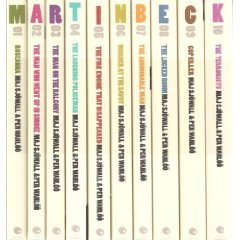
Martin Beck detective novels, by Maj Sjöwall and Per Wahlöö

The books, in the order they were published (and how I read them) are as follows:

Roseanna (1965) – In this first novel of the series Martin Beck must determine the identity of the corpse of a young woman found in a canal. The solving of the case requires long-term and meticulous research and sometimes a little luck.

The Man Who Went Up in Smoke (1966) – Beck is sent to Budapest to find a missing journalist. Sixties Eastern Europe is an interesting backdrop and the reader gets to know more an=bout Beck’s home life and his quirks and attitudes.

The Man on the Balcony (1967) – The series takes a dark turn as Beck & Co. try to track down a serial pedophile/murder. Two bumbling cops, Kristiansson and Kvant, are introduced, as well as detective Gunvald Larsson to provide some subtle and wry comic relief.

The Laughing Policeman (1968) Maybe the most well-known of the series, this was adapted into a Hollywood movie starring Walter Matthau (which I haven’t been able to find streaming anywhere) and also won the Edgar Award for Best Novel in 1971. The opening, and the main crime to be investigated is stunning – on a snowy night a gunman, wielding a sub-machine gun, boards a commuter bus and systematically kills everyone aboard and then disappears. One of the passengers happens to be Beck’s young colleague detective Åke Stenström.

The Fire Engine That Disappeared (1969) – Gunvald Larsson is about to replace a fellow cop on a routine surveillance assignment when the building they are observing goes up in flames. He singlehandedly rescues many of the residents, but Beck must determine the cause and more importantly, the why of the conflagration.

Murder at the Savoy (1970) – During a fancy banquet at Stockholm’s Savoy Hotel a gunman walks  in, shoots a man in the head and walks out. No one in the crowded room can offer much information on his identity. How will Beck track him down?

The Abominable Man (1971) – A former policeman is killed while in the hospital. Beck must not only track down the culprit but the motive. One of the most exciting books of the series, this involves a city-wide manhunt and a crazed sniper holding the city hostage.

The Locked Room (1972) – This book involves two separate crime investigations – a series of bank robberies (which was apparently a big problem in Sweden in the ’70s) and Beck trying to solve a classic locked room mystery.

Cop Killer (1974) – This book has a callback to first novel Roseanna as Beck investigates the disappearance of a young woman in southern Sweden.

The Terrorists (1975) – Beck and his team are tasked to protect a very unpopular U.S. senator on his visit to Sweden. The novel follows Beck and his team as well as the terrorist cell that is planning to disrupt the visit.

Monday, May 10, 2021

some great, some not so, some not even suspense

 A Century of Great Suspense Stories

I got this one to listen to on drives more than thirty minutes. You can basically hear one short story each way. It is a mixed bag, both in quality and presentation. It should be noted that the audible version of this book only includes seventeen stories, the first half of the book. The rest of the book’s nineteen tales are missing. Maybe the second half is also available as a book on tape. Maybe I’ll check.

The stories have been gathered by author Jeffrey Deaver (The Bone Collector). Many of the stories were previously published in Alfred Hitchcock’s Mystery Magazine. A lot of the stories have that twist ending reminiscent of The Twilight Zone, Alfred Hitchcock Presents and similar anthology shows. Deaver includes one of his own short stories, “The Weekender,” which also happens to be one of the best ones. Other highlights include “Missing: Page Thirteen” by Anna Katharine Green and “The Gentleman in the Lake,” by Robert Barnard. The absolute highlight of the collection is “Quitters Inc.” by Stephen King, which rounds out the collection.

A Century of Great Suspense Stories
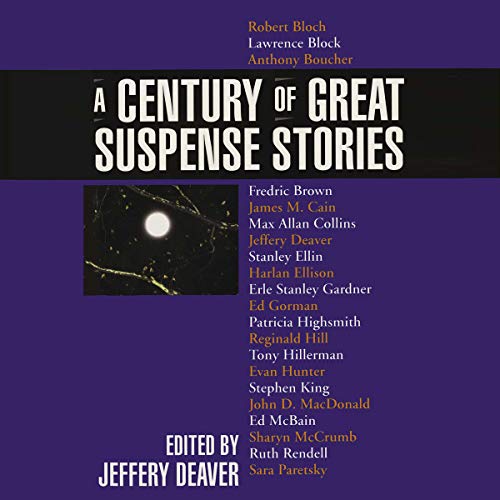
A Century of Great Suspense Stories, edited by Jeffrey Deaver (warning, a lot of the authors listed here aren’t in this truncated collection)

What is especially difficult is the inability to search through the collection as you’re listening to find a story or skip a story. You can fast forward, but it is a very clunky presentation. The readers of each story were mostly good. Some of the more detective noir-ish readings were a bit much, maybe, but that could have been the stories, too. I found the classic American detective stories to be the most dated. The Erle Stanley Gardner was especially tough going.

It took a lot of hunting online, as there is no complete list of authors and stories with the book on tape, but here is the complete list of the contents:

“Gentleman in the Lake” Robert Barnard
“Life in Our Time” Robert Bloch
“Batman’s Helpers” Lawrence Block
“Girl Who Married a Monster” Anthony Boucher
“Wench is Dead” Fredric Brown
“Cigarette Girl” James M. Cain
“Matter of Principal” Max Allan Collins
“The Weekender” Jeffery Deaver
“Reasons Unknown” Stanley Ellin
“Killing Bernstein” Harlan Ellison
“Leg Man” Erle Stanley Gardner
“One of Those Days, One of Those Nights” Ed Gorman
“Missing: Page Thirteen” Anna Katharine Green
“Voir Dire” Jeremaih Healy
“Chee’s Witch” Tony Hillerman
“Interpol: The Case of the Modern Medusa” Edward D. Hoch
“Quitters, Inc.” Stephen King

Review on Cannonball Read 13

strangers on a train - stranger and strangerer

Every once in a while I get a yen to read the source novel for one of my favorite classic movies. My most recent read (actually listen) is Strangers On A Train, by Patricia Highsmith. I have seen the classic Alfred Hitchcock film, featuring Robert Walker and Farley Granger, many times. There are some indelible, memorable scenes in that movie – the two men crossing legs and crossing lives on the train, the gold lighter which incriminates and absolves, the final deadly and hair-raising sequence on the merry-go-round at the amusement park. Apart from their initial meeting on the train, Hitchcock fans should know that none of those set pieces are in the book.

Strangers On A Train
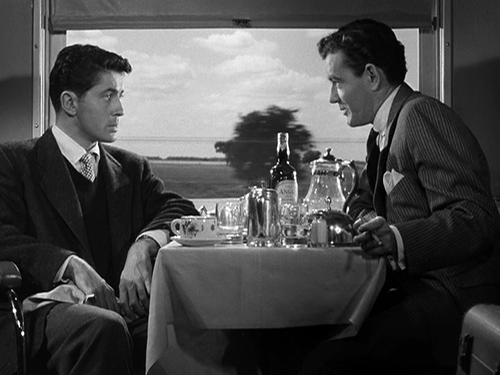
Strangers On A Train, directed by Alfred Hitchcock, with Farley Granger and Robert Walker.

That doesn’t mean that the book isn’t interesting, however. It was Highsmith’s first novel, published five years before her successful The Talented Mr. Ripley. It could be viewed as a precursor of some of the themes that appear in that novel, like the doubling effect of two male protagonists. Charles Bruno is a charming sociopath. He wants to “trade murders” with a random man he meets on a train, Guy Haines, an up-and-coming architect (Hitch made him a tennis pro). Guy doesn’t take Bruno seriously, but he doesn’t condemn him that forcefully, either. Guy’s got his own problems. His estranged wife Miriam is now pregnant by her new boyfriend and he’s hoping she will agree to a divorce so that he can marry his (very rich) sweetheart Anne. But Miriam is not known for being agreeable.

Strangers On A Train is a psychological thriller. Highsmith is most interested in Guy’s mental journey and collapse as Bruno continually pressures him to hold up his end of the bargain. Written in 1950, the undercurrents of homosexuality between the two men must have seemed shocking. Highsmith isn’t exactly sympathetic to the almost perpetually drunken Bruno, but she lets his character grow through his actions and how people react to him, which makes him more interesting than broody Guy. In fact, “hero” Guy becomes more and more unlikable as the story progresses. Highsmith does not do a very good job with her lone female character, Anne, who seems to only exist to be devoted to Guy, but we are never given a reason why she likes the increasingly unpleasant fellow. The story is told at times from both Guy’s and Bruno’s perspectives. The book would have definitely benefited if we had more of Anne’s perspective, too.

Strangers On A Train
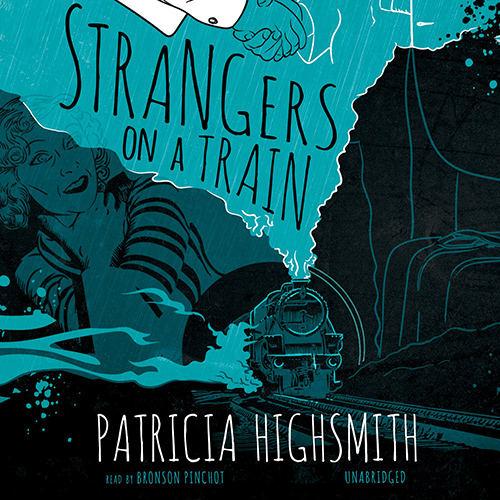
Strangers On A Train, written by Patricia Highsmith, read by Bronson Pinchot

Ultimately Strangers On A Train is an interesting read, but I prefer how Alfred Hitchcock streamlined some of the action and themes and certainly brought his visual flair to Highsmith’s clever plot idea. I “read” the audible version of this book, read by Bronson Pinchot.


Featured on Cannonball Read Instagram and on Cannonball Read

Tuesday, December 17, 2019

book to film: the talented mr. ripley

Patricia Highsmith wrote The Talented Mr. Ripley in in 1955. She based it loosely on Henry James’s The Ambassadors (which I now have to add to my to-read list). The lead character, Tom Ripley, proved so popular, that she brought him back for four more novels.
When the reader first meets Tom he is living close to the bone in New York City, subsisting on his “friends,” or running various schemes, including mail fraud. But Tom isn’t really great at his schemes, and he doesn’t like people, and he doesn’t have any true friends, just people he can sponge on. Tom’s prospects begin to look up when he runs into the rich Mr. Greenleaf, the father of an acquaintance, Dickie Greenleaf. Mr. Greenleaf wants his son, who he believes is frittering away his life in Italy by dabbling in painting, to come home, get serious, and work at the family shipping business. Tom exaggerates his friendship with Dickie, and agrees to track him down in the (fictional) Italian seaside port of Mongibello – staked with cash from Mr. Greenleaf.
Tom Ripley, (Matt Damon), Dickie Greenleaf (Jude Law), and Marge Sherwood (Gwyneth Paltrow) in the 1999 film The Talented Mr. Ripley
Tom doesn’t seem to have any real desire to fulfill his quest and bring home the prodigal son, but he does head to Mongibello and soon meets Dickie and his friend Marge Sherwood. Marge and Tom take an immediate dislike to each other as Tom tries to ingratiate himself with the open and (initially) clueless Dickie. Tom’s motives aren’t clear, to himself or the reader. His strongest motivating factor seems to be survival and acquiring money. He comes from nothing and is determined to not only be able to live, but live well. Dickie enjoys palling around with Tom at first, as a way to avoid Marge’s not-so-subtle attempts to take their relationship to the next level. In the meantime, Tom has been studying Dickie, to the point of copying his mannerisms and attire. One day Dickie walks into his bedroom to find Tom in his clothes – it is from that moment that their newfound friendship begins to sour. Dickie may not be the brightest bulb on the tree, but he can sense that Tom is not the real deal, not from his side of the tracks.
There is definitely an undercurrent of sexuality to Tom’s obsession with Dickie, which was made more blatant in the 1999 film version, directed by Anthony Minghella, starring Matt Damon (Tom), Jude Law (Dickie), and Gwyneth Paltrow (Marge). I had seen the film years ago and didn’t love it. I will say that Jude Law has never looked better on film. It’s a first-class production, with Philip Seymour Hoffman, Cate Blanchett, and Jack Davenport in supporting roles. I just didn’t find Damon to be very compelling. Ripley may be a cipher, but I felt Damon just played him as a blank space. I rewatched it recently, and it’s better than I remember, but Damon is definitely still its weakest link. There is also apparently a French version of the story, Plein Soleil (Purple Noon), filmed in 1960, directed by René Clément and starring Alain Delon that might be fun to track down sometime.
But back to the book . . . even though Tom bristles at memories of being called a “sissie” and is repulsed by Marge, he seems less attracted to Dickie the man than to Dickie’s lifestyle and all its trappings. Tom is first and foremost a parasite. His love of fine clothes and having money to spend will lead to murder and mayhem as he travels across Italy to escape his past and past identity. Tom Ripley is an anti-hero and sociopath who at times may put off the reader, who may find many of his crimes brutal and unnecessary, but Highsmith is such a gifted writer that she effortlessly pulls us into his thoughts and his fears. Will he avoid capture? Do we want him to? I can’t say I liked Tom Ripley much, but I am looking forward to checking out his further adventures.
p.s. Fleabag’s “Hot Priest” Andrew Scott will be portraying Tom Ripley in a new series, Ripley, on Showtime in 2020. So I have to start subscribing to that channel now?
This post first appeared on Cannonball Read 11

Wednesday, October 10, 2018

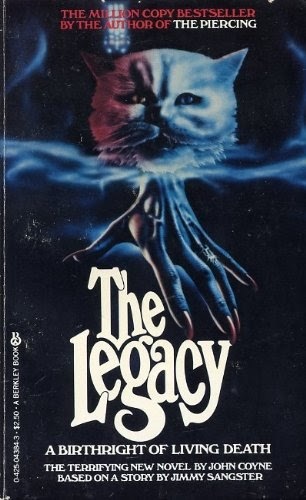
and then there were satanists ... the legacy

The Legacy, by John Coyne, is a mixture of an Agatha Christie whodunnit, as members of a house party are knocked off one by one, and an occult thriller. It's not always clear how much of the menace is due to dark magic or just plain old greed, as six people have been elected to inherit a legacy — of vast wealth, property, and possibly, supernatural power. Coyne wrote the novel as a tie-in to the successful film starring Katharine Ross and Sam Elliot (and The Who's Roger Daltrey in a small role). He wrote a number of other horror novels before switching to golf novels, which is his current genre.

I liked the film when I saw it as a kid, so thought I'd give the book a try. It's a good read for a few spooks and thrills, but much of it seemed very dated — especially how the relationship between the main couple, Maggie and Pete (Ross and Elliott in the film) is handled. It was hard not to roll my eyes while Pete took fragile Maggie in his strong arms again and again. I remember Katharine Ross being pretty kick-ass and spunky in the movie, so I put those scenes down to the author's own attitudes about the sexes and their roles. There were a few occasions where Coyne could have added some more background, as to why Maggie and Pete found themselves at an English palatial estate, and how Maggie's family tree might be a factor. But after one fevered dream sequence that Maggie has halfway through the book, he seemed to drop it.

So, honestly, there is not much to be gained by reading the book versus seeing the original film, which is just some cheesy fun (complete with a Sam Elliot shower scene — bonus). That's the way to go, in my opinion.


Novelization or film? Film all the way. Plus, it's fun to watch these two fall in love (and they're still together 40 years later!)

Sunday, August 26, 2018

favorite movie #10: in a lonely place

Favorite movies that have had an impact on me - #10 - In A Lonely Place (1950) - My dad introduced me to Bogie movies, and we watched the classics - Casablanca, The Maltese Falcon - together. This one I discovered on my own. It’s film noir, but with the bright sunshine, or maybe glare, of California. Bogie and Gloria Grahame are great together - tender, sexy, and doomed. I could watch it a million times, still hoping for a different ending. Talk about being your own worst enemy. I think it is Bogart’s greatest work.
Dixon Steele (Bogart): I was born when she kissed me. I died when she left me. I lived a few weeks while she loved me.


Wednesday, April 12, 2017

as spooky as ever: we have always lived in the castle

We Have Always Lived in the Castle is an amazing, unsettling book. It is a tale told by a fanciful and unreliable but fascinating narrator, Mary Katherine Blackwood, or Merricat, as her older sister Constance calls her. Merricat and Constance and their Uncle Julian and Merricat's cat Jonas live in Blackwood House, on top of the hill overlooking a small and small-minded village.


The author Shirley Jackson was a master of the macabre and creepy. Her short story "The Lottery" continues to haunt schoolchildren every year, as does her masterly haunted house novel, The Haunting of Hill House. Jackson lived for many years in North Bennington, Vermont, and has ratcheted up the standoffish prototypical New Englander to the nth degree in this story. The Blackwoods experienced a family tragedy six years ago, when four of the family members died one night after sprinkling what they thought was sugar on their blackberries. It turned out to be arsenic. Constance was acquitted of the crime, but the cloud of doubt, distrust, and thinly-veiled hate has hung over her and her remaining family ever since.

The details of the Blackwoods' existence and the genteel, class-conscious life that their family has led in contrast to their unneighborly neighbors plays out throughout the book. The devil is in the details - descriptions of china patterns and the meticulously kept remnants of their departed relatives - a hairbrush, a gold watch, a harp. Merricat admits her life is a difficult one, but she enjoys it - until a visit by distant cousin Charles threatens to destroy all the barriers she has carefully, and sometimes magically constructed to the outside world.


Merricat's and Constance's home and way of life are under siege. Can they hold onto any of their old, familiar graces? Can their neighbors treat others equally, without suspicion, and not resort to violence? We Have Always Lived in the Castle seems an especially pertinent and spooky read, as we sadly read more and more discussions of "otherness' and persecution daily in our press.