Favorite movies that have had an impact on me - #17 - Young Frankenstein (1974) - This is one of those movies that I could probably say most of the dialog along with the actors from beginning to end. If I wasn't laughing. Everyone is at their peak performance, and the B&W photography is beautiful to look at, too.
Igor (Marty Feldman): Dr. Frankenstein ...
Dr. Frederick Frankenstein (Gene Wilder): "Fronkensteen."
Igor: You're putting me on.
Frankenstein: No, it's pronounced "Fronkensteen."
Igor: Do you also say "Froaderick"?
Frankenstein: No ... "Frederick."
Igor: Well, why isn't it "Froaderick Fronkensteen"?
Frankenstein: It isn't; it's "Frederick Fronkensteen."
Igor: I see.
Frankenstein: You must be Igor. [He pronounces it ee-gor]
I'm not sure how old I was when I first saw the classic 1965 Blake Edwards comedy The Great Race on television. But I do remember loving the silliness, the epic pie fight, and the amazing (19) costumes (designed by Edith Head) worn by Natalie Wood. One of my favorite Saturday morning cartoons when I was little was The Perils of Penelope Pitstop, a sort of feminist spin-off toThe Wacky Racers. Penelope, getting into one dangerous situation after another, was far from a helpless female (despite her silent-movie cries of "Help! Help!" and always managed to triumph over her arch-enemy, The Hooded Claw (voiced by Paul Lynde), and look great while doing it.I may not have consciously made the connection until much later, with repeated viewings, but The Great Race was clearly an inspiration for both cartoons.
Professor Fate, "What's next?"
Max, "Car number five, the engine falls out!"
Professor Fate, "Car number five! Ha ha ha ha! ... Max ... we're number five."
Penelope Pitstop (top) and Maggie DuBois (Natalie Wood)
Director Edwards has acknowledged that The Great Race was also inspired by silent comedies, especially the slapstick featured in Laurel and Hardy (to whom Edwards dedicated the film). Edwards was riding high on the successes of The Pink Panther and A Shot in the Dark, and The Great Race had a huge budget — it cost $12 million to make, the most expensive comedy film for its day. Much of the budget went to securing its star cast — Jack Lemmon in a dual role, as the scheming Professor Fate and Prince Friedrich; Tony Curtis as the spotless, ever-clad-in-white hero The Great Leslie; and Natalie Wood as suffragette Maggie DuBois, as loose and funny as we would ever see her in movies.
The Great Leslie (Tony Curtis) and Maggie DuBois sip champagne while stranded on an iceberg.
On a more recent viewing of The Great Race it also became abundantly clear that it was a comic source for many subsequent movies — especially for some of Mel Brooks's comedies, like Blazing Saddles and Space Balls. Edwards pulled out all the stops. Just about every film genre is showcased: a western segment, complete with saloon singer Dorothy Provine and a barroom brawl brings Blazing Saddles to mind. Other mini-parodies within the film include a romantic desert tent, a la The Sheik, as well as a climactic sword fight, that wouldn't be out of place in any Errol Flynn or 1940s swashbuckler, between Curtis and Ross Martin as Baron Rolfe von Stuppe. The amazing pie fight sequence has been replicated but never equaled, although Lemmon didn't count it as his favorite time on the set, "A pie hitting you in the face feels like a ton of cement."
Jack Lemmon as Prince Friedrich ("Haw haw haw!")
Cinema's greatest pie fight — watch for Max's (Peter Falk) entrance about halfway through.
An interesting behind-the-scenes tidbit — Tony Curtis was not the original choice for The Great Leslie. Edwards wanted Robert Wagner, but he and Wood had recently divorced, and she was still reeling from the impact. Wood was distraught throughout the shoot, and reportedly took too many sleeping pills after filming wrapped (she was fortunately awake enough to call a friend for help, who got her to a hospital), but her personal distress never shows for an instant on film. Charlton Heston (!) is also rumored to have been offered the part.
The Great Leslie, Maggie DuBois, and Professor Fate with The Leslie Special in Paris.
Max, "Red sky. Gonna be a storm."
Professor Fate, "What are you babbling about?"
Max, "Red sky in the morning, sailor take warning."
Professor Fate, "Why, you simple-headed gherkin, do you know the chances of a storm in this part of the world at this time of the year?"
Max, "No, what?"
Professor Fate, "Hundred to one."
[Thunderclap — it begins to pour rain]
Curtis and Wood are winning romantic leads, but as usual, Jack Lemmon walks away with the film. He is brilliant, whether he is scolding his sidekick Max (Peter Falk) on another evil plan gone awry, or as the foppish, perpetually drunk Prince Friedrich — no one in the film is having as good a time as he is, except possibly the audience. Let Lemmon, Curtis and Wood take you on a wacky, laugh-filled journey — The Great Race is still as funny today as when it first premiered in 1965.
Some of the best films that came out last year had a common theme — nostalgia. Not only were these films set in bygone eras, but they shared an expressed yearning for the past, a nostalgia for older films.
Hugo is the ultimate love letter to the cinema, showcasing the work of the father of the movies, Georges Méliès. Director Martin Scorsese has never been more accessible. His affection for the subject matter clearly shows.
The Artist is a silent movie set in the golden age of Hollywood, during the transition from silents to talkies. It radiates charm and viewers can enjoy its nods to Fred and Ginger musicals and classic films like Singin' in the Rain and A Star is Born.
Midnight in Paris takes Owen Wilson to magical eras in the City of Light's past where he can rub shoulders with Ernest Hemingway, Salvador Dali, Zelda and F. Scott Fitzgerald and even the French Impressionists. But Woody Allen is also calling up the magic in classic Hollywood films like A Connecticut Yankee in King Arthur's Court and Time After Time, where the hero has an opportunity to trip through time and find romance in the past.
My Week with Marilyn is a movie about the making of a movie. The Muppets is set in the present, but its plot and its entire vibe hearkens back to the Muppet's first movie, which came out in 1979. The Adventures of Tintin is a boy's adventure that evoke film noir. Puss in Boots has its obvious roots in Zorro and other classic movie swashbucklers and Rango uses Hollywood westerns as its inspiration.
Not since the early '70s have so many movies been looking backward. So many films seemed to have an affection for the '30s — and the movies made in that era.
The Sting (1973) wears its love for '30s gangsters movies proudly and also pays homage to silent films with title cards. Depression-era America is also the setting for Peter Bogdonavich's Paper Moon (1973), which calls to mind The Grapes of Wrath. Bogdonavich took another nostalgic turn with Nickelodeon (1976), where he featured the birth of motion pictures.
The Great Gatsby (1974) is about the nostalgia of a past love, and is filmed to look like the classic '30s doomed romances featuring Joan Crawford. Cabaret (1972) is in a slightly more modern era, Weimar Germany, but it calls to mind classic movie musicals as well as war movies filmed in the late '30s, early '40s.
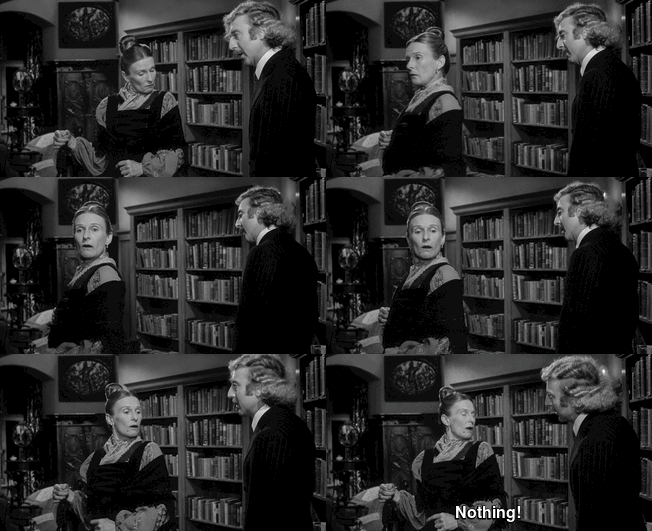
Chinatown (1974) is Roman Polanski's '70s take on film noir, with Jack Nicholson playing the ultimate beleaguered P.I., fascinated and double-crossed by a gorgeous dame (Faye Dunaway), in the long filmic tradition of Philip Marlowe and Sam Spade. Mel Brooks's Young Frankenstein (1974) is a true homage to the classic '30s horror films, characters, and actors. It's also still one of the funniest and beautiful-to-look-at moves ever made.
Is it because we are again in a recession that we would rather look back? When Hollywood looks back, it always seems to look back not just to another era, but on itself, its history. But its self-reflexive nature does make for some great films.
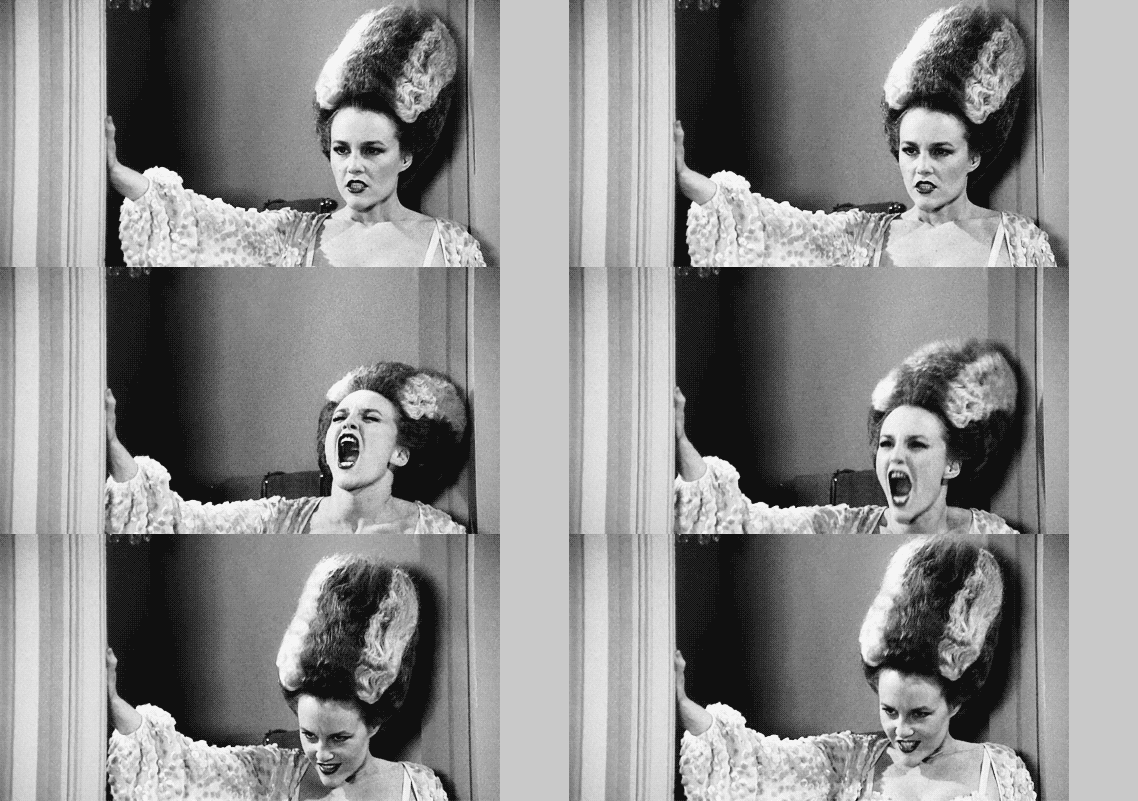
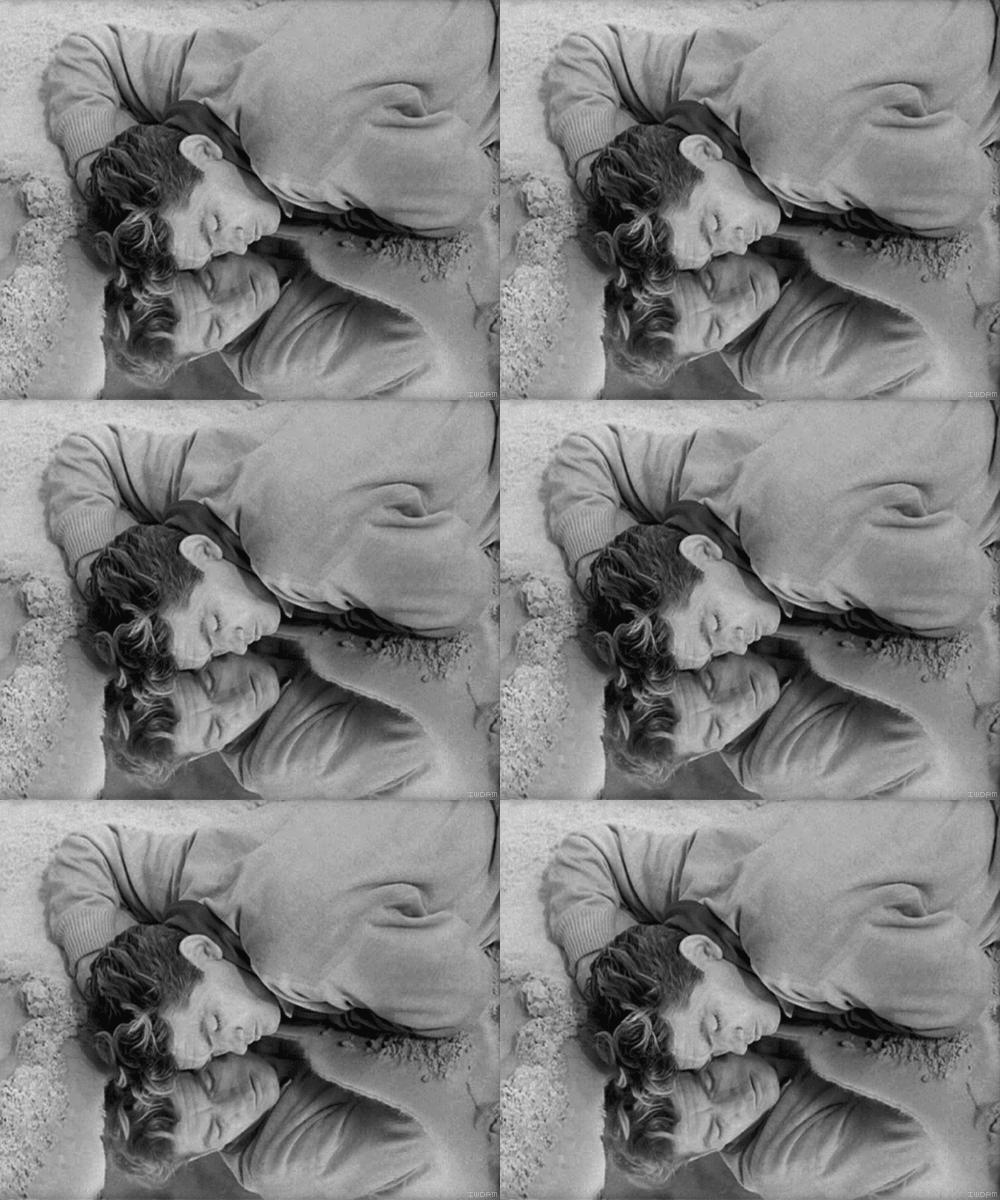
If We Don't Remember Me is a great tumblelog specializing in gifs made from classic movies. And when I say classic, I mean it — Stanley Kubrick's 2001, Francis Ford Coppola's The Godfather, and Jean Cocteau's Orphée are a few of the great movies represented on the site.
But the gifs in the posts are not just favorite scenes cut and snipped from the movies. The gifs all have a stillness, a time stands still quality. Here is a lovely one, from Orphée.
This one is amazing, a Greek bronze statue come to life, from, surprisingly, Francis Ford Coppola's Apocalypse Now.
Not all of the posts are serious in tone. Some have a sense of humor, too, like this one from Mel Brooks's Young Frankenstein.
My mom's memory continues to slip, tiny bit by bit, but with no discernible pattern. Some days it feels like there is only the worst to look forward to. Some days seem fine. One saving grace, at least for the present, is that no matter how hard it can be for her to communicate at times—the right word seems harder and harder to come by—she still enjoys reading and watching movies. And of course watching her adorable granddaughter.
I come from a family of movie buffs. My mom and dad had special nicknames for favorite actors. They always talked about movies particularly—how a certain movie at a certain time in their lives meant something. My brother and I would watch movies with them, mostly on television. From a young age we would also get to go out to the movies on rare occasions, to see something special.
Some of the movies we all trooped together to see made a lasting impression. Young Frankenstein is still my favorite Mel Brooks film, even though I was too young to get the dirty joke/punchline. I think I could probably quote it from beginning to end. 2001: A Space Odyssey bored the whole family to tears, and we are all sci-fi geeks. But shared misery can be a bonding experience. Star Wars thrilled us all and was the first movie we all saw together more than once. Life of Brian was controversial at the time it was released (sacreligious!), but my newspaperman dad wasn't going to let anyone censor his family seeing Monty Python or anything, for that matter. The Sting and Butch Cassidy and the Sundance Kid we saw in the space of one week, while they were playing at the local drive-in. Robert Redford was probably the first movie actor I fell in love with that was in a current movie, and not someone from one of the old B&W ones my mom loved that we would see on television, like Tyrone Power or Robert Taylor. Another of my first loves was Frank Langella. We all went to see him in Dracula, as we liked scary movies as much as sci-fi—Langella was very sexy—sort of weird to see with mom and dad. Dad bought me the Bram Stoker novel with Langella on the cover, maybe to get me to read it, or get back to to the source. I was just thrilled at first to get to relive some of the movie's scenes, but then got caught up in the late 19th century epistolary writing style, so maybe dad was onto something. I think I may still have it somewhere ...
I remember when my mom and dad both got so excited about The Godfather coming out. They had both read the book from the library, taking turns, while trying to keep it away from us, from the racy and violent parts. When the movie came out my brother and I had to stay with our grandma while mom and dad drove to NY to see it on a big screen. Maybe my dad had some sort of press pass. Or maybe they just wanted a big night out in the city. My brother and I were so jealous, but we got from them that movies can be special.
I grew up with a B&W television until I was in my teens. One of my fondest childhood memories was when the Wizard of Oz was playing at the local movie theater and my mom insisted on us going to see it. My brother and I had already seen it on television, so we didn't know what the big deal was. We walked downtown with mom who made sure we got good seats. It was fun seeing Dorothy on such a huge screen, and I always liked going to the movies, but I didn't get it until ... She opened the door to technicolor Munchkinland. My brother and I both screamed. I looked at my mom and she just smiled. She had saved that surprise, that bit of movie magic, for us all those years.
So it is extremely gratifying to me that we can sit together in the evening on occasion and still watch movies together. I can see with some of the more recent films that she is losing the plot a bit. But if I put on an old movie, it's like magic. She's much more into the story and excited at seeing the old familiar faces of actors and actresses. I might have to supply the names, but she knows exactly who they all are, sometimes much better than I do. That happened the other night when I was flipping past channels and found Zero Mostel singing the opening number, "Comedy Tonight" in A Funny Thing Happened on the Way to the Forum. I had seen the movie years ago, actually probably late one night on television with my dad. I didn't really remember it much, so it was fun to rediscover it with her.
The same thing happened again on a recent Sunday afternoon when we all watched The Pirate. My mom thought she hadn't seen it before (who knows?), but no matter. She loves Judy Garland and Gene Kelly, the kid got to dance along to Dorothy and that guy who tap dances on roller skates, and I got to see Gene Kelly dance in shorts, so it was a win-win-win.
I've always liked old movies, but I think I am going to like them even more now.








 is still my favorite Mel Brooks film, even though I was too young to get the dirty joke/punchline. I think I could probably quote it from beginning to end. 2001: A Space Odyssey bored the whole family to tears, and we are all sci-fi geeks. But shared misery can be a bonding experience.
  thrilled us all and was the first movie we all saw together more than once.
  was controversial at the time it was released (sacreligious!), but my newspaperman dad wasn't going to let anyone censor his family seeing Monty Python or anything, for that matter.
  and
and  we saw in the space of one week, while they were playing at the local drive-in. Robert Redford was probably the first movie actor I fell in love with that was in a current movie, and not someone from one of the old B&W ones my mom loved that we would see on television, like
  , as we liked scary movies as much as sci-fi—Langella was very sexy—sort of weird to see with mom and dad. Dad bought me the Bram Stoker novel with Langella on the cover, maybe to get me to read it, or get back to to the source. I was just thrilled at first to get to relive some of the movie's scenes, but then got caught up in the late 19th century epistolary writing style, so maybe dad was onto something. I think I may still have it somewhere ...
 coming out. They had both read the book from the library, taking turns, while trying to keep it away from us, from the racy and violent parts. When the movie came out my brother and I had to stay with our grandma while mom and dad drove to NY to see it on a big screen. Maybe my dad had some sort of press pass. Or maybe they just wanted a big night out in the city. My brother and I were so jealous, but we got from them that movies can be special.
  . I had seen the movie years ago, actually probably late one night on television with my dad. I didn't really remember it much, so it was fun to rediscover it with her.
 . My mom thought she hadn't seen it before (who knows?), but no matter. She loves Judy Garland and Gene Kelly, the kid got to dance along to Dorothy and that guy who tap dances on roller skates, and I got to see Gene Kelly dance in shorts, so it was a win-win-win.
