Showing posts with label history. Show all posts

Tuesday, March 10, 2015

i love the bowery boys

No not these guys, although I grew up watching them and like them too.


These guys.

Greg Young and Tom Meyers (from Warby Parker)

I am addicted to their podcasts, which I listen to to on longer car rides. I left New York many years ago and don't really harbor even the tiniest desire to move back, but it's is in my blood. Growing up in New Jersey, "the city" was always a big focus and a draw. I lived there many years, in Brooklyn and then Manhattan — some of my most formative ones, going to college and starting my life as an independent adult and artist.

The Bowery Boys go way, way back in their New York histories, to the origin of places like Gramercy Park and Little Italy, but they also do more modern episodes, like one on CBGBs and another on subway graffiti art. I urge you to check them out. They also have me wanting to learn a lot more about some forgotten names that helped shape the city, like Joseph Petrosino, Hilla Rebay, and famous names who you might not have known had strong New York connections, like Rudolph Valentino. Once you listen to the podcasts you'll want to check out their blog for great photos, too.

Tuesday, September 25, 2012

the kelloggs of deerfield, ma

Genealogy continues to not only teach me things about my family, but about history. When I was a kid we played Cowboys and Indians sometimes, but as I grew older I learned how the Native Americans were slowly and surely forced out of their land by encroaching European settlers. Coming from a long line of such people gives a person pause, but I never expected to find out how direct a connection I may have had to such conflicts.

I have recently discovered that one of my ancestral lines, the Kelloggs, were directly involved in what has come to be known as the Raid on Deerfield, or the Deerfield Massacre, a Franco-Indian raid on English settlers in Deerfield, MA in 1704. The more I read about these 18th century family members the more I realize that their story was more complicated than I at first may have thought.

In 1704 the Kellogg family was living in Deerfield, MA when a group of French and Native Americans launched a surprise raid on the English settlement of Deerfield. The attack was led by New France colonial military officer Jean-Baptiste Hertel de Rouville, whose force was made up of almost 300 attackers, including French colonists and Indian tribesmen from the Abenaki, Iroquois, Wyandot, Pocumtuc, and Pennacook tribes.


Deerfield had been a center of conflict and controversy from its very beginnings. Originally inhabited by the Pocumtuc nation, the village was called Pocumtuck when English settlers arrived in the mid-1660s. Ten years later it was dubbed Deerfield, but the colonists and the Indians were already skirmishing, in what came to be called King Philip's War, and two battles, one favoring the Indians (the Battle of Bloody Brook), and one favoring the English (Turner's Falls), resulted in multiple deaths on both sides. But the colonists kept coming back to settle in Deerfield, and the Indians were forced northward to Canada.

Raids on villages were common, but still the attack on Deerfield on February 29, 1704 was for the most part a surprise. Although over 40 of the residents were killed, that doesn't seem to have been the raiders' main objective. 109 villagers were taken captive — including the entire Kellogg family, minus Jonathan Kellogg (1698 – 1704), a boy of five, who perished during the raid, and the mother, Sarah (1656-1732). There is a lurid story of how Sarah may have escaped capture:
Mrs. Kellogg had been concealed in the cellar under a tub upon which the Indians sat and regaled themselves with whatever they could find to eat. She had escaped from the bed with an infant a few days old, and after secreting the child had turned the tub over herself. The cries of the child soon attracted the attention of the Indians, who at once seized it and dashed it against the wall. At their departure the Indians set fire to the dwelling, but Mrs. Kellogg escaped to a house then used as a fort. The family was afterwards allowed to return from their captivity. Martin was several times captured by the Indians, but returned before 1714 — Early New England Schools, p. 182
The captives of the raid were forced to march to Canada, in the rough and brutal February winter conditions. Miraculously most of the Kelloggs, although separated from each other, survived the march, and what happened to them is fascinating.
Martin Kellogg (1658-1732, my 8th great grandfather) was 46 at the time of the raid and the patriarch of the family. He was ransomed and released in 1705 and relocated to Suffield, Connecticut. Many of the original Deerfield inhabitants refused to go back there to live. 
Martin Kellogg, Jr. (1686-1753) was 18 at the time of the raid. He escaped from his captors and returned home to Deerfield on June 8, 1705. He became a scout, and was captured again by Indians in 1708, where he remained, becoming fluent in Indian languages and French. Martin eventually relocated to Connecticut, where he married Dorothy Chester and had nine children. 
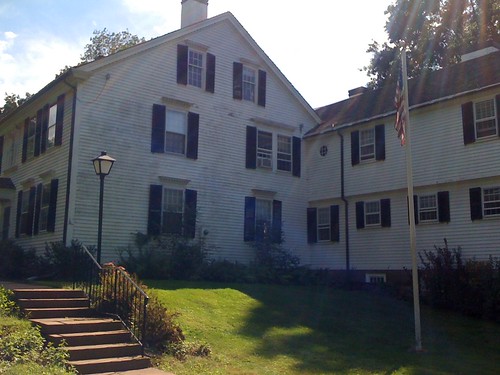
Martin Kellogg's house, Newington
The Martin Kellogg House in Newington, CT
Joseph Kellogg (1691-1756) was 13 at the time of the raid. Joseph stayed in New France with the French and Indians and became a fur trader and explorer. He is credited as the first English settler to have seen the Mississippi River. In 1714 his brother Martin persuaded him to come home, where he married Rachel Devotion, of Suffield, MA. They had five children. Joseph worked as a scout, translator, soldier, diplomat, interpreter, and magistrate until his death from a fever in 1756. 
"I travelled two & fro amongst the French and Indians" learning "the French language as well as those of all the tribes of Indians I traded with, and Mohawks, & had got into a very good way of business: So as to get Considerable of monies ... & handsomely to support myself & was under no restraint at all." — The French and Indian raid on Deerfield Massachusetts, 1704 
Joanna Kellogg (1692 – 1780) was 11 at the time of the raid. Joanna married a Caughnawaga Indian chief (according to ancestry.com his name was Indian Chief Crawfoot) at Kahnawake and never returned to New England. She is recorded as visiting her brother Martin in Connecticut, but returning to Canada to live. 
Rebecca Kellogg (1695-1757) was 9 at the time of the raid. She lived with the Kahnawake until 1728, but eventually returned to New England, supposedly "rescued" by her brother Joseph when she was 33. She married Benjamin Ashley and worked as an interpreter for many years. She died in 1757 at the Iroquois village of Ouaquaga, where she was given the Indian name “Wausaunia.”
The early English settlers may have found themselves opposing Indian tribes and French villages, but many, like the Kelloggs, also found ways to coexist. I am just scratching the surface of the stories here, but I hope that sometime in the near future I can take a trip to Deerfield, MA, to learn even more.

Sources:
The American Surveyor, Spring 2004, "Joseph Kellogg of Deerfield (1691-1756) Indian captive, Interpreter & Guide, Explorer & Soldier," By Silvio A. Bedini, LLD

Raid On Deerfield: The Many Stories of 1704


Enhanced by Zemanta

Wednesday, December 09, 2009

a day in the life

The other day on the drive to work, a song by Paul McCartney came on and my daughter said, "It's the Beatles!" I told her no, this was a song he did after the band broke up.

"You mean after the others died?"

"No..."

"Is Ringo still alive? Is he singing on this song?"

"He's alive, but he's not on this song, he has his own band."

"Why did George and John die?"

"Well, George got sick, and John . . ."

"Did he get sick?"

"No, a very bad person hurt him. They shot him."

"Why? Where?"

"It was in New York. Actually the first year I was in college. It was very sad."

"You were there? You saw it?"


"No, but we heard about it. It was very upsetting. It still is."

"How did he shoot him?"

"He was coming out his front door, where he lived, and this person shot at him and unfortunately John was so badly hurt that he died."

"Just like Abraham Lincoln!"

"Yes, but that happened a long, long time ago, here, in DC."

"Here?" We are parking the car now, getting out.

"Yes, just up the street, at Ford's Theater." Walking through the garage, towards the exit.

"Can we take the escalator?"

"Absolutely."


Elegantly Dressed Wednesday button

Saturday, June 06, 2009

history lesson

I'm sorry, but I don't understand all the snobbishness about The Tudors and similar shows that take a twist on history. Yes, they get the dates and characters and events mixed up at times, usually for dramatic effect. Sometimes, inexplicably. But carping about that is missing the point. What the series does accomplish is to give the viewer a real glimpse into life at the Tudor court and how the political and sexual machinations of the sixteenth century are not so very different from current maneuvers.

I am still haunted by last week's finale and depiction of Thomas Cromwell's end, which was gruesome, and accurate, maybe not specifically for Cromwell's death, but certainly for public executions of the time. The trajectory of Cromwell's career was fascinating, too. Not the first "common man" loved, elevated and revered by a king only to take a steep nose dive when the winds changed. Wolsey met a similar fate, also with Henry VIII (and Cromwell himself had a hand in that), and of course Thomas Becket and Henry II are legendary friends turned enemies. Funny that what we consider a success story in America, the "American Dream," was almost a recipe for disaster with the Plantagenets.

The attempt to rival Rome, and the combination of Jonathan Rhys Meyer's pretty boy intensity with a fair amount of bodice ripping was the original recipe for success for The Tudors. What has kept it interesting has been some excellent acting this season, most touchingly, from Joss Stone as Anne of Cleves, and the politics of fear and absolute power. Maybe the details are somewhat sketchy at times, but if you want to get all the facts there are plenty of great books on the subject to check out. If you want to get a taste of not-so-merry-Olde-England, a feast awaits.

Sunday, May 03, 2009

here's something...

Today is the birthday of:

Niccolo Machiavelli
5/3/1469 - 6/21/1527
Italian writer, statesman and political theorist

and

"Alice"
Ann B. Davis
Actress ("The Brady Bunch")

Talk amongst yourselves...

Sunday, April 26, 2009

bewitched

"The internets" is an amazing place. I recently discovered through ancestry.com that one of my ancestors was one of the first women executed at what would come to be known as the Salem Witch Trials, Sarah Averill Wildes. I wonder what my maternal grandmother would think. She did extensive family research many years ago to prove a connection to a Revolution-era ancestor in order to become a member of the Colonial Dames. But this bit of history goes back farther than that. Sarah, at age 65, was hanged on July 19, 1692.

I remember having to read something about the trials in English class and being pretty bored with all the"Goody this" and "Goody that" characters. It must have been The Crucible, unless it was another popular fictional account. As interesting as the subject matter was, the Salem witch trials came most alive for me in two fantasy shows from my childhood.

In a two- or three-part episode of Bewitched, Samantha goes back to Salem. I always loved that show and Elizabeth Montgomery, but especially liked how they took what had been a fun, fluffy, fantasy and special-effects show and combined it with some real history.
In one of my favorite episodes of The Avengers, "Murdersville," Mrs. Peel goes to visit a friend in his new home and runs into a village full of twisted, crooked individuals. In an extended scene she is hunted and then imprisoned in a chastity belt, and then later placed in the dunking stool, which is a torture device that was also used to ferret out "witches." What human beings will do to one another is astounding. And in the name of religion, too. This scene of public humiliation and torture to a modern, athletic, kick-ass woman brought the horror of how a crowd can be deadly and how a strong woman can be perceived as very threatening.

I have some more research to do, but various accounts of Sarah and her fate suggest that she may have been difficult to get along with, and her disputes with a neighbor woman over something as mundane as the borrowing of a scythe may have contributed to the accusation and her execution. It's difficult being a strong woman in any era, but terrifying to contemplate how a weak-minded herd could result in this sad chapter of history.

Monday, December 15, 2008

crazy book lady...

...or bibliophile. That sounds less compulsive, doesn't it?

I needed to get the books out of my daughter's room, to see if that would effect or improve her allergy situation. Another in a long list of lifestyle adjustments for us both, which has included the exile of my beloved cat of fifteen years to the Virginia suburbs (sigh). But that's another story...

...so back to the books, and boy, there are a lot of them! I was able to get her books into a medium size bookcase and two small storage units for easy access. I also decided to move the three piles of "to-reads" from my bedroom out to the foyer as well, which is now our ersatz library. While I was doing all of this moving around I decided to take a little inventory and see if I could shed some - for donation or trade at my favorite used bookstore. Not a lot of luck. There were a few titles that my daughter was willing to pass on to a baby friend of ours, but not much more. And looking at my books, well, they are divided into quite a few categories, none of which I'm wiling to pare down yet either, if ever:As I was looking at all the books, I started thinking about connections and how one thing leads you to another. Of course my art education has provided a background for my interest in Ancient and European art, culture and history, whether I have pursued this interest through fiction (Christian Jacq's Ramses and Stone of Light series) or non-fiction (Antonia Fraser's Wives of Henry VIII, Death in Ancient Egypt, Love and Hate in Jamestown). But anyway, I find that a movie or a television program like The Tudors led me to read more about the period. Reading about the Tudors made me want to know about the Wars of the Roses, which led me back to the Plantagenets and how it all started. As I read about the English I became more interested in France, as the two separate countries we know today were in those days completely intertwined. This brought back my trip to the Loire Valley, which was part of a tour of northern France. At the time I was not so interested in chateau after chateau, but now I realize that I was walking in the footsteps of Francois Premier, Henry II and Eleanor of Aquitatine as I strolled through Chinon and Angers, where I saw the amazing Apocalypse Tapestry. Of course now I want to go back to France and England, armed with my better understanding and reference points. The question is, once there, what will spark my fancy and lead me off on another thread, supplemented of course by books, books, books?