Friday, October 15, 2021

classic swedish noir

 Originally published on Cannonball Read

In 1965 writing partners (and partners in real life) Maj Sjöwall and Per Wahlöö embarked on a quest – to write and publish ten novels in ten years featuring Stockholm’s Martin Beck. The novels, police procedurals, were structured as not only mysteries, but reflections and commentary on modern Swedish society. The duo wore alternating chapters – but since I haven’t read any of their individual works I couldn’t guess who wrote which chapter in any given novel. The books are cohesive and follow policeman Martin Beck as he progresses through the ranks of the Swedish national police.

Although these books were written decades ago many of the issues and crimes depicted by Sjöwall and Wahlöö sound eerily familiar – violence against women and children, serial killers, terrorism. Their top detective Beck is an interesting character. We follow him through the ten years as his marriage implodes and he becomes more and more disillusioned with the growing militarism of the police and his superiors’ endless bureaucracy (and incompetence). But Beck doesn’t work alone. Equally interesting are his colleagues Lennart Kollberg and Gunvald Larsson and female detective Åsa Torell and Rhea Nielsen. I listened to these books on Audible and was grateful for the reader to pronounce all of the Swedish place names, but also surprised at the pronunciation of some of the characters names. If I had been reading it in paperback or Kindle I never would have guessed that Kollberg is pronounced Kahl-bree-yah in Sweden.

Sjöwall and Wahlöö are considered the origin and of modern Scandi-noir. They have influenced a great many writers, such as Henning Mankell (Wallander), Stieg Larsson (Girl with the Dragon Tattoo, etc.) and Jo Nesbø (The Snowman). I enjoyed all of the books and came to care about Beck and his compatriots. Not only was reading the series doable, it satisfied my completist mentality. I really enjoyed a glimpse into the swinging ’60s and ’70s Sweden. Maybe not so free-thinking as I might have thought. My favorites were probably The Man on the Balcony, The Laughing Policeman, The Abominable Man and The Locked Room, although I recommend checking out the entire series. Although I appreciate the authors’ discipline, I wish there were more Beck novels. Apparently there are a ton of movie and television adaptations of the books and the characters, although so far I haven’t found any on any of my streaming services.
Martin Beck detective novels, by Maj Sjöwall and Per Wahlöö

The books, in the order they were published (and how I read them) are as follows:

Roseanna (1965) – In this first novel of the series Martin Beck must determine the identity of the corpse of a young woman found in a canal. The solving of the case requires long-term and meticulous research and sometimes a little luck.

The Man Who Went Up in Smoke (1966) – Beck is sent to Budapest to find a missing journalist. Sixties Eastern Europe is an interesting backdrop and the reader gets to know more an=bout Beck’s home life and his quirks and attitudes.

The Man on the Balcony (1967) – The series takes a dark turn as Beck & Co. try to track down a serial pedophile/murder. Two bumbling cops, Kristiansson and Kvant, are introduced, as well as detective Gunvald Larsson to provide some subtle and wry comic relief.

The Laughing Policeman (1968) Maybe the most well-known of the series, this was adapted into a Hollywood movie starring Walter Matthau (which I haven’t been able to find streaming anywhere) and also won the Edgar Award for Best Novel in 1971. The opening, and the main crime to be investigated is stunning – on a snowy night a gunman, wielding a sub-machine gun, boards a commuter bus and systematically kills everyone aboard and then disappears. One of the passengers happens to be Beck’s young colleague detective Åke Stenström.

The Fire Engine That Disappeared (1969) – Gunvald Larsson is about to replace a fellow cop on a routine surveillance assignment when the building they are observing goes up in flames. He singlehandedly rescues many of the residents, but Beck must determine the cause and more importantly, the why of the conflagration.

Murder at the Savoy (1970) – During a fancy banquet at Stockholm’s Savoy Hotel a gunman walks  in, shoots a man in the head and walks out. No one in the crowded room can offer much information on his identity. How will Beck track him down?

The Abominable Man (1971) – A former policeman is killed while in the hospital. Beck must not only track down the culprit but the motive. One of the most exciting books of the series, this involves a city-wide manhunt and a crazed sniper holding the city hostage.

The Locked Room (1972) – This book involves two separate crime investigations – a series of bank robberies (which was apparently a big problem in Sweden in the ’70s) and Beck trying to solve a classic locked room mystery.

Cop Killer (1974) – This book has a callback to first novel Roseanna as Beck investigates the disappearance of a young woman in southern Sweden.

The Terrorists (1975) – Beck and his team are tasked to protect a very unpopular U.S. senator on his visit to Sweden. The novel follows Beck and his team as well as the terrorist cell that is planning to disrupt the visit.

Monday, May 10, 2021

kindle enthusiasm

 This pandemic has made everything hard, including reading. Something that I love to do, but somehow didn’t want to concentrate that hard to do … until I got a Kindle. This is not an ad. But the times we are living in have encouraged a few bigger-than usual purchases. Since I haven’t been spending my money elsewhere (or anywhere), one of those purchases was a Kindle. It has seemed easier for me to read some titles on this device for a few reasons. First, I am not clogging my already overstuffed bookshelves, or adding to my seemingly endless to-read stack. Only I know how many unread titles I have on the Kindle. Second, I can buy more pulpy, fun reads with zero guilt, as their pop-lit covers won’t mar the afore-mentioned shelves. Third, if I like the title I have just read I can immediately download the next in the series or another book by the author. Instant gratification.

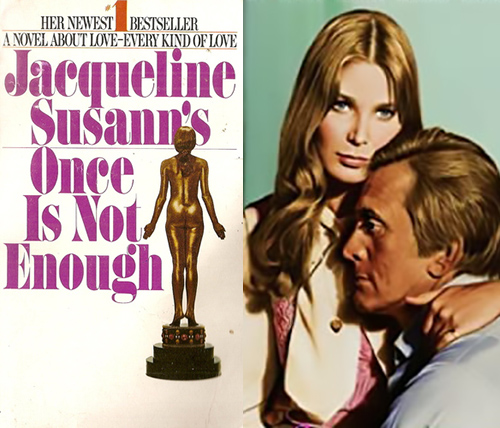
Once Is Not Enough
Once Is Not Enough by Jacqueline Susann – A girl’s best friend is her father

A friend was reminiscing on Facebook recently about Jacqueline Susann novels. I remembered seeing two of the so-bad-they’re-good movies on cable years ago, but had I ever read the novels? Well, thanks to Kindle I can. I read her three most famous novels in reverse chronological order, starting with Once Is Not Enough. I vaguely remembered the movie starring Deborah Raffin as the heroine January (!) She was a young woman with daddy issues who has a Freudian affair with an older man, played by David Janssen – with zero chemistry and sex appeal. Maybe he read the book and didn’t like the author’s emasculating take on his character. Susann piles on the drama, with January overcoming a terrible motorcycle accident that takes her years to recover from, drug addiction, and even virginity. The most sympathetic and interesting character in the book is Karla, a lesbian (maybe actually bi) famous movie actress. Susann tells her story in flashbacks, from WW2 atrocities to fame and fortune in Hollywood. Karla is loosely based on Greta Garbo. Part of the charm and fun of Susann’s books are her thinly disguised characters based on larger-than-life celebrities. Once Is Not Enough ends in a strange and perplexing way that I wasn’t prepared for – the movie completely skipped Susann’s crazy plot turns and stayed with the January as triumphant city gal narrative.

From Electra complex to Narcissus. My next read was The Love Machine. Here Susann tries to tell the story (sort of) from a man’s point of view, although a few of his main squeezes get to chime in with chapters of their own. The Love Machine is a mess. The hero, Robin Stone, is a total jerk. Every woman he meets and even every man is overly impressed by him. But the dude has absolutely no personality and is rude and downright mean to all of the above. If there weren’t the chapters featuring the ladies I would have quit on this one. Another implausible and unearned ending here, too. But it was a fast read and I did enjoy the Mad Men-esque depiction of the sixties world of television in Manhattan.

Valley of the Dolls
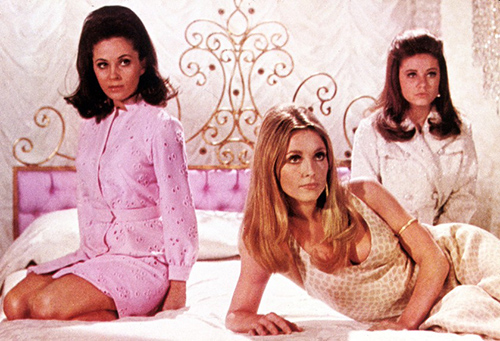
Valley of the Dolls – L-R: Anne, Jennifer and Neely

I saved the most well-known book for last, Valley of the Dolls. The movie with Patty Duke, Sharon Tate and Barbara Parkins is so indelible that it is hard to imagine Susann’s trio as anyone else while reading the book. As much as it was a fast and fun read, it really wasn’t as good as Once Is Not Enough. Susann puts Neely, Jennifer and Anne though all the racy topics of the day – plastic surgery, lesbianism, terminal disease, drug addiction. Again, the male objects of their affection are pretty boring or just unpleasant dudes, but Susann’s heroines are constantly obsessing about getting, keeping, losing their men. In fact, after plowing through these three books I was struck by the schizophrenic nature of Susann’s characters. On the one hand she writes openly about subjects that had to be extremely taboo for their day – homosexuality, drugs, women with careers. She even has a trans character in The Love Machine. But on the other hand Susann seems pretty conservative. Her heroines all pine for their men, putting up with tons of bad behavior. They stay in bad relationships just because the guy is rich or so they can dine at “21” every night. Without a man in their lives their careers go downhill. What started out as escapist fun, reading Susann’s bestsellers, ended as a sad peek into lives that were only glamorous on the surface. The girls ended up being as boring and empty as their men.

Review on Cannonball Read 13

little grey cell comfort food

When I can’t think of anything else to read, or just want something comforting and familiar, there is always Agatha Christie. And although I have read (I think) most of her books by now, I am still drawn most frequently to the ones featuring the inimitable Belgian sleuth Hercule Poirot. He of the meticulous ways and fantastic mustaches. With his obsession with detail and as Ben Franklin says, “a place for everything, everything in its place,” he has to be a Virgo, like me. And probably a little bit OCD.

“There was only one thing about his own appearance which really pleased Hercule Poirot, and that was the profusion of his moustaches, and the way they responded to grooming and treatment and trimming. They were magnificent. He knew of nobody else who had any moustache half as good.” ― Agatha Christie, Hallowe’en Party

I downloaded some Poirot-centric titles on Kindle and was not disappointed. The first, Hercule Poirot and the Greenshore Folly, is a shorter, novella-length version of what became her novel Dead Man’s Folly. The plot is similar to the novel, but there are a few changes and twists to the story. Christie was well-known for reusing plots and motifs and then changing around settings and even murderers for a completely different result. It is fun to read Christie’s description of the main house where the murder takes place, as she based it on her own house in Devon.

Hallowe'en Party
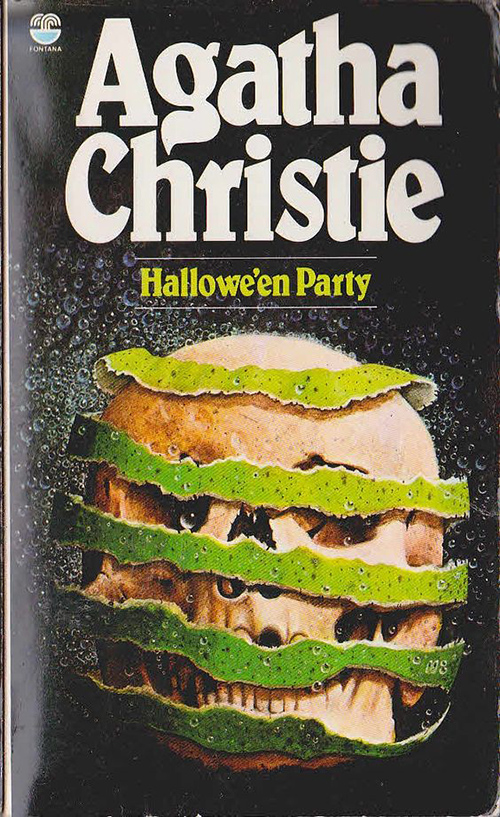
Hallowe’en Party by Agatha Christie

The next Christie I read is a longtime favorite, Hallowe’en Party. This is a particularly diabolical mystery, as the victim and even some of the suspects are children. Agatha Christie never shied away from the concept of evil, or its being able to take root at an early age. Poirot has to tread lightly as he tries to solve a brutal drowning – in a tub full of apples – as he questions a seemingly nice community of nice people. The ultimate solution has to feature one of her most interesting motives, too.

The next Christie was a new collection of short stories, featuring Poirot and Christie’s other detectives: Miss Marple, Tommy and Tuppence, Parker Pyne, etc. Along with a reminiscence about one of her childhood Christmas holidays, the featured stories include: “Christmas at Abney Hall,” “Three Blind Mice,” “The Chocolate Box,” “A Christmas Tragedy,” “The Coming of Mr. Quin,” “The Clergyman’s Daughter/The Rose House,” “The Plymouth Express,” “Problem at Pollensa Bay,” “Sanctuary,” “The Mystery of Hunters Lodge,” “The World’s End,” “The Manhood of Edward Robinson,” and “Christmas Adventure.” Christie fans will recognize that “Three Blind Mice” is the novella version of her long-running play “The Mousetrap.” These are all good stories and the winter’s theme makes them feel especially cozy.

Poirot and Me
Poirot and Me, by David Suchet

Not quite ready to quit Christie, but not in the mood for a re-read, I stumbled across Poirot and Me, by David Suchet. This is a charming book by the actor most well-known as the definitive Poirot (sorry Kenneth Branagh). Suchet outlines his entire acting career in this memoir, which includes a lot of award-winning theater and films and television. But a great bulk of his career and life has been spent playing Christie’s most famous detective. He is proud to share that journey and how Poirot has affected his career and life. He may have initially taken the role thinking it would be a short-term thing, as many British series are, but he grew to love the character and become a champion for filming every Christie novel and short story featuring Poirot. This was a monumental project, completed over the course of many years and different production companies. The decision to keep the time frame in the 1930s gave the series an impeccable feel and design. But he was finally able to realize his dream and the Agatha Christie’s Poirot series is one of television’s best classic mystery series.

And this concludes my adventures with Poirot. Until the next re-read.

Reviews on Cannonball Read 13

some great, some not so, some not even suspense

 A Century of Great Suspense Stories

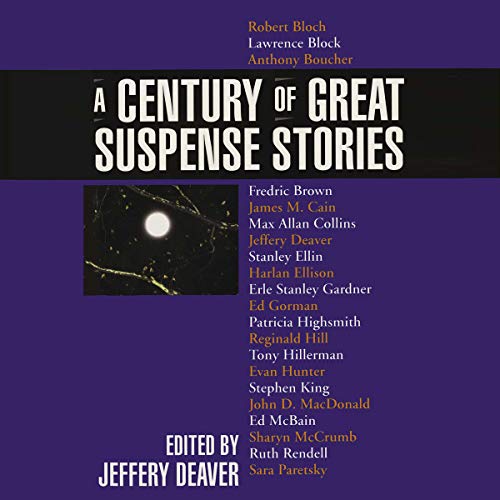
I got this one to listen to on drives more than thirty minutes. You can basically hear one short story each way. It is a mixed bag, both in quality and presentation. It should be noted that the audible version of this book only includes seventeen stories, the first half of the book. The rest of the book’s nineteen tales are missing. Maybe the second half is also available as a book on tape. Maybe I’ll check.

The stories have been gathered by author Jeffrey Deaver (The Bone Collector). Many of the stories were previously published in Alfred Hitchcock’s Mystery Magazine. A lot of the stories have that twist ending reminiscent of The Twilight Zone, Alfred Hitchcock Presents and similar anthology shows. Deaver includes one of his own short stories, “The Weekender,” which also happens to be one of the best ones. Other highlights include “Missing: Page Thirteen” by Anna Katharine Green and “The Gentleman in the Lake,” by Robert Barnard. The absolute highlight of the collection is “Quitters Inc.” by Stephen King, which rounds out the collection.

A Century of Great Suspense Stories
A Century of Great Suspense Stories, edited by Jeffrey Deaver (warning, a lot of the authors listed here aren’t in this truncated collection)

What is especially difficult is the inability to search through the collection as you’re listening to find a story or skip a story. You can fast forward, but it is a very clunky presentation. The readers of each story were mostly good. Some of the more detective noir-ish readings were a bit much, maybe, but that could have been the stories, too. I found the classic American detective stories to be the most dated. The Erle Stanley Gardner was especially tough going.

It took a lot of hunting online, as there is no complete list of authors and stories with the book on tape, but here is the complete list of the contents:

“Gentleman in the Lake” Robert Barnard
“Life in Our Time” Robert Bloch
“Batman’s Helpers” Lawrence Block
“Girl Who Married a Monster” Anthony Boucher
“Wench is Dead” Fredric Brown
“Cigarette Girl” James M. Cain
“Matter of Principal” Max Allan Collins
“The Weekender” Jeffery Deaver
“Reasons Unknown” Stanley Ellin
“Killing Bernstein” Harlan Ellison
“Leg Man” Erle Stanley Gardner
“One of Those Days, One of Those Nights” Ed Gorman
“Missing: Page Thirteen” Anna Katharine Green
“Voir Dire” Jeremaih Healy
“Chee’s Witch” Tony Hillerman
“Interpol: The Case of the Modern Medusa” Edward D. Hoch
“Quitters, Inc.” Stephen King

Review on Cannonball Read 13