Showing posts with label 1940s. Show all posts

Monday, September 23, 2019

i loved laura, except for . . .

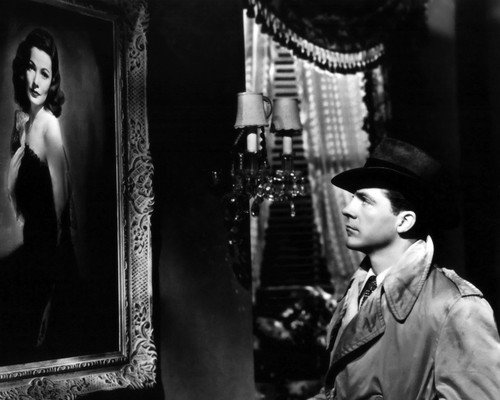
Another book from my personal challenge of reading the source material for favorite classic movies: Laura, by Vera Caspary. This book is a detective noir, as hard-boiled and cynical as any of the genre, but written by a woman. It was originally published, a la Dickens, as a serial, "Ring Twice for Laura," in Colliers Magazine in 1942/43. The  classic film noir, starring Gene Tierney as Laura and Dana Andrews as a detective who finds himself falling in love with a dead woman as he investigates her murder, came out a year later—so Hollywood was right on this as the perfect tale for a hit movie.

Detective Mark MacPherson (Dana Andrews) contemplates a portrait of Laura Hunt (Gene Tierney)

The story is told from the viewpoint of several main characters, including Detective Mark MacPherson, esthete and friend of the deceased Waldo Lydecker, and Laura's unfaithful fiancĂ© Shelby Carpenter. It is up to the reader to piece together the stories about this fascinating woman and race along with Mark to solve the crime. The murder is actually a quite brutal one—ostensibly Laura went to answer her doorbell and was killed with a shotgun blast to the face. The method of the crime is in stark contrast to the glamorous New York City apartments and surroundings of Laura's life as an advertising executive, an impressive job for a young woman in 1942. We learn quite a bit about Mark, Waldo, and Shelby, too. Laura, a romantic thriller, is a great book with great characters, and I loved it - with one major caveat. Spoiler alert—read no further if you haven't seen the movie . . .
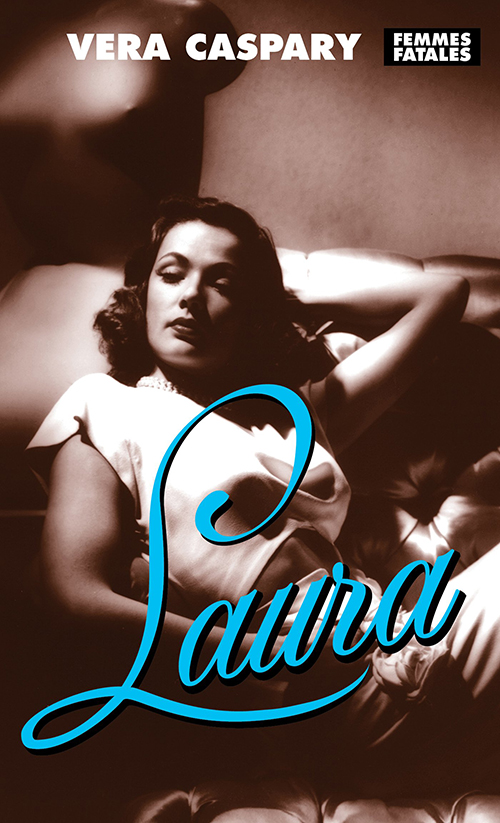

Laura, by Vera Caspary

SPOILER:

It is discovered more than halfway through the book that the body of the murdered woman in Laura's apartment was not Laura, so the reader finally gets to meet her and see if other's descriptions of her square with the genuine article. And at first, she does, beautifully. She is honest, earnest and even shows some interest in Mark, so things seem to be going quite smoothly to a romantic finish—as long as Laura isn't the murderer. But the real problem for me is that Caspary has Laura casually drop the "N" word in conversation and it completely soured my interest in her character. I understand that such casual racism was probably quite common in the 1940s, but . . . yuk.

I did a little research on the author, who led a quite interesting life, but found no clues as to her thoughts about race. She dabbled in Socialism and Communism, even going so far as visiting Russia to see if the country lived up to her expectations. She lived openly with her married British lover for years before finally marrying in 1948. She led an unusual life, like her protagonist, for a woman of the time.

Apparently the publisher of this reprint series, actually subtitled Femmes Fatales, and published by The Feminist Press at CUNY, didn't see any reason to add an editor's note about Laura's outburst. It's a single, strange event that happens and never occurs again in the text, by her or any other character.
Sigh. It's best to be honest about our past to go forward into the future. This is not the only instance of racist language that I have encountered in my recent book-to-film adventures. So far the 40s and 50s American popular literature is proving quite problematic.

This post also appears on Cannonball Read 11

Sunday, December 23, 2018

favorite movie #118 - holiday edition: christmas in connecticut

Favorite movies that have had an impact on me - #118 - Christmas in Connecticut (1945) - Barbara Stanwyck makes this cornball romance about a single food writer who falls in love with one of her biggest fans a joy to watch. Nobody could mix corny and sassy like Stanwyck. Along for the ride are Dennis Morgan, Sydney Greenstreet, S.Z. Sakall, and Una O'Connor.


Friday, December 21, 2018

favorite movie #116 - holiday edition: meet me in st. louis

Favorite movies that have had an impact on me - #116 - Meet Me in St. Louis (1944) - The film covers a year in the lives of the Smith family, in turn-of-the-century St. Louis, and their contemplating moving to New York before the World's Fair coms to town in 1904. Judy Garland performs many great musical numbers in the film, including "The Trolley Song" and "The Boy Next Door", but the most touching and memorable sequence is her singing to her younger sister Tootie (Margaret O'Brien), "Have Yourself A Merry Little Christmas", probably my favorite version of the song, which has been covered by everyone from Frank Sinatra to John Legend.


Saturday, December 15, 2018

favorite movie #110 - holiday edition: miracle on 34th street

Favorite movies that have had an impact on me - #110 - Miracle on 34th Street (1947) - Maureen O'Hara os a divorced single career mom (a pretty unusual person to be portrayed in Hollywood films of the 40s), who is trying to stay strong for her little girl (Natalie Wood). Bout sometimes strong can seem tough, or even brittle. Along comes a man (Edmund Gwenn) who may or may not be Kris Kringle, but can tell that she and her daughter could use some magic in their lives. The movie is still magic and it and its Macy's New York City setting is beautiful to behold in black and white, especially in HD on a big TV screen.


Wednesday, September 26, 2018

favorite movie #55 and art in film: The big clock/no way out

Favorite movies that have had an impact on me - #55 - The Big Clock (1948)/No Way Out (1987) - The Big Clock is an interesting blend of comedy and film noir. The comedy comes mainly from hero Ray Milland, who can never help but be charming, and Elsa Lanchester, who puts in a wonderful comic turn as an eccentric artist. Milland plays George Stroud, a New York editor who works for megalomaniac publisher Earl Janoth (Charles Laughton). Stroud befriends Pauline York (Rita Johnson), Janoth's mistress, who is fed up with his controlling ways. After a madcap night of drinking and complaining about the boss, Stroud leaves York's apartment as Janoth arrives - the jealous Janoth only sees a man's silhouette, but he is still enraged, and in a fit of passion kills York. The rest of the film has Janoth and his right-hand man Hagen (George Macready) tasking Stroud with finding this mystery man so that they can pin the crime on him. As Stroud leads the investigation he has to stay one step ahead at every moment, fearful that he will be recognized as the man in question. Directed by John Farrow, the film is beautifully shot in black and white, with modern furniture and settings, especially the Janoth Publications enormous clock that ticks away,  possibly ticking away Stroud's future and freedom. Art by Lanchester's character is used cleverly both as clues to the crime and for comic effect.

Art by Boris Grisson

Hagen (George Macready) tries to cover up for his boss


Stroud hides out inside the clock

The Big Clock was remade in 1987 as No Way Out. The setting was changed to Washington, D.C., and the emphasis was less on murder mystery and more as a political thriller/romance. Kevin Costner stars as Navy Lieutenant Commander Tom Farrell, who is introduced to the Secretary of Defense, David Brice (Gene Hackman) by a college friend (Will Patton) at an inaugural ball. At the same event he meets Susan Atwell (Sean Young). The two begin an intense, passionate affair, but Farrell soon learns that Susan is also the mistress of a powerful man ... guess who? After seeing a shadowy male figure leave Susan's home, a jealous Brice accidentally kills her, and as in The Big Clock, Farrell is put in charge of the investigation to find the "real" killer. The rest of the film takes place in the claustrophobic halls and offices of the Pentagon, as Farrell tries to avoid capture while proving that Brice is the true culprit. No Way Out is not as stylish as The Big Clock, but it is fast-paced and exciting, and Costner and Young are very sexy in their scenes together. The political setting also provides the filmmakers with some additional twists and turns featuring a Russian spy subplot.


Both films are great to watch and favorites when I'm in the mood for a paranoid thriller.

Tuesday, September 25, 2018

favorite movie #54 and art in film: cat people

Favorite movies that have had an impact on me - #53 - Cat People (1942) - Jacques Tourneur directed and Val Lewton produced this horror classic. Simone Simon stars as Irena Dubrovna, a young artist who meets and marries architect Oliver Reed (Kent Smith). Irena is deeply troubled about her past — she believes her people come from a long line of cat women — who prey on their lovers. Oliver can only see that she is beautiful, and he wants to be with her. His co-worker Alice, who is not-so-secretly in love with him, waits patiently for Oliver to give up on his mysterious young wife. Psychiatrist Dr. Judd doesn't believe that Irena is a cat, but an extremely beautiful woman that he desires. What makes this love quadrangle stand out is Tourneur's superbly subtle direction. The horror is implied, but never overtly seen, in a series of wonderful, moodily-shot set pieces — Alice crossing the park and swimming in a pool in the dark, a catlike woman greeting Irena as "moya sestra" on her wedding day, Irena causing havoc in a pet store. Simon turns in a emotional performance as the tormented heroine. Irena being an artist adds to her outsider status. She sketches the big cats at the zoo obsessively, is haunted by a sculpture portraying a myth from the old country, and feels alienated and isolated when Oliver and Alice thoughtlessly ignore her during a trip to a museum. A classic film not to be missed.


Oliver (Kent Smith) meets Irena at the zoo
Irena shows a sketch to Alice (Jane Randolph)
Elizabeth Russell at the "cat woman" in the restaurant

Irena pauses under Goya's painting of& Manuel Osorio Manrique de Zuñiga (1784–1792), in the collection of the Metropolitan Museum of Art


Dr. Judd (Tom Conway) "counsels" Irena 


Related:

favorite movie #9: the seventh victim
these are a few of my favorite things . . .
cinema village

Friday, September 21, 2018

favorite movie #50: dark passage

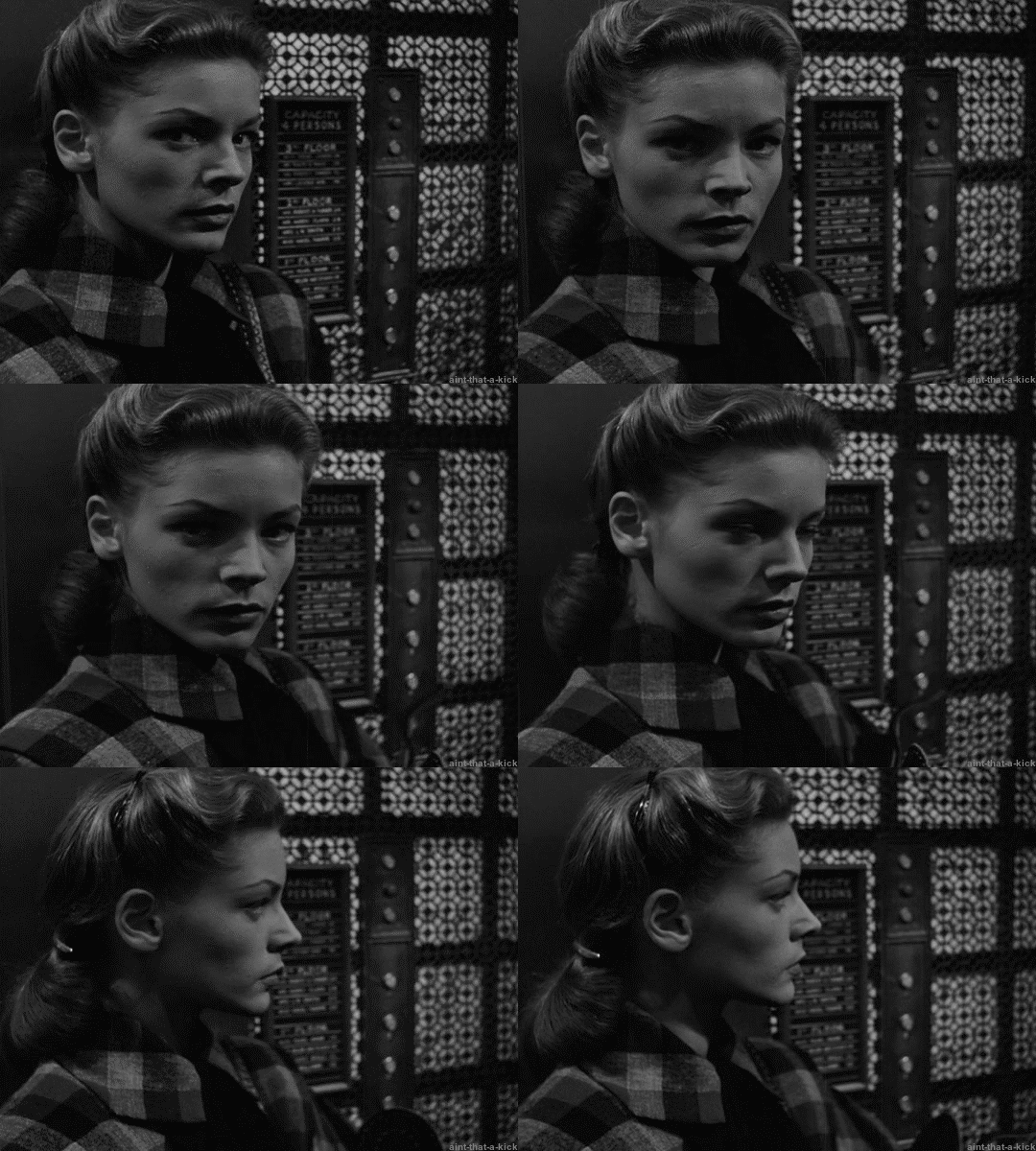
Favorite movies that have had an impact on me - #50 - Dark Passage (1947) - Bogart and Bacall in their third film together. It's a bit of a gimmick film — the first half is filmed through Bogart's eyes — but because of Bogie's familiar voice it works. Bacall holds her own as she carries the early part of the film, while the camera keeps her in close-up as she talks to Bogart. Dark Passage is a brightly-lit film noir, set in San Francisco. Bogart's Vincent Parry has been wrongly accused of murdering his wife. The story begins as he escapes from San Quentin and hitches a ride into the city. He is immediately recognized, but saved from having to go back to prison by Good Samaritan Irene Jansen (Bacall), who has always believed in his innocence. She is an artist, so is presented as an 'unconventional' girl. There are some other people sympathetic to his cause, like a cabby (Tom D'Andrea), his friend George (Rory Mallinson), and a doctor of plastic surgery (Houseley Stevenson), who gives Vincent a new face, one with which movie fans are quite familiar. Agnes Moorehead shows up to keep things interesting as woman scorned Madge, in leopard print and looking to cause trouble.


A couple weeks ago I picked up a dame in my cab, she musta had her face lifted by one of them quacks. She got caught in the rain, and the whole thing dropped down to here. She shoulda left it unlifted.


Same eyes. Same nose. Same hair. Everthing else seems to be in a different place. I sure look older. That's all right, I'm not. If it's all right with me, it ought to be all right with you.
AI thought I had a good life here... but your going away doesn't make it seem good anymore. I've sort of joined your team and... and I don't look forward to being without you.