Showing posts with label painting. Show all posts

Monday, September 24, 2018

art in film - bell, book, and candle

I love to see paintings and other art objects in movies. Depictions of artists are always fun, too. Here are some images from the Greenwich Village setting depicted in Bell, Book, and Candle (1958). Kim Novak's downtown witch, Gillian Holroyd, owns a gallery that sells African Art. There is also plenty of modern art to be found on the walls of her apartment, book publisher Shep (Jimmy Stewart)'s office, and his fiancee Merle (Janice Rule)'s apartment.

A cubist approach to Pyewacket
All of the art objects were supplied by the Carlebach Gallery, New York
"Pyewacket, stop scratching the sculpture!"

Hey, isn't that the Brady Bunch horse sculpture behind Ernie Kovacs?
Yep!
Merle is definitely influenced by Miro


Gillian has a very abstract Xmas tree


Monday, March 02, 2015

the story of women and art

Art historian and host Amanda Vickery (professor of early modern history at Queen Mary University of London) poses a question at the start of her series The Story of Women and Art: Women as muses and artists models line countless gallery and museum walls, in sculptures and paintings made by male "old masters" - but where are all of the female artists?

... Viewers are treated to works created over the last five centuries, of some wonderfully talented women, including sculptors Properzia de Rossi and Anne Seymour Damer; and painters Sofonisba Anguissola, Lavinia Fontana, Artemisia Gentileschi, Clara Peeters, Judith Leyster, Maria Sibylla Merian, Angelica Kauffmann, Élisabeth Vigée-Lebrun, Berthe Morisot, and Georgia O'Keeffe.

... Vickery takes viewers along on her journey, for the most part on site, but also, inexplicably, at times features details from stress's works on her iPad. Not very helpful really - show us the real art. That criticism aside, she has incredible enthusiasm for her subjects and helps give insights into there lives and art. A common thread through many of the female artists lives, is, unsurprisingly, how they were held back both personally and professionally, by trying to work as artists in a male-dominated world. Women being able to learn anatomy, work from bud models, was a barrier to their progress. Not all male artists were threatened by these women, however. She shares a lovely story of how painter Anthony van Dyck, a huge fan of Sofonisba Anguissola, visited her and even did a sketch of her.

A delightful painting of her sisters, "The Chess Game," by Sofonisba Anguissola, 1555.

You can read the complete review on Cinema Sentries ...

Monday, February 09, 2015

tim's vermeer

Tim Jenison is a Renaissance man. An inventor, and engineer, he has a questing, questioning mind. Tim's Vermeer, a documentary film by Penn and Teller, follows Tim in his quest to understand how Vermeer made his paintings, and to prove his personal theory that he used optical devices to get his painterly effects. Teller directed the film and wrote it with Penn Jillette, who also produced and serves as the narrator.

"The Music Lesson, " Johannes Vermeer, 1662–1665, Oil on canvas, Royal Collection, St. James's Palace, London

Tim is not the first to write about or question Johannes Vermeer's techniques. Painter David Hockney famously wrote about it in his book Secret Knowledge, which started Tim on his quest. Teller takes Tim to England to meet the artist, and others as well, including architecture professor Philip Steadman, author of the book Vermeer's Camera, which suggests the camera obscura was behind Vermeer's precise brushwork.

It is fascinating to watch Tim try to rebuild a famous work of art from the inside out. He tries to recreate Vermeer's work by grinding authentic pigments, using real, not modern, electric, or artificial light, even building a room to recreate the "set" of Vermeer's "The Music Lesson." It is also gratifying to see him be awed by the painting in real life, after taking a trip to see it first-hand.

Tim at work in his studio
Art inspires, and Tim is inspired to return home and try to recreate the painting using all that he has learned. Tim is not trained as a painter, but he is eager to learn. During the process he starts to notice little details and anomalies which continue to reveal the skill of the original artist. Some of the same anomalies occur in his process, which leads him to believe he is on the right track with his technique.

When I was in art school, the first year in our Color and Design class we were tasked to recreate an Old master's famous painting. I chose Vermeer's "Woman with Pearl Necklace." It is probably the best class assignment I ever had. I learned so much, like Tim, trying to just recreate the color and light of that wonderful work of art. As Hockney states in Tim's Vermeer, a lot of the formulas for paintings of the past have been lost. It is a worthwhile endeavor to try to recapture them.

Woman with a Pearl Necklace, Johannes Vermeer, 1664, oil on canvas, Staatliche Museen, Berlin

Tuesday, March 25, 2014

a mirror-lined nursery

While most internet wags are spoofing or critiquing the upcoming April cover of Vogue magazine, featuring Kanye West and Kim Kardashian, another photo, released from the shoot, taken by Annie Leibovitz, has caught my eye. It is a pseudo-candid taken in their baby girl North's nursery, with both mama and papa unable to pry themselves away from digital camera screens.


There is so much to ponder in this photo.

Wall-to-wall white and mirrors for a baby's room?

One tweet that has gone viral posed the question — why isn't Kanye reflected in any of the many floor-to-ceiling mirrors? Is he a vampire? It's impossible to tell from all of the artificial lighting what time of day it really is in the photo.

The baby is cute.

This photo and its screens within screens make me think of these paintings by Diego Velázquez:

Diego Velázquez,  "Rokeby Venus [Venus at her Mirror]," c. 1647–51, National Gallery, London.
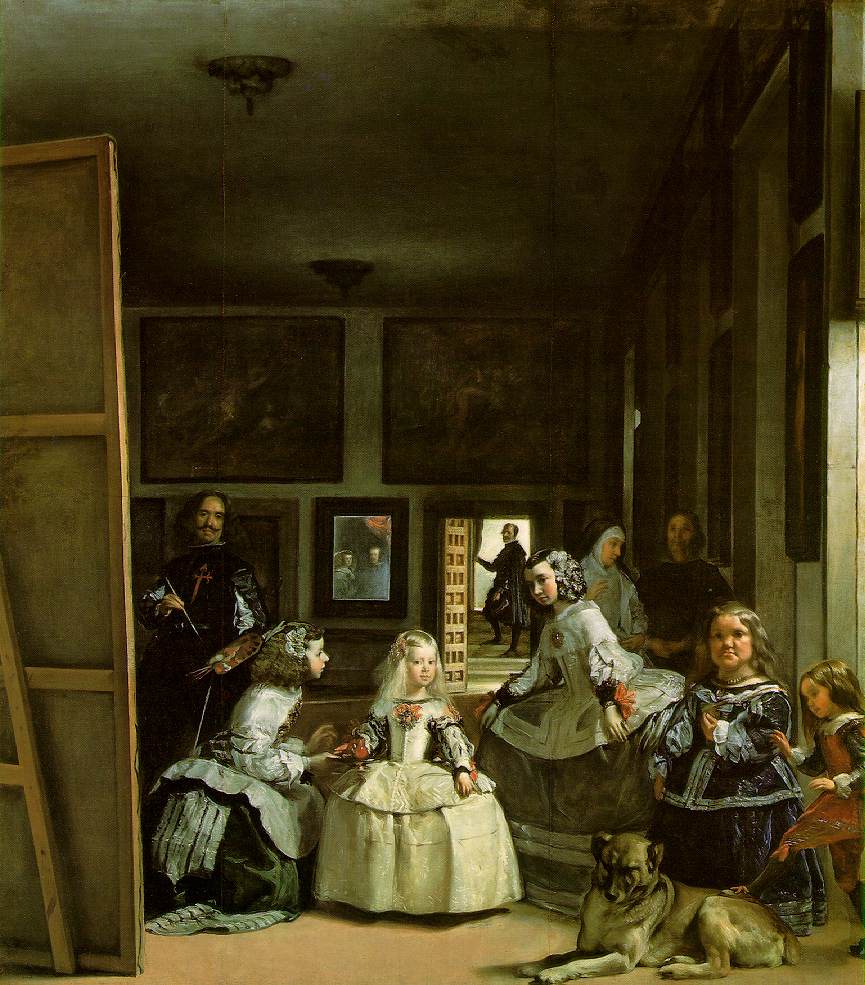
Diego Velázquez, "Las Meninas [The Maids of Honour]," 1656, Museo del Prado, Madrid.

Vogue (and America) celebrates celebrity and wealth, and this picture is just an illustration, maybe the ultimate representation, of that. What bothers me the most, however, is the complete absence of joy in the photo. Velázquez, in "Las Meninas," may look a little burnt-out, but there is life and action in his depiction of the Spanish royal family. His "Rokeby Venus" may be vain, but Cupid loves her, and she seems comfortable and happy. Why are Kim and Kanye, in their Givenchy fox stole and Balmain tee, so somber and serious? Life at the top seems closed off and not too much fun, with too many screens and other reflective surfaces.

Monday, December 03, 2012

operation anti-dementia

I got a brainstorm this week. My mother, who has dementia, is an artist and we have a closet full of her work that we never get to see. Our house is full of many beautiful old paintings that have been acquired over the years by various ancestors. It gives the place a rather formal look. This weekend I suggested to her that we take down and store some of the old landscapes and replace them on the walls with some of her work. I thought it might be nice for her to have some very visual reminders of her talents — and it would be nice for my daughter and me to have those reminders, too.

My mom liked the idea and had a blast going through the paintings with me. I think we were both pleasantly surprised at how many she remembered doing. We even managed to put some unfinished ones aside, so we were able to do some spring cleaning, too. I'll be posting some of her colorful work over the rest of the month, but here is one that I really liked that is now hanging in her bedroom. It's very Florida, quirky, even silly. Like a lot of her work she mixes painting and collage. I really like it.

photo

photo

photo

The experience had an impact on her, because the next day she was eager to look through a portfolio we have of some of her drawings. I think this may be a good thing to do every once in a while. Everyone has accomplishments that they want to revisit and share.
Enhanced by Zemanta

Friday, January 20, 2012

stephen king's duma key

I've been reading a bit of Stephen King lately and picked up Duma Key because it was about an artist (I was a painting major in college) who relocates to Florida (I live in Florida) with some supernaturally creepy results. Duma Key started off slow, picked up a bit, and then started to slow down again. It's clear that King was more interested in the trials of the artist, which are the best part, the central section, of the book. When the bodies started to pile up in the last third of the novel it became a less compelling read. I began to wish that he had an editor who wasn't afraid to wield a red pencil — and get bloody with it. I didn't want to abandon the book. I wanted to finish it and see how things came out, but I have to admit that it got tough at times to hang in there.
"How to Draw a Picture. Start with a blank surface. It doesn't have to be paper or canvas, but I feel it should be white. We call it white because we need a word, but its true name is nothing. Black is the absence of light, but white is the absence of memory, the color of can't remember."
Cover art by Mark Stutzman
Duma Key evokes The Flying Dutchman and King's own The Shining, as it follows protagonist Edgar Freemantle as he tries to recover from a devastating on-the-job accident — the loss of his right arm and a head injury — and nurture his artistic talent by relocating to a remote location, Duma Key, off the west coast of Florida, near Sarasota.

Stephen King's writing always evokes a wonderful sense of place. He can write about a location, a house, an atmosphere, so well that no matter how creepy it may turn out to be, you still want to be there with the characters. This is not touristy Florida, but an old-world, isolated, overgrown with vegetation, Florida. Edgar's house, "Big Pink," in Duma Key may be the port of call for all sorts of not-so-nice psychic energy, but I still got into its relaxed, beachy vibe.

The more Edgar paints, the more he gets in touch with the supernatural forces that seem to surround Duma Key. He discovers that his inspiration to paint is tied directly to his missing right arm when he experiences a phantom limb sensation whenever he is working. His paintings begin to tell him things about people, and  by painting specific objects and scenes he finds he can affect people's lives. His paintings pack such power that just owning them may be dangerous.

King does a wonderful job describing Edgar's work process and his body of work. In fact he describes Edgar's surrealist Dali-influenced paintings and drawings so well that the reader can see the Edgar's step-by-step progress and visualize the finished artwork. We even get wrapped up in his first art show and crowning as the next great thing to hit the Sarasota art scene.

Edgar befriends former lawyer Jerome Wireman, the caretaker of an elderly woman suffering from Alzheimer's disease, Elizabeth Eastlake, who also happens to own most of the real estate on the island. The three are all linked inextricably to Duma Key, which has a special attraction and affection for damaged goods. They are three people who have escaped death by receiving some sort of head injury, and have been granted psychic powers.
“I felt it and knew: the three of us were here because something wanted us here.”
Edgar's injuries are never far from the surface of the story or King's mind. It is hard not to relate Edgar's struggles to King's own long road to recovery after being horribly injured when he was hit by a van in 1999. His exploration of mind and memory also resonates. As the daughter of someone with dementia (who also was a painter who dealt with primarily Florida-themed subject matter), I found it difficult to read about Elizabeth's failing health as she slipped further and further into her disease. King has either done his research here, or been directly affected by someone he loves with memory issues.

As much good as there is in the novel, it also had some disappointments. There is so much foreshadowing of both past and future spooky events, that the secrets as ultimately revealed, and the monster, feel rushed and disappointing. When Edgar, like in a classic Twilight Zone episode, finds whatever he paints he can make happen, I immediately began to wonder why he didn't start to manipulate his talent more. He is able to help one character who is near and dear to him by painting their portrait, so why doesn't he try to help another who is very much in need of help? Why does he seem in control of his gift at some times, and at others his talent is just a tool, a conduit for some evil force?

I can't say that I loved the ending. It may have worked, fit the road that the book was relentlessly following, but I still wasn't satisfied with what happened to many of the characters. But despite its problems, there is a lot to enjoy in Duma Key, especially the description of Edgar's process and the obsession of the artist. Edgar's paintings are so vividly described that it is a shame to realize that we can only attend his grand art opening and visit his painting studio in our minds.

Enhanced by Zemanta

Sunday, February 06, 2011

monkey with ball and chain

We went to the Norton Gallery of Art today and saw a load of interesting stuff, but what really still stands out in my mind are two paintings from the European gallery, both featuring "fettered monkeys."

Monkey with ball and chain

According to the Courtauld, "Fettered monkeys, like this one, are traditionally used to symbolize man entrapped by earthly and sensual desires." and that "The monkey shown here ... would have been an object of curiosity and wonder in his own right. He is thus as "collectable" as the ... portrait ... that stands nearby."

Monkey with ball and chain
Enhanced by Zemanta

Monday, October 04, 2010

high definition venus

I'd be remiss if I didn't share this wonderful website, Halta Definizione, that lets a person get up close and personal with some of the greatest works of art, including my all-time favorite painting and permanent avatar, Botticelli's Venus, or Venus on a half shell, as I like to think of her.

Venus botticelli detail

I first tripped across the site via Flavorpill (via Boing Boing), so I'm sure it's making the rounds, but it is worth another finger-pointing. I've spent hours at the Uffizi, parked in front of this painting and I have never seen it quite like this. It's almost indecent. Sandro Botticelli certainly never got quite this close, but computers can allow us to view not just the brushstrokes, but what the brushstrokes contain. You can practically see the pigment floating in the medium.

I'm not sure ultimately, if this sort of deep close-up is good or bad for the art experience, but I have to admit that it is fascinating to get lost in the details. For the study of art and art-making, and for future Old Master restorations this will undoubtedly prove to be an invaluable tool.
Enhanced by Zemanta

Thursday, March 18, 2010

stripes...

IMG_3383


I am part of a flickr photo club, One After 909. Every month or so we have themed assignments. A few months back we were tasked to find stripes in our environment. I surprised myself with how much I enjoyed this challenge.


IMG_3405

When I was in college, one of my teachers was Sean Scully, whose abstract paintings frequently use stripes. It was impossible not to think of Scully's work a bit while doing this challenge, but I realized that his sculptural stripes constructed out of oil piant were actually quite different from the stripes that ended up attracting me. A stripe isn't a stripe isn't a stripe . . .


IMG_3464

Reblog this post [with Zemanta]

Thursday, March 04, 2010

speaking of art students . . .

Goofy as hell video, but the painting choices are good. Rock on art dudes . . .

Saturday, August 29, 2009

very fine arts

We spent a very museum day in this rainy town of mourning. Ted's funeral procession passed by our hotel on Tremont Street.

We cabbed our way through the wet streets, first to
the Isabella Stewart Gardner Museum, which was a little like the Frick or the Barnes Foundation—an incredible house, with the proviso that the collection always be displayed exactly as Mrs. Gardner originally laid it out. This made some works difficult to see, and included oddities like the empty frames where canvases that had been stolen were left hanging ion their original spots on the walls.

No photography was allowed unfortunately, so you will just have to take my word for it that the collection included the best Veronese ceiling painting that can be seen outside of Italy. What a treat.

We pushed onward to the Museum of Fine Arts, where we raced through treasures including Italian renaissance, Spanish masters Velasquez and Zurbarán, Impressionist gems by Degas, Monet and Manet, Greek, Roman and Egyptian art—and these are just the highlights. I had as much fun checking out these masterworks as I did playing with my iPhone camera special effects. A damp but good day.

Thursday, February 05, 2009

parrino kaleidoscope

I was thinking of Steven Parrino the other day.

I met Steven at Parsons, in the Fine Arts Department, where he was a few years ahead of me. He inspired a cartoon character for my animation class, where I did a short film, The Amazing Adventures of Bugman. When I told him about the character he wasn't sure whether to be flattered or insulted, but was OK with it and wanted to see the results.

He helped me get my first (paying) job (I worked for my dad's newspaper as a layout artist, typesetter, etc. when I was in high school), at Canal Jean Co., in New York.

One day Parrino, my friend Mary and I went out for our lunch break from Canal to the nearby Greek diner and ordered our usual cheeseburgers and fries. Parrino was telling a story and as he was talking, a large cockroach walked sideways on the wall beside him. Mary and I were struck dumb with horror, but he nonchalantly picked up the ketchup bottle, squashed the roach, and finished the story, without missing a beat. Mary and I were beyond impressed.

Once at a party Parrino and I danced to Elvis Costello's Mystery Dance. He was a wild man on the dance floor, but never took off his leather jacket, even though the party was crowded and it was hot. Sometimes I wondered if he slept in that jacket.

I had a dream once with Parrino in it, where he was constructing an elaborate sculptural piece that would shoot a knife blade across a room to cut someone's throat (I had just been reading Kafka and was probably under the influence.) In the dream the knife went in slow motion and I saw it heading towards him, but then the perspective shifted and I was looking down at blood flowing very slowly - down my neck, my chest. I woke up, gasping. The next day at Parsons I looked for Parrino everywhere, but he wasn't around. Finally after classes were over he showed up, wearing a white wind breaker. It was the only time I ever saw him in white. This vivid dream inspired a set of red paintings and an installation where Parrino, at my request, supplied the music. Of course he did it on his terms. I was very much into the Clash and had even contacted someone at Clash, Inc. (the band had an office in New York) to ask permission to use their music as background for my installation. Their representative said yes and even came to the show at Parsons on the day it was open. Of course what she heard when she arrived didn't sound much like the Clash - Steven had sampled the tape of songs I gave him and distorted them until they became a wall of noise.

I'm not sure when I last saw Parrino, but I recall a visit to his Brooklyn studio. Later we went out to a local diner and he had french fries, but ordered them with mayo, as he was still jazzed having just come back from Amsterdam.

I was really upset last year to hear that he had died in a motorcycle accident. And that was more than a year after the fact. I hadn't seen or heard about him in years, but he was someone from my life, my past. And he was an individual and a painter. And an inspiration.

Monday, July 14, 2008

mirrors, windows and walls


I like Spanish painting, but don't love it. Italian Renaissance painting, ancient Egyptian wall painting or a Degas drawing is more my style. But there is no denying that Velasquez's Las Meninas is probably one of the greatest works of art. Ever. And when I was in art school, Michel Foucault's analysis of this masterpiece in The Order of Things (Les Mots et les choses) really made me think about Painting with a capital P and whether I wanted to make paintings that work as mirrors, windows or walls (Van Dyck, Matisse or Marden, for example.) Foucault was hardly alone in trying to work out all the ins and outs of Las Meninas. There are plenty of theories. For me, the fact that I can still go back to Las Meninas after all these years and want to look longer, deeper, is what makes this painting, and art, so essential.