
With the exception of two letters, which he returned to their authors, during his lifetime Lee Strasberg never sold or gave away any of Marilyn’s personal effects — this totally contravened the instructions in Marilyn’s Will. It is clear that she did not intend for Lee Strasberg to keep her possessions, which included clothing, letters, documents, furniture, all her personal effects that she absolutely clearly stated, that she wanted distributed amongst her friends. — from Loving MarilynAlthough this action, or more accurately, inaction on Strasberg's part would have disappointed Marilyn, it is because of his neglect that so many of her personal items remained intact, and are able to be viewed as a whole. Anna Strasberg, who had never even met Marilyn, asked family friend Stanley Buchthal to help her determine what to do with the boxes' contents, and he soon enlisted the help of editor and essayist Bernard Comment. Together the pair sorted through the materials and created Fragments: Poems, Intimate Notes, Letters
 a glimpse into Marilyn's life and mind in book form.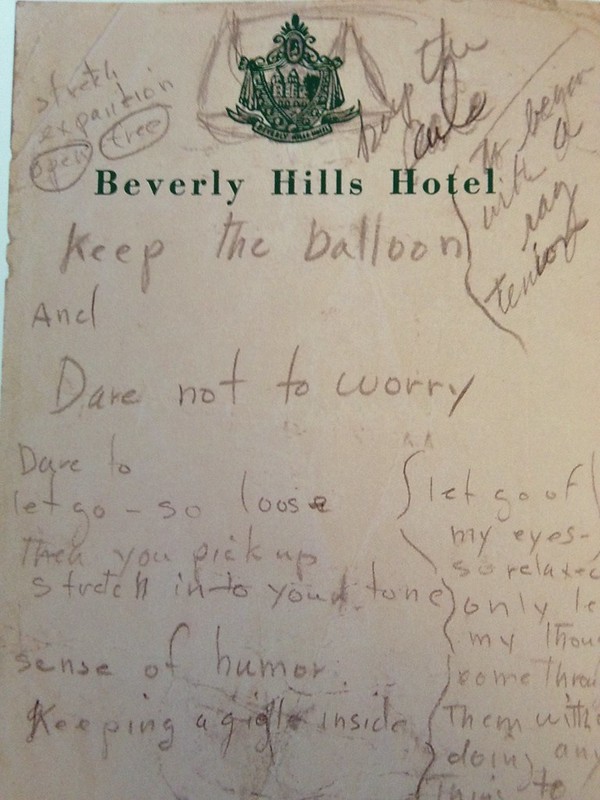
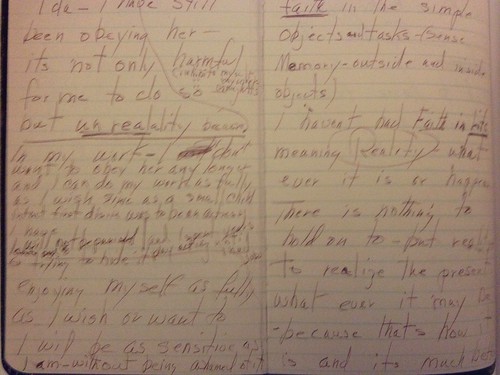
Buchtal and Comment have tried to present Marilyn's writings in as straightforward a manner as possible, keeping things chronological. A photograph of the original item, in Marilyn's handwriting,is presented on a left-hand page, while their transcription, sometimes joined by notes of explanation, appears opposite, on the right.
Black and white photographs of Marilyn, frequently reading, also accompany the text. Marilyn wrote poems, letters, and kept journals. While perusing Fragments it is unavoidable not to feel as if one is prying, sneaking a peek at her diary. We are. But it is undeniably fascinating. Her notebooks contain notes from classes she took on Italian art, as well as from acting class. Some of her note-taking seems to meld with her poetry and become stream-of-consciousness prose poetry, as does this fragment, c. 1955:
On the stage — I willSome of her notes are like puzzles or maps. Talk about fragments. She writes a paragraph in her notebook on the left hand page, and then continues, sometimes at an odd angle, on the opposite page, and then back again, drawing arrows, linking one thought to the next. She may not have been writing continuously, and went back to add ideas at a later time, or she may have purposely wanted to keep her writing difficult to understand and more private.
not be punished for it
or be whipped
or be threatened
or not be loved
or sent to hell to burn with bad people
or feeling that I am also bad
or be afraid of my genitals being
or ashamed
exposed known and seen —
so what
or ashamed of my sensitive feelings — they are reality
or colors or screaming or doing
nothing
and I do have feeling
very strongly sexed feeling
since a small child — think of all the
things I felt then
Especially revealing are two poems she wrote, on Parkside House stationery, during her stay in England when she was filming The Prince and the Showgirl. Marilyn, newlywed to playwright Arthur Miller, was already feeling insecure about the marriage:
I guess I have always been
deeply terrified to really be someone's wife
since I know from life
One cannot love another,
ever, really.
where his eyes rest with pleasure — I want to still be — but time has changedBack in the U.S., at their home in Roxbury, CT in 1958, her life with Miller hadn't improved much:
the hold of that glance.
Alas how will I cope when I am
even less youthful —
starting tomorrow I will take care of myself for that's all I really have ever had. Roxbury — … I think I hate it here because there is no love here anymore. I regret the effort I desperately made here. ... what I could endure helped both of us and in a material way which means so much more to him than me. ... When one wants to stay alone as my love (Arthur) indicates the other must stay apart.It becomes clear that many of these fragments are first drafts for notes or letters. One page in her notebook, scribbled in pencil, which she signs with multiple pet names, was confirmed by close friend Norman Rosten as a letter he received from her. Some of her notes seem to be character studies. There are also thoughtful observations about not just the character she would be playing, but other characters in a film with her, like this one about The Misfits:
I feel the camera has gotThere is a really interesting letter to Lee Strasberg, dated December 18, 1961, where Marilyn tells him she is forming an independent production company, possibly jointly with Marlon Brando, and that she would like him to be a part of it. Marilyn definitely had some big plans for her future, and was constantly trying to get more control over her career.
to look through Gay's [the character played by Clark Gable]
eyes whenever he is in a
scene and even when he
is not there still has to be a sense of
him
He is the center and the
rest move around him
but I guess Houston [sic - director John Huston] will
see to that
He is both subtle and overt in his meeting them
and in his cruelty and his tenderness
(when he reaches out of himself for her – R. [R stands for Roslyn, Marilyn's character in the film])
Strasberg wouldn't accept Marilyn as a student unless she agreed to undergo psychoanalysis. This led to a whole additional host of problems for the already insecure star, and doctors who may have done her more harm than good. After her break-up with Miller, her New York psychiatrist Marianne Kris had her committed to Payne Whitney's psychiatric ward — Marilyn thought she was only going to a hospital for a rest cure. This was one of the most traumatic events of Marilyn's life. She reached out to Kris and the Strasbergs, but only ex-husband Joe DiMaggio was able to secure her release. Once she moved to Los Angeles, her psychiatrist Dr. Ralph Greenson crossed all the boundaries of doctor/patient relations by having Marilyn socialize with his family. He may also have been instrumental in her taking more barbiturates than were necessary on the day of her death.

Fragments: Poems, Intimate Notes, Letters stresses Marilyn's love of books and her lifelong respect for writers. Writers also seem to have admired her greatly, as Buchtal and Comment take pains to point out.
In 1959 Karen Blixen asked to meet her, "... she radiates, at the same time, unbounded vitality and a kind of unbelievable innocence. I have met the same in a lion-cub ... I shall never forget the most overpowering feeling of unconquerable strength and sweetness which she conveyed."
Truman Capote, who met her in 1950, dedicated his short story "A Beautiful Child" to her.
Through husband Arthur Miller Marilyn befriended Carson McCullers, who wrote about her in "Illumination and Night Game."
Norman Mailer tried to cultivate her friendship, but she demurred. He wrote the controversial "Marilyn," which started the unsubstantiated-by-fact Kennedy/Marilyn rumor mill going on 1973.
Somerset Maugham approved of her proposed role as Sadie Thompson in a television production of "Rain," which was never produced.
She admired British poet Edith Sitwell and met with her both in Hollywood and London, while filming "The Prince and the Showgirl."
Marilyn met Carl Sandburg in 1959, and their appreciation of each other was very mutual. She loved his biography of Abraham Lincoln and he wrote, "She was not the usual movie idol. There was something democratic about her. She was the type who would join in and wash up the supper dishes even if you didn't ask her."Buchtal and Comment also include some selected book covers from her personal library, which included:
Mme. Bovary by Gustave Flaubert
The Secret Agent by Joseph Conrad
The Unnamable by Samuel Beckett
Sister Carrie by Theodore Dreiser
A Farewell to Arms and The Sun Also Rises by Ernest Hemingway
Tortilla Flat by John Steinbeck
On the Road by Jack Kerouac
The Fall by Albert Camus
Invisible Man by Ralph Ellison
Once There Was A War by John Steinbeck
Fragments: Poems, Intimate Notes, Letters is an interesting, even unexpected look into Marilyn's life, with the accent not on glamor, but on her thoughts and aspirations. Marilyn was always trying to learn new things and improve herself, and many of these fragments show her progress.


 , Susan Strasberg tries to tell what it was like to have Marilyn Monroe enter her life and the life of her family. Her father was Lee Strasberg, head of the Actors Studio, and guru to many of the film and stage actors of the 1950s, '60s and '70s (Marlon Brando, Geraldine Page, James Dean, Elia Kazan, Eva Marie Saint, Paul Newman, Jane Fonda, Al Pacino, Robert DeNiro, etc.) Her mother was former actress Paula Strasberg, who became Marilyn's personal coach and factotum. For a short spell their home was a haven to Marilyn, who had fled Los Angeles after her divorce from Joe DiMaggio. Marilyn was looking for a new life as an actress, and was scheming with photographer Milton Greene about starting her own film production company, which would free her from the dumb blonde roles that her studio Twentieth Century-Fox was determined to lock her into.


