Showing posts with label The Prince and the Showgirl. Show all posts

Friday, August 17, 2012

little bits of marilyn

In 1982, after his death, Actor's Studio Director Lee Strasberg's widow, his third wife Anna, found two boxes of poems and other writings by Marilyn Monroe. Monroe had named Strasberg the primary beneficiary in her will. Strasberg, however, had not followed Marilyn's final wishes:
With the exception of two letters, which he returned to their authors, during his lifetime Lee Strasberg never sold or gave away any of Marilyn’s personal effects — this totally contravened the instructions in Marilyn’s Will. It is clear that she did not intend for Lee Strasberg to keep her possessions, which included clothing, letters, documents, furniture, all her personal effects that she absolutely clearly stated, that she wanted distributed amongst her friends. — from Loving Marilyn
Although this action, or more accurately, inaction on Strasberg's part would have disappointed Marilyn, it is because of his neglect that so many of her personal items remained intact, and are able to be viewed as a whole. Anna Strasberg, who had never even met Marilyn, asked family friend Stanley Buchthal to help her determine what to do with the boxes' contents, and he soon enlisted the help of editor and essayist Bernard Comment. Together the pair sorted through the materials and created Fragments: Poems, Intimate Notes, Letters a glimpse into Marilyn's life and mind in book form.
photo

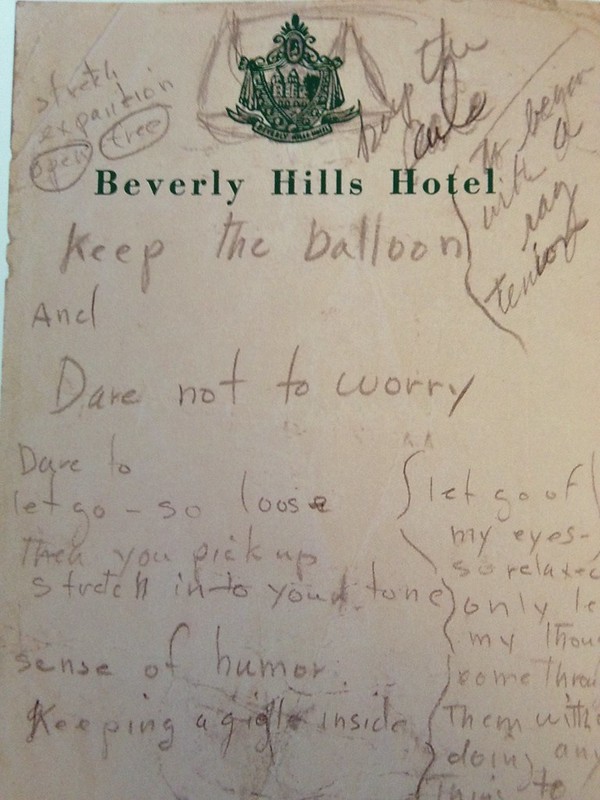
Buchtal and Comment have tried to present Marilyn's writings in as straightforward a manner as possible, keeping things chronological. A photograph of the original item, in Marilyn's handwriting,is presented on a left-hand page, while their transcription, sometimes joined by notes of explanation, appears opposite, on the right.

Black and white photographs of Marilyn, frequently reading, also accompany the text. Marilyn wrote poems, letters, and kept journals. While perusing Fragments it is unavoidable not to feel as if one is prying, sneaking a peek at her diary. We are. But it is undeniably fascinating. Her notebooks contain notes from classes she took on Italian art, as well as from acting class. Some of her note-taking seems to meld with her poetry and become stream-of-consciousness prose poetry, as does this fragment, c. 1955:
On the stage — I will
not be punished for it
or be whipped
or be threatened
or not be loved
or sent to hell to burn with bad people
or feeling that I am also bad
or be afraid of my genitals being
or ashamed
exposed known and seen —
so what
or ashamed of my sensitive feelings — they are reality
or colors or screaming or doing
nothing
and I do have feeling
very strongly sexed feeling
since a small child — think of all the
things I felt then
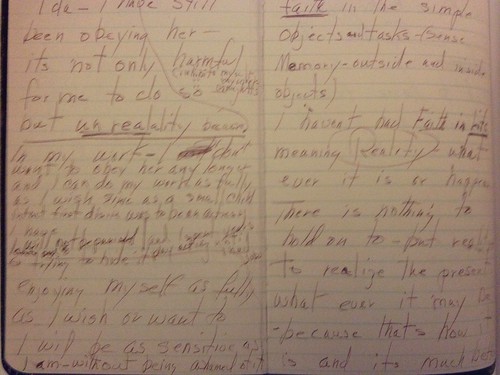
Some of her notes are like puzzles or maps. Talk about fragments. She writes a paragraph in her notebook on the left hand page, and then continues, sometimes at an odd angle, on the opposite page, and then back again, drawing arrows, linking one thought to the next. She may not have been writing continuously, and went back to add ideas at a later time, or she may have purposely wanted to keep her writing difficult to understand and more private.

photo

Especially revealing are two poems she wrote, on Parkside House stationery, during her stay in England when she was filming The Prince and the Showgirl. Marilyn, newlywed to playwright Arthur Miller, was already feeling insecure about the marriage:
I guess I have always been
deeply terrified to really be someone's wife
since I know from life
One cannot love another,
ever, really. 
where his eyes rest with pleasure — I want to still be — but time has changed
the hold of that glance.
Alas how will I cope when I am
even less youthful —
Back in the U.S., at their home in Roxbury, CT in 1958, her life with Miller hadn't improved much:
starting tomorrow I will take care of myself for that's all I really have ever had. Roxbury — … I think I hate it here because there is no love here anymore. I regret the effort I desperately made here. ... what I could endure helped both of us and in a material way which means so much more to him than me. ... When one wants to stay alone as my love (Arthur) indicates the other must stay apart.
It becomes clear that many of these fragments are first drafts for notes or letters. One page in her notebook, scribbled in pencil, which she signs with multiple pet names, was confirmed by close friend Norman Rosten as a letter he received from her. Some of her notes seem to be character studies. There are also thoughtful observations about not just the character she would be playing, but other characters in a film with her, like this one about The Misfits:
I feel the camera has got
to look through Gay's [the character played by Clark Gable]
eyes whenever he is in a
scene and even when he
is not there still has to be a sense of
him
He is the center and the
rest move around him
but I guess Houston [sic - director John Huston] will
see to that
He is both subtle and overt in his meeting them
and in his cruelty and his tenderness
(when he reaches out of himself for her – R. [R stands for Roslyn, Marilyn's character in the film])
There is a really interesting letter to Lee Strasberg, dated December 18, 1961, where Marilyn tells him she is forming an independent production company, possibly jointly with Marlon Brando, and that she would like him to be a part of it. Marilyn definitely had some big plans for her future, and was constantly trying to get more control over her career.

Strasberg wouldn't accept Marilyn as a student unless she agreed to undergo psychoanalysis. This led to a whole additional host of problems for the already insecure star, and doctors who may have done her more harm than good. After her break-up with Miller, her New York psychiatrist Marianne Kris had her committed to Payne Whitney's psychiatric ward — Marilyn thought she was only going to a hospital for a rest cure. This was one of the most traumatic events of Marilyn's life. She reached out to Kris and the Strasbergs, but only ex-husband Joe DiMaggio was able to secure her release. Once she moved to Los Angeles, her psychiatrist Dr. Ralph Greenson crossed all the boundaries of doctor/patient relations by having Marilyn socialize with his family. He may also have been instrumental in her taking more barbiturates than were necessary on the day of her death.


Fragments: Poems, Intimate Notes, Letters stresses Marilyn's love of books and her lifelong respect for writers. Writers also seem to have admired her greatly, as Buchtal and Comment take pains to point out.
In 1959 Karen Blixen asked to meet her, "... she radiates, at the same time, unbounded vitality and a kind of unbelievable innocence. I have met the same in a lion-cub ... I shall never forget the most overpowering feeling of unconquerable strength and sweetness which she conveyed." 
Truman Capote, who met her in 1950, dedicated his short story "A Beautiful Child" to her. 
Through husband Arthur Miller Marilyn befriended Carson McCullers, who wrote about her in "Illumination and Night Game."
Norman Mailer tried to cultivate her friendship, but she demurred. He wrote the controversial "Marilyn," which started the unsubstantiated-by-fact Kennedy/Marilyn rumor mill going on 1973. 
Somerset Maugham approved of her proposed role as Sadie Thompson in a television production of "Rain," which was never produced.  
She admired British poet Edith Sitwell and met with her both in Hollywood and London, while filming "The Prince and the Showgirl." 
Marilyn met Carl Sandburg in 1959, and their appreciation of each other was very mutual. She loved his biography of Abraham Lincoln and he wrote, "She was not the usual movie idol. There was something democratic about her. She was the type who would join in and wash up the supper dishes even if you didn't ask her." 
Buchtal and Comment also include some selected book covers from her personal library, which included:

Mme. Bovary by Gustave Flaubert
The Secret Agent by Joseph Conrad
The Unnamable by Samuel Beckett
Sister Carrie by Theodore Dreiser
A Farewell to Arms and The Sun Also Rises by Ernest Hemingway
Tortilla Flat by John Steinbeck
On the Road by Jack Kerouac
The Fall by Albert Camus
Invisible Man by Ralph Ellison
Once There Was A War by John Steinbeck

Fragments: Poems, Intimate Notes, Letters is an interesting, even unexpected look into Marilyn's life, with the accent not on glamor, but on her thoughts and aspirations. Marilyn was always trying to learn new things and improve herself, and many of these fragments show her progress.
Enhanced by Zemanta

Tuesday, August 07, 2012

his week with marilyn (maybe)

"For five months, whether she turned up or not, she dominated our every waking thought."
My Week with Marilyn by Colin Clark actually contains two books, The Prince, the Showgirl, and Me, a diary that Clark published in 1995 based on his time on the set and detailing the  making of the film The Prince and the Showgirl, and My Week With Marilyn, from 2000, his revisionist view of the "lost week" he left out of the first volume and that he allegedly spent with the biggest star in the world at the time, Marilyn Monroe.

It's interesting to read his intimate (fantasist?) diary first, and then read the more reporter-like journal of his days working on the film and catch clues to his possibly more intimate interactions with Marilyn. His dates don't match up exactly, which doesn't help with his credibility. In My Week with Marilyn he is present in her home on the night of September 18 when she suffered a miscarriage. He plays a very active, even take-charge role in getting a doctor, managing her entourage, etc. during the crisis (newlywed husband Arthur Miller was absent in New York at the time). In The Prince, the Showgirl, and Me he hears about Marilyn losing a baby while gossiping with her bodyguard, after the fact, on September 8. Does one of these scenarios sound more realistic than the other?

Olivier trying to direct Marilyn on the set of The Prince and the Showgirl
Williams as Marilyn and Branagh as Olivier in My Week with Marilyn
In a way, whether his memories are accurate or not don't really matter. Both books capture what life on a film set was like, and how Marilyn's erratic behavior affected all of the people around her. This factual ambivalence did not escape the makers of the film version, which adheres pretty closely to the second book. Director Simon Curtis cast My Week with Marilyn with the cream of British and American acting. The fact that none of them really resemble the people they are supposed to be portraying ultimately doesn't matter. Michelle Williams, for me, did not look for one moment like Marilyn Monroe. Even with padding, she is not voluptuous, and lacks Monroe's amazing hourglass silhouette. But she does, in her confusion and flickering moods, capture the behavior that we have come to believe was Marilyn's. Likewise Kenneth Branagh does not immediately bring Laurence Olivier to mind, or Zoe Wanamaker Paula Strasberg, but they both ably convey the frustrations of their very different positions in Marilyn's orbit.

The double-edition is structured so that one reads Clark's lost diary first and then his more day-to-day account of the making of The Prince and the ShowgirlMy Week with Marilyn is probably as much fantasy as fact, but the reader still comes away with a sense of what Marilyn must have been going through during her time in London, such a fish out of water, endlessly pampered but also abandoned. It's highly unlikely that Clark could remember verbatim so many conversations so long after the fact, but there is still a ring of truth in his exchanges with Marilyn. On an excursion the pair take to Windsor Great Park he has Marilyn say, "Why do I take all those pills? Why do I worry about what all those men think? Why do I let myself get pushed around? This is how I ought to feel, every day of my life. This is the real me ... " Maybe he writes her as he wishes she had been. But he somehow does manage to capture some essence of Marilyn.

Where the book is at its most observant and entertaining is in his (frequently catty) observations of the other key players. He has no use for Marilyn's husband of a few weeks, playwright Arthur Miller, "... Arthur Miller takes it all for granted — his house, his servants, his driver, his wife's bodyguard, and even, so it seems to me, his wife. That is what makes me so angry. How can you take Marilyn Monroe for granted?"

He is incredibly sympathetic to Marilyn, and frequently criticizes his boss (and family friend) Olivier for his callous treatment of her. "The rest of Olivier's circle, including Olivier himself, actually welcomed reports of her deteriorating condition as evidence that their opinion of her had been right all along. It was only toward the end of his life that Olivier was able to relent." He repeatedly describes her ill treatment on the set and wishes that Olivier and others could be more kind, patient, and understanding with her. "[Lighting cinematographer Jack Cardiff] is the only person on the set who treats Marilyn like a chum. As a result he is the one crew member to whom she can relate, and certainly the only Englishman she trusts. In return he uses all his artistry to bring out her beauty. He clearly adores her, and because he's an artist, with no ulterior motive, she responds to him very well."

My Week with Marilyn, ultimately, is a bit of fluffy wish-fulfillment romance, with the two unrequited lovers parting amicably, never to see one another again. Clark's earlier book, The Prince, the Showgirl, and Me, is a much more straightforward account of Clark's experience during the making of the film. Although the focus is squarely on Clark, including some accounts of youthful, fumbling, sexual encounters, it gives the reader a good sense of life on a movie set; all the drama and romance, as well as describing how shots are set up and what the crew does, including lighting, sets, and make-up.

Clark comes off as a bit of a cad as he boasts of his dealings with the "wdg," his nickname for a nameless wardrobe girl. He is a rich kid, who got the job through his connections with the Oliviers (Laurence and actress Vivien Leigh), friends with his parents. His father was Kenneth Clark, the famous art historian. He is a snob, too, sharing all of his superior attitudes about extras and frequent name-dropping of his parents' friends. But he does bring to life the chaos and management of all of the minute details that go into making a movie. He outlines how difficult it was to wrangle extras for the coronation scene in the film (from the pool of extras as well as a ballroom dancing club) as well as the ridiculous but long-standing power of film unions. He recounts how he wasn't allowed to fetch or move a chair so that elderly actress Dame Sybil Thorndike (who played the Queen dowager in the film) could sit down (a scene included in the film version, with Judi Dench as Thorndike) while they waited for Marilyn to appear on the set — a prop mover insisted that only he or one of his fellow union members could do it, so everybody stood around for ten minutes while that was accomplished.

Even with all of his upper class and film world connections, Clark had to fight to get work on the film. He is quickly blown off by the head of Laurence Olivier Productions when he shows up for a job, but he perseveres, showing up every day, and tries to make himself useful. After a week or so his persistence pays off as he is tasked with finding a suitable house for Marilyn to stay in while filming. He comes up with a clever solution, by securing two houses for the company, but it is also undeniable that his family connections also came in handy, as he travels in the circles where securing an available manor house is a regular occurrence. His success leads to a job as a third assistant director, or gofer, on the film set.

In The Prince, the Showgirl, and Me Clark seems less impressed and sympathetic about Marilyn, "She has got a cute smile, but so far she only turns it on for the cameras. Her figure — and especially her bust — is fantastic but a little on the plump side. Problems — too much fakery: peroxide hair, dead white make-up, heavy lipstick, but that is her image. She looks confused too, lost, troubled."

One interesting anecdote: for some reason they filmed tests with Marilyn first without make-up, and then after in full make-up, wig, and costume. Clark is amazed by her transformation. "The film was magical, and there's no other way to describe it. Stuff we shot in the morning, although it resembled a police lineup mug shot, was quite heartbreaking. MM looked like a young delinquent girl, helpless and vulnerable under the harsh lights. The afternoon footage was even more extraordinary. What an incredible transformation. Now MM looks like an angel — smooth, glowing, eyes shining with joy (Jack [Cardiff]'s lights), perfect lips slightly parted, irresistible."


He is much less understanding of her personal problems and vulnerability in this book. "It's true that MM doesn't notice much of what is going on around her, but the knowledge that 60 actors and technicians are waiting for you, and at enormous cost to you personally, it's hardly one to induce calm in anyone, let alone someone with such a fragile grip on stability as MM. ... MM is so difficult to work with that even hardened technicians are driven crazy. But when she doesn't show up, we miss her! What a paradox."

Amusingly and consistently, he hates Arthur Miller, and never hesitates to say so, in both books, "AM seems big headed, insensitive, and super selfish. I never saw him look tenderly at MM, only with what looks like a sort of boasting self-satisfaction. What bad luck on MM. Why couldn't she have found what she really needs — someone sympathetic to support her? She doesn't move around with those sort of people I suppose."

He doesn't just reserve his criticisms for the Americans. He can be just as tough on his boss, Olivier. Clark may love and respect his old family friend, but he never stints on honesty where he is concerned. "[Olivier] has made many films — some great and some mouldy. Only on stage, to a very limited audience, can he be seen as the great actor he is."

Both books offer a kaleidoscopic view of the difficulties behind making the film. Although Marilyn most definitely added another layer of mayhem, Clark's recounting reminds us that most film sets are chaotic worlds, and that it is a miracle that with so many disparate and opposing elements that any movie gets completed at all. One of the volumes may be more fiction than fact, but together they offer a glimpse behind-the-scenes of the only film produced by Marilyn Monroe Productions. As Clark frequently reminds the reader, none of the tensions, bickering, or even all-out hatred that may have been felt by the parties involved is evident on screen. Marilyn is fresh and lovely and walks away with the picture from a stiff and old-fashioned Olivier. Movie magic.


Enhanced by Zemanta

Sunday, August 05, 2012

marilyn, gone 50 years ago today

Here's another essay from the longer-format piece I'm working on about Marilyn Monroe.

There are so many books, movies, and documentaries about Marilyn Monroe, and I've been reading a lot of them recently. Something they all share in common: her sex life, her troubles. No one seems to want to talk about the woman as an actress, an artist. It's easy to get caught up in the sordid and tragic details of her life and death, but I would rather focus on her incandescent screen presence. She may never have been a classical actress along the lines of Eleanora Duse, one of her idols, but her movies are still highly enjoyable and watchable, and she was serious, always, about her craft. In fact, her notorious lateness and difficulty on film sets could be attributed to her stage fright, for which she experienced actual physical symptoms of nervous rashes and flushing, which caused delays in re-applying of make-up. But even more so, she always, even before encountering the Method, insisted on multiple takes, as she was obsessed with getting a scene “right.” This also extended to rigorous rehearsals of musical numbers. Marilyn, even when she was a bit player, employed acting, singing, and dancing coaches in an effort to improve herself and give the best possible performance.

As Lorelei Lee in Gentlemen Prefer Blondes
When her marriage to Joe DiMaggio went bust in 1954, she decided to leave California and concentrate on honing her craft in New York City, where the acting was “serious.” Against all the advice of friends and advisers, she left Los Angeles and moved across the country. Once there, she began to study with Lee Strasberg at the Actors Studio, of Method acting fame. Strasberg, like so many others who met her, was impressed with her beauty and her star power, He wasn’t just her acting guru, but like many of the men in her life he became an ersatz father figure, and he welcomed her into his family. She respected Strasberg so much she even made him the primary beneficiary in her will. Strasberg made Marilyn believe what she dreamt of — that more serious roles were in her future. This dream did come true, with dramatic roles in Bus Stop, The Prince and the Showgirl, and The Misfits. Her marriage to playwright Arthur Miller in 1956 also steered her away from the frothy musicals she had done previously.

For someone who reportedly was so full of sadness and vulnerability, Marilyn was said to be a joyful presence in many lives. But she was also always aware of death. She may have contemplated and attempted suicide many times — reports of failed attempts are non-existent or frequent, depending on which biography you are reading. Unfortunately, she finally did overdose in 1962, fifty years ago today. We'll never know how serious her intent was. She was so use to taking a lot of pills over the course of a day that she may have miscalculated. Or maybe she thought there would be someone — there was always someone, like an assistant or a doctor — waiting and able to rescue her. Unfortunately, on August 5, 1962, that wasn't how the story ended.

Marilyn in New York
Marilyn’s dependence and misuse of drugs definitely played a part in her death. The amount of barbiturates in her system was staggering. Her use of barbiturates and painkillers began at an early age, and a lot of her drug dependencies can be traced to her difficulties with menstruation. She was plagued by endometriosis, and suffered excruciatingly painful periods from her youth. Throughout her life doctors prescribed painkillers and Marilyn took them. Drug abuse was not a "thing", a social crisis, a cause, in the 1940s, '50s, and '60s. Maybe things would've been different for her if she had a hysterectomy as was advised by a gynecologist. But Marilyn refused. She always wanted the possibility of having a child. If Marilyn had undergone a hysterectomy in her 20s she would no longer have had to suffer the miscarriages (or purported, by some, abortions) that caused her both physical and mental anguish, hence more drugs to numb the pain. This painful irony didn’t escape the screen goddess — that a walking, talking symbol of sex was cursed with such troubles with procreation, with her own womanhood.

And Marilyn is still a goddess of sex and of womanhood. She is an extreme version of so many issues that women deal with every day. Trouble conceiving or bringing a baby to term. The difficulties in finding a man, maintaining a relationship The difficulties of being taken seriously in a man's world. How hard it is to balance a career and family. Marilyn dealt with all of these issues firsthand, before feminism, with few to guide her. She had a shaky foundation; her mother in and out of institutions, and a succession of families (where she encountered alleged child abuse at worst, or indifference) who were willing to take her on and care for her — until they couldn’t — and then she would be sent on to the next family.

Marilyn burned with ambition and a desire to excel and succeed. And she had a powerful tool in her arsenal: her beauty. She continued this cycle of patronage and ersatz protection with older men in Hollywood, and even the men she married, but no one seemed able to give her the acceptance, the support that she craved.

On the set of The Misfits
Marilyn's only escape as a child from the drudgery of foster homes (and even for a few years an orphanage) was the movies. She went a lot, and her favorite screen idol was Jean Harlow. She was actively being considered for a biography of Harlow before she died. She may never have been as sassy as Harlow — she just didn't have it in her — but her performance in Some Like it Hot hints at how great that movie might have been. (Two movies, both named Harlow, were eventually filmed, both released in 1965, one starring Carrol Baker, the other Carol Lynley, and both were resounding flops.)

Marilyn is to be applauded and respected for trying to shake off the stereotype of the dumb blonde and to always challenge herself. But it is also a shame that she turned her back on some of her most engaging work. She was a born comedienne, and what makes her such a star, so unique, is that talent, paired with her beauty and sexiness. She apparently didn’t care for Some Like it Hot, one of her best films. Husband Miller had little respect for her musical numbers, and he urged her to drop her idea of having songs in The Prince and the Showgirl. Maybe after that marriage fell apart in 1960 she began to revise her opinions about appearing in musicals, as she was in talks to do a remake of The Blue Angel, Irma La Douce, Can Can, I Love Louisa (which became What A Way to Go!), and a musical version of A Tree Grows in Brooklyn. She was also in talks to star in Some Came Running, which leads one to ponder that Shirley MacLaine may owe a lot of her film roles to Marilyn’s being out of the picture.

To watch Marilyn on the screen is frequently pure joy. She bubbles over. Some find her exuberance, her sensuality, her uber-femininity, embarrassing. But the camera loved Marilyn and she loved it back. On this, the fiftieth anniversary of her death, she is best commemorated by her film legacy, not the ups and downs of a life that ended too soon.

Some viewing suggestions:

Musicals/comedies

Gentlemen Prefer Blondes (1952) A Technicolor explosion of fun, with Marilyn, Jane Russell, fabulous costumes and lots of fun musical numbers, capped off by Marilyn's wonderful rendition of “Diamonds Are A Girl’s Best Friend.”

Seven Year Itch (1955) Not her best film, but possibly her most iconic, featuring the infamous subway grating scene and Travilla’s amazing white pleated dress.

Some Like It Hot (1959) Marilyn is amazingly beautiful and vulnerable in one of the funniest films ever. She matches Jack Lemmon and Tony Curtis in the comic moments too. A classic.

In Some Like It Hot

Drama

All About Eve (1950) In just a small part, as Miss Casswell, a “graduate of the Copacabana school of dramatic art,” Marilyn still impresses.

Niagara (1953) Marilyn is beyond sexy as a femme fatale in this color-saturated film noir. Husband Joseph Cotton is driven mad by his young wife’s wayward ways, against the backdrop of the Falls location shoot.

Bus Stop (1956) The first film where Marilyn was taken seriously, and she is frequently heartbreaking as saloon singer Cherie.

The Prince and the Showgirl (1957) Marilyn effortlessly steals the show from director and costar Laurence Olivier. The much-reported off-screen trials and tribulations aren’t visible to the audience, but Oliver’s stiff performance highlights his classical method versus Marilyn’s fresh, modern approach to acting.

The Misfits (1961) Marilyn is raw, vulnerable, even painful to watch. With a screenplay by then-husband Arthur Miller, The Misfits is not the greatest film, but it is still fascinating. Marilyn's interactions with costars Clark Gable and Montgomery Clift are wonderful.

.......

Looking for more interesting articles on the ultimate movie star?

Check out high50, a British-based site for "the fifty-plus generation that aims to put the AARP in the old folks' home."

high50 is featuring and article by Julie Burchill, Mrs. Morgenstern’s Morning. "One of the UK's best-known and most controversial writers, Burchill imagines how Marilyn might have turned out, had she survived the last 50 years. It's in short-story format — with a real sting in the tail."

.......

R.I.P. Marilyn ♥

Enhanced by Zemanta