Showing posts with label Marlon Brando. Show all posts

Friday, August 31, 2018

favorite movie #32: guys and dolls

Favorite movies that have had an impact on me - #32 - Guys and Dolls (1955) - There is so much to love about this musical. Its New York City setting, the wise-racking Damon Runyon characters, the bright colors and costumes, the wonderful cast, and of course the great songs and dance numbers. But for me, what takes Guys and Dolls over the top is Marlon Brando, at his sexiest and most charming. He was at the peak of his popularity when this film was made, and Frank Sinatra couldn't talk the producers into giving him the role of Sky Masterson when Gene Kelly, their first choice, was unavailable. They wanted Brando. And thank goodness for that, as he was perfect for the role and even did his own singing. Sinatra was great as Nathan Detroit, but apparently was no fan of Brando during filming. Oh well. Any petty personality issues were definitely left in the dressing room, as this filmed version of the great musical is a joy to watch. Members of the Broadway cast were also on board, including Vivian Blaine as Miss Adelaide, Stubby Kaye as Nicely Nicely, B.S. Pully as Big Jule ("from Chicago!"), and Johnny Silver as Benny Southstreet. British actress Jean Simmons does a nice job as Sister Sarah Brown, Skye's love interest, and does her own singing as well.


When a guy wears tails with the front gleaming white Who the hell do you think he's tickling pink on Saturday night?
Pet Me Poppa
In other words, Just from waiting around, For that little band of gold, A person can develop a cold
Nathan Detroit (Frank Sinatra) tries to convince Skye Masterson (Marlon Brando) to bet on Lindy's cheesecake
That bacardi flavor, it certainly makes a difference, doesn't it?
Your eyes are the eyes of a woman in love...
Luck if you've ever been a lady to begin with ...

I dreamed last night I was on the boat to heaven ...


Thursday, April 30, 2015

throwback thursday: favorite movie towns

A post from 2009:

movies I'd like to visit, maybe even live there


Hollywood is not really a town, if you've ever visited. Not a town like the small one that some folks come from, or a bigger one, like where I live, here in D.C. But every once in a while Hollywood puts out a movie that takes place in "a small town," just like the ones that we know never really existed, but maybe would like to visit, or at least pretend to live in, for ninety minutes to an hour. And it's clear that the key to the attraction is as much the locals as the remote location.

In Doc Hollywood Michael J. Fox plays his usual smart-ass, this time as a hot-shot doc wanna-be Beverly Hills plastic surgeon who lands smack dab in the middle of the squash capital of the South. After waking to a morning skinny-dipping goddess vision and a pee-in-the-woods mating ritual, he is smitten with the girl, the town and its cast of kooks and so are we. And it's got Woody Harrelson in a good bit part, among others. Anther film with the same small town fish-out-of-water fun is the brilliant Groundhog Day, with Bill Murray reliving a day and getting to know everyone and everything really well until he gets it right. He also is in one of my all-time favorites. What About Bobwhere he takes over Richard Dreyfuss's vacation, family and life ably abetted by some helpful neighbors.


Julia Roberts manages to lure Richard Gere from the Big Apple, or is it the other way around, in Runaway Bride? The Maryland town she is supposed to inhabit is full of a bunch of people you'd want to hang out with. Any town that sports Joan Cusack would be worth looking into. There are strange, unexplained details that make you wonder. What's with all the multiples? There are different sets of twins and triplets in many background scenes. Maybe it's something in the water...Housesitter, directed by Frank Oz, is another small-towns-and-romance-go-great-together movie, where Goldie Hawn insinuates herself into Steve Martin's life after a one-night stand. It's interesting, because we watch her fall in love with his house and his life and his family and (most of) his friends and have to wait impatiently for him to catch up. Oz hits another home run with In and Out, which has Kevin Kline slowly but surely discovering his inner homosexual and learning that everyone in town still loves him as much as we do. The final scene where everyone parties down so that his mother can get the "wedding" she always dreamed of is pure fun. And again, Joan Cusack lives there.


Casablanca is a classic, with the magnificent Bogie and an exotic collection of individuals all trying to escape from something. Wartime and romance are major plot points, but as the credits roll, I am secretly glad that Bogie has decided to stay in Casablanca with Louis and fight the good fight. It sure seems like they're going to have a hell of a time.


There are some other excellent movies that have fascinating small towns that I am glad I only have to visit for a little while, as they would be terrifying to live in full-time. Hitchcock must have been fascinated by small-town America, because he depicts it many times, all to sinister effect. Two of my favorite of his movies, Shadow of a Doubt and The Birds turn the safety and familiarity of living in a place where you know everyone on its head, as one town is hosting a serial killer and the other is besieged by unexplained deadly bird attacks. A holiday classic, It's a Wonderful Life, actually shows a town, that no matter how wonderful some of its inhabitants are, would be a pretty rough place to have to live. I'll pass, thanks.

I don't live in New York any more, but once you have, it never quite leaves you. New York is not a small town, but there have been a few film fantasies that somehow manage to get a sense of the city. Guys and Dolls is a real slice of Broadway history, both musical and depicting the sorts of characters that used to hang out near Times Square. A far cry from the Disney theme park that exists there today. And Marlon Brando sings! The Godfather, Part II is a crime classic, but it also gives a slice of what it meant to be an Italian immigrant in this country, coming through New York. Another fun film set in downtown New York is After Hours, the ultimate trip through SoHo in the 80s with Griffin Dunne being dragged from one bizarre situation to the next. Woody Allen is well-known to be in love with his home town New York and has made movies set in the city many times, but as an ex-new Yorker, I don't really get a strong sense of the city, except as travelogue, in his films. Hannah and Her Sisters is one exception, where the SoHo and downtown sequences seem truly "the city," as Michael Caine tries to seduce Barbara Hershey in bookstores, her partner's painting studio, and on the street.

So whenever big city life gets to be a bit much, I know I can retreat to one of these film oases. Any other favorite film fantasy small towns?

Thursday, November 14, 2013

bedtime story vs. dirty rotten scoundrels

There aren't many actors in my mind who can compare to a young Marlon Brando. Maybe I was scarred (in a good way) by seeing him in Guys and Dolls (1955) on television when I was a kid. He was smooth, sophisticated and a bit of a bad boy. It's that Marlon Brando, the improbably singing Brando of Sky Masterson, more than his brilliant Don Corleone, who I hold in my heart.

Luck be a lady tonight: Marlon Brando as Sky Masterson
Brando is primarily responsible for an entire school of acting. So many actors since his critically acclaimed work of the 1950s — James Dean, Paul Newman, Warren Beatty, Steve McQueen, Robert DeNiro — have followed in his footsteps. And what footsteps. A Streetcar Named Desire (1951), Viva Zapata! (1952), The Wild One (1953), Julius Caesar (1953), On the Waterfront (1954), The Young Lions (1958).

His film work in the 1960s, by comparison, has been criticized as lightweight. But it is more than understandable, after such an intense run of films, that Brando might want to shake up his image and reputation — of a hyper-intense Method mumbler. Brando didn't consider himself a proponent of The Method. He was taught the Stanislavski technique by Stella Adler, which stressed naturalism above all else. He did attend classes at The Actor's Studio, but was resentful of Lee Strasberg's trying to attach himself to his acting style.
"After I had some success, Lee Strasberg tried to take credit for teaching me how to act. He never taught me anything. He would have claimed credit for the sun and the moon if he believed he could get away with it. He was an ambitious, selfish man who exploited the people who attended the Actors Studio and tried to project himself as an acting oracle and guru. Some people worshipped him, but I never knew why. I sometimes went to the Actors Studio on Saturday mornings because Elia Kazan was teaching, and there were usually a lot of good-looking girls, but Strasberg never taught me acting. Stella did – and later Kazan."
Certainly one of the best American actors of any generation, Brando must have wanted to pull back, from time to time, from the many intense stage-to-screen dramas he starred in and try something different, even funny. In 1964's Bedtime Story, in which he starred with David Niven, he is definitely having a blast.


Marlon and friend in Bedtime Story
"Working with David was the only time I ever looked forward to filming. I just couldn't wait to wake up each morning and go to work so he could make me laugh."

I have always been a big fan of Frank Oz's Dirty Rotten Scoundrels, which stars Michael Caine and Steve Martin as two rival con men, one polished, one boorish, who try to fleece an American heiress, played by Glenne Headley. Filmed on the French Riviera, it is a bright, smart comedy that isn't afraid to look silly. Oz has always had a great hand with farces and comedies of manners (What About Bob? Housesitter, In & Out, Bowfinger) and Dirty Rotten Scoundrels is an ever-escalating exercise in comedic one-upmanship. I was surprised to find out recently that this favorite comedy was actually a remake, of the 1964 film starring Niven and Brando. Bedtime Story was not just the basis for Dirty Rotten Scoundrels, but an exact blueprint. From the plot to the characters' names, to the location — the second film is almost a scene-for-scene copy.

Brando & Niven: Private Freddie Benson teaches Lawrence Jamieson about women

Martin & Caine: And again

I think of Brando's '60s work as a respite. He pulled back from Hollywood and tried to sort out how he felt about the world. He became involved politically, especially focusing on civil rights issues. By the '70s Brando was "back" in Hollywood, as the critics and public were concerned, with his amazing turns in The Godfather (1972), Last Tango in Paris (1972), and Apocalypse Now (1979).
[When asked how he spent his time away from the camera] People ask that a lot. They say, "What did you do while you took time out?", as if the rest of my life is taking time out. But the fact is, making movies is time out for me because the rest, the nearly complete whole, is what's real for me. I'm not an actor and haven't been for years. I'm a human being — hopefully a concerned and somewhat intelligent one — who occasionally acts.

Con men Freddie and Lawrence — Marlon as Ruprecht the Monkey Boy

At the casino: David Niven, Marlon Brando and Shirley Jones

Dirty Rotten Scoundrels all: Michael Caine, Glenne Headley, & Steve Martin
I still love Dirty Rotten Scoundrels, but after seeing Bedtime Story (the whole movie is available on Youtube, and I was able to mirror it full-screen to my Apple TV) I am amazed at how funny Brando and Niven were together. And even more, I was really amazed to see whole bits of business  —especially Brando's take on "Ruprecht The Monkey Boy" that Steve Martin lifted wholesale. The only bum note for me in the older film was Shirley Jones as Janet. She plays a typical bland '50s good girl, and her voice and performance are very one-note throughout. Glenne Headley, on the other hand, may start off in a similar manner, but her character takes an interesting twist. She's also frankly, a much better actress, and can hold her own with her two scheming boys.

Don't get me wrong — a dramatic Brando is also a superb Brando. His performances in all of the '50s films listed above were brilliant. He positively oozed sex appeal, not unlike his friend Marilyn Monroe. But this most naturalistic of actors also had a flair for comedy. Check out Bedtime Story and you'll see what I mean.

Brando quotes from imdb and Wikipedia

Wednesday, January 09, 2013

marilyn matters

It was just a year ago that I wrote a post about Marilyn Monroe's weight, "Why Marilyn Monroe ('s size) Still Matters" — it was in response to an article written about her in Slate that I found to be generally clueless about Marilyn, women's weight, and the perception of women in our society. My post hit a nerve, generating over 23,500 views on my blog, and over 26,000 in its subsequent republishing on BlogHer to date. I felt that in taking a look at Marilyn from a different perspective I might be onto something. I have always been a fan of the actress, and knew the general details of her life and death, but I decided that if I was going to expand my piece I would need to take a deeper look at the lady.


Marilyn Monroe is such an iconic figure. She is our modern goddess. It is possible to be familiar with especially her image from The Seven Year Itch —  the white pleated dress billowing skywards, exposing her lovely legs, without ever having seen one of her movies. I want to remedy that. I'd like to not only explore why I think Marilyn is an important female image, and has more than earned her goddess status, but why I also think she is important as an actress and a celebrity. She has shaped the perception and career paths of contemporary actresses.

Over the past year I have read tons of books and articles, good and bad, on Marilyn — on her films, her life, and her death. I have watched and rewatched many of her films. I still have quite a bit of reading and film viewing ahead of me. It hasn't been easy. Not just the sheer volume of of material to wade through, but the endless repetition of her path to oblivion. Most of the writing out there is only concerned with getting Marilyn and the reader to August 5, 1962, and usually in as seamy a way as possible. No one can change the facts of Marilyn's life, but there are other ways to look at her journey than such a negative, straight-line view. At least I think so. No one lives their life with the end moment in mind. Marilyn certainly did not.

I have to admit that reading, over and over, her hard times and final days took a toll. I had to take a break from the lady for a while. What I have been doing, instead of immersing myself in her life and troubles, is continue to look at the massive amount of images left of the lady. Marilyn was first a model, and then the ultimate Hollywood starlet. She posed for tons of publicity photos. She loved the camera and it loved her back. She seems to have been incapable of taking a bad picture. She always seemed to be willing to sit for multiple photos and loved working with photographers. She worked with some of the best during all phases of her career — Eve Arnold, Richard Avedon, Alfred Eisenstaedt, Milton Greene, Cecil Beaton, and many more. As many familiar photos as there are of Marilyn, it seems that every day I have run across one that I have never seen before, like these she did with Marlon Brando, publicizing an Actors Studio benefit.


This post is a bit of a progress report, and a note that you once again will be seeing some more Marilyn-related posts from me in the future. I continue to find Marilyn Monroe fascinating. As well-known as Marilyn may be, she is also completely under-appreciated and a bit misunderstood. I hope to be able to do something about that.
Enhanced by Zemanta

Saturday, September 08, 2012

cat people

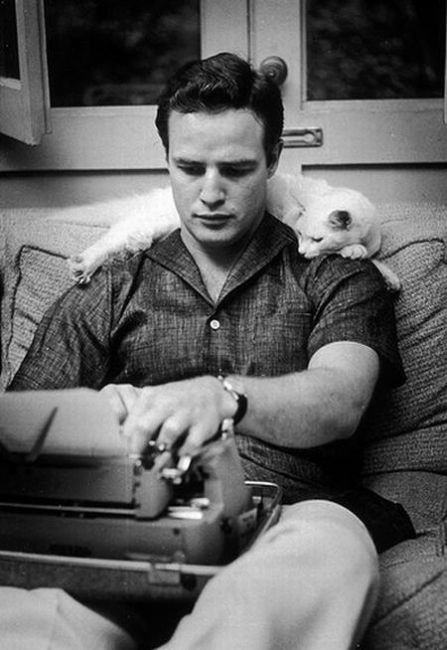
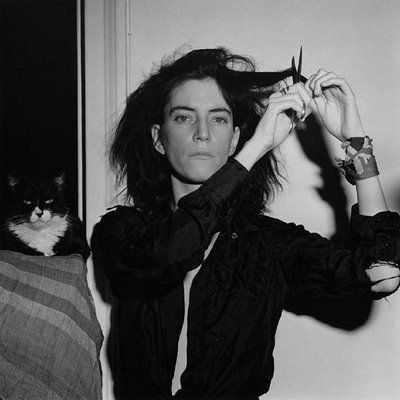
Some of my favorite people are friends to felines. Here's some fun pix from one of my Pinterest boards, Cat People.


Enhanced by Zemanta

Friday, August 17, 2012

little bits of marilyn

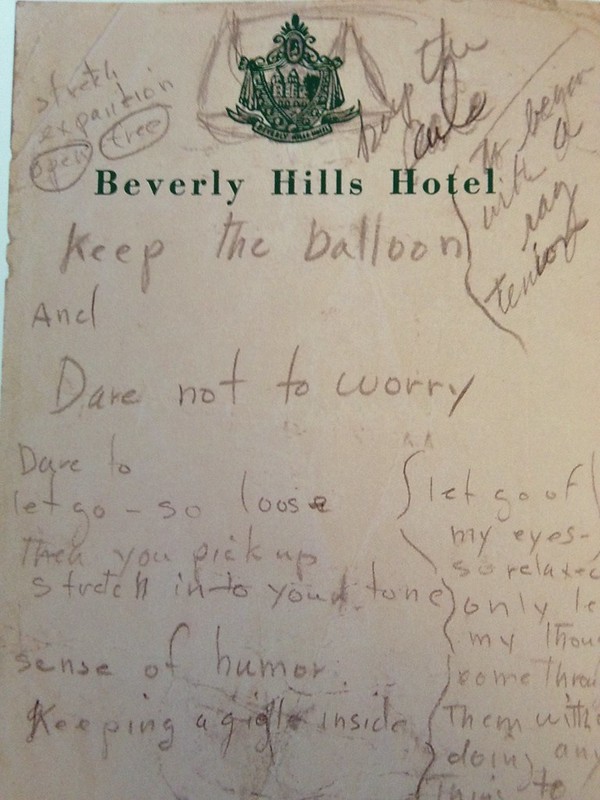
In 1982, after his death, Actor's Studio Director Lee Strasberg's widow, his third wife Anna, found two boxes of poems and other writings by Marilyn Monroe. Monroe had named Strasberg the primary beneficiary in her will. Strasberg, however, had not followed Marilyn's final wishes:
With the exception of two letters, which he returned to their authors, during his lifetime Lee Strasberg never sold or gave away any of Marilyn’s personal effects — this totally contravened the instructions in Marilyn’s Will. It is clear that she did not intend for Lee Strasberg to keep her possessions, which included clothing, letters, documents, furniture, all her personal effects that she absolutely clearly stated, that she wanted distributed amongst her friends. — from Loving Marilyn
Although this action, or more accurately, inaction on Strasberg's part would have disappointed Marilyn, it is because of his neglect that so many of her personal items remained intact, and are able to be viewed as a whole. Anna Strasberg, who had never even met Marilyn, asked family friend Stanley Buchthal to help her determine what to do with the boxes' contents, and he soon enlisted the help of editor and essayist Bernard Comment. Together the pair sorted through the materials and created Fragments: Poems, Intimate Notes, Letters a glimpse into Marilyn's life and mind in book form.

photo

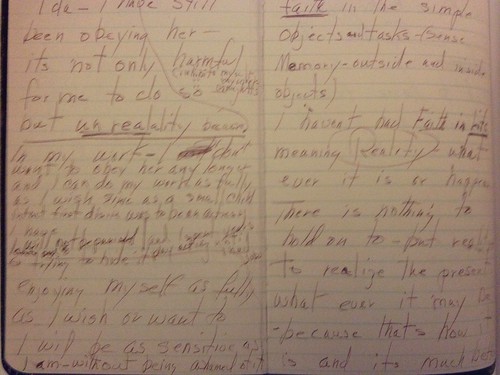
Buchtal and Comment have tried to present Marilyn's writings in as straightforward a manner as possible, keeping things chronological. A photograph of the original item, in Marilyn's handwriting,is presented on a left-hand page, while their transcription, sometimes joined by notes of explanation, appears opposite, on the right.

Black and white photographs of Marilyn, frequently reading, also accompany the text. Marilyn wrote poems, letters, and kept journals. While perusing Fragments it is unavoidable not to feel as if one is prying, sneaking a peek at her diary. We are. But it is undeniably fascinating. Her notebooks contain notes from classes she took on Italian art, as well as from acting class. Some of her note-taking seems to meld with her poetry and become stream-of-consciousness prose poetry, as does this fragment, c. 1955:
On the stage — I will
not be punished for it
or be whipped
or be threatened
or not be loved
or sent to hell to burn with bad people
or feeling that I am also bad
or be afraid of my genitals being
or ashamed
exposed known and seen —
so what
or ashamed of my sensitive feelings — they are reality
or colors or screaming or doing
nothing
and I do have feeling
very strongly sexed feeling
since a small child — think of all the
things I felt then
Some of her notes are like puzzles or maps. Talk about fragments. She writes a paragraph in her notebook on the left hand page, and then continues, sometimes at an odd angle, on the opposite page, and then back again, drawing arrows, linking one thought to the next. She may not have been writing continuously, and went back to add ideas at a later time, or she may have purposely wanted to keep her writing difficult to understand and more private.

photo

Especially revealing are two poems she wrote, on Parkside House stationery, during her stay in England when she was filming The Prince and the Showgirl. Marilyn, newlywed to playwright Arthur Miller, was already feeling insecure about the marriage:
I guess I have always been
deeply terrified to really be someone's wife
since I know from life
One cannot love another,
ever, really. 
where his eyes rest with pleasure — I want to still be — but time has changed
the hold of that glance.
Alas how will I cope when I am
even less youthful —
Back in the U.S., at their home in Roxbury, CT in 1958, her life with Miller hadn't improved much:
starting tomorrow I will take care of myself for that's all I really have ever had. Roxbury — … I think I hate it here because there is no love here anymore. I regret the effort I desperately made here. ... what I could endure helped both of us and in a material way which means so much more to him than me. ... When one wants to stay alone as my love (Arthur) indicates the other must stay apart.
It becomes clear that many of these fragments are first drafts for notes or letters. One page in her notebook, scribbled in pencil, which she signs with multiple pet names, was confirmed by close friend Norman Rosten as a letter he received from her. Some of her notes seem to be character studies. There are also thoughtful observations about not just the character she would be playing, but other characters in a film with her, like this one about The Misfits:
I feel the camera has got
to look through Gay's [the character played by Clark Gable]
eyes whenever he is in a
scene and even when he
is not there still has to be a sense of
him
He is the center and the
rest move around him
but I guess Houston [sic - director John Huston] will
see to that
He is both subtle and overt in his meeting them
and in his cruelty and his tenderness
(when he reaches out of himself for her – R. [R stands for Roslyn, Marilyn's character in the film])
There is a really interesting letter to Lee Strasberg, dated December 18, 1961, where Marilyn tells him she is forming an independent production company, possibly jointly with Marlon Brando, and that she would like him to be a part of it. Marilyn definitely had some big plans for her future, and was constantly trying to get more control over her career.

Strasberg wouldn't accept Marilyn as a student unless she agreed to undergo psychoanalysis. This led to a whole additional host of problems for the already insecure star, and doctors who may have done her more harm than good. After her break-up with Miller, her New York psychiatrist Marianne Kris had her committed to Payne Whitney's psychiatric ward — Marilyn thought she was only going to a hospital for a rest cure. This was one of the most traumatic events of Marilyn's life. She reached out to Kris and the Strasbergs, but only ex-husband Joe DiMaggio was able to secure her release. Once she moved to Los Angeles, her psychiatrist Dr. Ralph Greenson crossed all the boundaries of doctor/patient relations by having Marilyn socialize with his family. He may also have been instrumental in her taking more barbiturates than were necessary on the day of her death.


Fragments: Poems, Intimate Notes, Letters stresses Marilyn's love of books and her lifelong respect for writers. Writers also seem to have admired her greatly, as Buchtal and Comment take pains to point out.
In 1959 Karen Blixen asked to meet her, "... she radiates, at the same time, unbounded vitality and a kind of unbelievable innocence. I have met the same in a lion-cub ... I shall never forget the most overpowering feeling of unconquerable strength and sweetness which she conveyed." 
Truman Capote, who met her in 1950, dedicated his short story "A Beautiful Child" to her. 
Through husband Arthur Miller Marilyn befriended Carson McCullers, who wrote about her in "Illumination and Night Game."
Norman Mailer tried to cultivate her friendship, but she demurred. He wrote the controversial "Marilyn," which started the unsubstantiated-by-fact Kennedy/Marilyn rumor mill going on 1973. 
Somerset Maugham approved of her proposed role as Sadie Thompson in a television production of "Rain," which was never produced.  
She admired British poet Edith Sitwell and met with her both in Hollywood and London, while filming "The Prince and the Showgirl." 
Marilyn met Carl Sandburg in 1959, and their appreciation of each other was very mutual. She loved his biography of Abraham Lincoln and he wrote, "She was not the usual movie idol. There was something democratic about her. She was the type who would join in and wash up the supper dishes even if you didn't ask her." 
Buchtal and Comment also include some selected book covers from her personal library, which included:

Mme. Bovary by Gustave Flaubert
The Secret Agent by Joseph Conrad
The Unnamable by Samuel Beckett
Sister Carrie by Theodore Dreiser
A Farewell to Arms and The Sun Also Rises by Ernest Hemingway
Tortilla Flat by John Steinbeck
On the Road by Jack Kerouac
The Fall by Albert Camus
Invisible Man by Ralph Ellison
Once There Was A War by John Steinbeck

Fragments: Poems, Intimate Notes, Letters is an interesting, even unexpected look into Marilyn's life, with the accent not on glamor, but on her thoughts and aspirations. Marilyn was always trying to learn new things and improve herself, and many of these fragments show her progress.
Enhanced by Zemanta

Thursday, July 12, 2012

marilyn and her

In Marilyn and Me: Sisters, Rivals, Friends, Susan Strasberg tries to tell what it was like to have Marilyn Monroe enter her life and the life of her family. Her father was Lee Strasberg, head of the Actors Studio, and guru to many of the film and stage actors of the 1950s, '60s and '70s (Marlon Brando, Geraldine Page, James Dean, Elia Kazan, Eva Marie Saint, Paul Newman, Jane Fonda, Al Pacino, Robert DeNiro, etc.) Her mother was former actress Paula Strasberg, who became Marilyn's personal coach and factotum. For a short spell their home was a haven to Marilyn, who had fled Los Angeles after her divorce from Joe DiMaggio. Marilyn was looking for a new life as an actress, and was scheming with photographer Milton Greene about starting her own film production company, which would free her from the dumb blonde roles that her studio Twentieth Century-Fox was determined to lock her into.

Written approximately 30 years after Marilyn's untimely death at the age of 36, Strasberg is still able to write from a teenage perspective. She may have been in awe of the glamorous movie star, but she was mostly envious of the attention her father payed her. Even while in the throes of a passionate love affair with Broadway costar Richard Burton, Strasberg can't help but complain how available her father made himself for Marilyn at all hours. Once Marilyn moved to New York and started taking private acting lessons with Lee, she used the Strasberg home as her refuge — before, during, and after her marriage to playwright Arthur Miller.

Paula became a surrogate mother, but Lee was her barometer — she constantly sought his approval. Apparently everyone in his orbit felt the same way, including his daughter, who seems to have fought a lifelong battle with resisting but desiring his help and input in her own work. Marilyn managed to get his attention more than most. That is what Strasberg is most jealous of. She idolizes her father, but she doesn't seem to want to truly understand him. When he does offer her praise she doesn't believe him, and becomes even more insecure. She had more in common with Marilyn than she realized.

Laurence Olivier, Marilyn Monroe and Susan Strasberg visit backstage (Cort Theatre) in 1956.
Strasberg may be unwilling or unable to personally criticize her father, but she does allow others to share their viewpoints:
Johnny Strasberg: "He [Lee] was really fascinated by her, but that's like saying about someone who is so fascinated by animals they put them in a cage so they can study them. In that sense you could say he loved her. He did have this great generosity in his work, although usually he never considered the needs of anyone else before himself. His gift to Marilyn, his great gift, was that he took her seriously in her work, and even personally, too, up to a point. Marilyn was there more than anyone before had been. Lee adored her; at least he seemed to do anything to please her."
Strasberg does share a story that shows just how brainwashed and dependent everyone became on Lee. She was offered the role of Allison in Peyton Place (to be filmed at Twentieth Century-Fox, Marilyn's studio, and the same one that once fired Lee) for $150,000. It was a great part and a great sum — Marilyn hadn't made that much per picture yet. She asked her father if she should take it. He said no. When the family objected, he then told her to ask for more money. The studio refused to pay more, but still wanted her at the original sum. She debated about whether she should take the part anyway, without his permission (she was 19 and already her earnings were helping support the family.) Strasberg ultimately turned it down, and regretted it, but also justified her decision by saying she was avenging her father's previous firing at Fox. Lee was using both his daughter and Marilyn to try and avenge his wounded ego. Strasberg doesn't seem to see how her early success on stage (at age 16, in The Diary of Anne Frank) may have threatened her father. She didn't study with him (although her mother coached her.) She never seems to consider that he may have helped her behind-the-scenes. Marilyn and Me is almost better reading between the lines.

Marilyn congratulates Susan backstage at The Diary of Anne Frank on opening night
As much as the Strasbergs offered Marilyn a second home, they may not have been the best port in the storm, as they had their own problems, including a strange way of expressing and dealing with anger. Lee would rage so much he would sometimes get a nosebleed, scaring everyone. Paula would get hysterical and threaten suicide. Susan would hide in a closet, silently screaming. But none of this would have mattered to Marilyn, who had finally met someone who showed her some respect:
Marilyn, "The best thing that ever happened to me was when your father took me seriously. I've always wanted for people to see me, not the actress, the real person. Your daddy does. He treats me like a human being. ... I worked with this woman in California for years [her first acting coach, Natasha Lytess]. She taught me, educated me, like your father, gave me books to read, but even she thought I was a dummy. He doesn't, and the most important thing is, with your father for the first time I feel it's okay to be me, the whole kit and caboodle, you know, the whole mess."
Once Marilyn gathered the courage to attend classes at the Studio and to even do scenes, her confidence increased, if only temporarily. Strasberg ran the Studio as a place where actors could experiment, be free. People may have thought she was a joke when she said she wanted to play Lady Macbeth, but they might have reconsidered if they had known Lee's ideas for her in the part. He envisioned Lady Macbeth as "a sensitive, driven, compulsive woman, who used her sexuality and power to get her husband to do these terrible things. It was a side Marilyn possessed, but that she had never shown in her work."

Strasberg is never able to truly focus on Marilyn without dragging herself into the picture, as she does when telling about Marilyn recounting her horror story of being locked up in a psychiatric hospital ward by her New York shrink Dr. Marianne Kris: "'I was always afraid I was crazy like my mother or that I'd get that crazy with age. You know women sometimes to go nuts then, but when I got in there with really crazy people, I realized I had problems, but I saw I wasn't as bad as they were.' She made it sound as if it hadn't been that bad. Yet I had heard that it had been worse. Was she trying to protect me from how horrible life was, or didn't she trust me? Who was she lying to? Me or herself? Why?" It's not all about you, Susan.

With all of Strasberg's competitive neuroses, she still comes across as likable, and as someone, who with all the envy, did care for Marilyn. "[Marilyn] took ordinary black-and-white light and reflected it back to us in Technicolor, in epic proportions. Yet she kept it accessible. As famous as she was, she remained human." Marilyn and Me is a very human book about the star and an entertaining read. Strasberg may have been jealous of her, loved her, but she never ceased to be amazed by Marilyn and her power. At the 1962 Golden Globes, when Marilyn attended to accept the World Film Favorite Award, "There was a room full of the biggest stars in the world, and when Marilyn walked in and made her way slowly to the table, her dress was so tight she could barely move; some people in the room stood on chairs, just to get a look at her, like kids. I'd never seen stars react to another star like that." Strasberg's judgements and impressions may not always be accurate, but they do offer a personal glimpse of a woman and a movie star who for most, still remains a mystery.
Enhanced by Zemanta