My eight year-old loves libraries, which thrills me to no end. Not only are her reading choices getting more adventurous as she reads more and more, but while she is picking out books I also peruse titles and pick out something to read to her — or to myself, that I may have missed. As I was checking out the Newbery section a title caught my eye, a book that was set in the Middle Ages, during the bubonic plague. Sounds more like my kind of book than a kid's book, so I had to check it out.
The Door in the Wall
is a lovely little book by Marguerite de Angeli about a young boy named Robin set in England during the Middle Ages. The story takes place during the reign of Edward the III (1327-77), but that is as specific time-wise as de Angeli gets.
The protagonist, young Robin, is a bit of a brat at the beginning of the story, but if you consider his circumstances. At the age of ten he is deemed old enough to not be a child anymore. His parents arrange to ship him off to a friend's, Sir Peter de Lindsay's castle to begin his training as a knight. His father has been away for quite some time, fighting with the King against the Scots. His mother has gone to become a lady-in-waiting to the Queen, leaving Robin with their servants until someone comes to take him to his new home, while the plague is raging through London. But soon after his mother leaves, Robin contracts a serious illness that leaves him lame. Little by little he is left alone, as his servants either get the plague, or abandon him and London to escape it. His last remaining servant, Dame Ellen, is also struck down with the plague. Luckily for Robin, Brother Luke at the neighboring monastery, St. Mark's, finds out about Ellen and comes to check on the boy and take him in.
This is pretty heavy stuff for a book aimed at 3rd grade and up. It may move a little slowly at first for today's kids, who have been raised on sparkly vampires and Spongebob. It's a bit like the classic
The Secret Garden in terms of pacing. The action takes place in the 1300s, an era that may seem too far away to be interesting, but
The Door in the Wall struck a chord. As I was reading I couldn't help but think a bit of Bran from
Game of Thrones, and some other current pop culture references, especially Artie and Quinn's current storyline on
Glee. It was nice to read an older novel (the book was published in 1949 and won the 1950 Newbery medal) and see such a positive story centered around a disabled character.
How many 10 year olds would cope as well as Robin with suddenly not being able to walk, or run, or play— or being told by their parents that their childhood was essentially over and that they were being shipped off to live in a stranger's house? Robin may not immediately know what Brother Luke means when he tells him, "Thou hast only to follow the wall far enough and there will be a door in it," but he soon comes to understand.
The
Door in the Wall's metaphor's may be a little predictable, but it is far from an easy or predictable read. Robin and his two closest friends, Brother Luke and the minstrel John-go-in-the-Wynd, are forced to deal with many difficult issues: the plague, illness, dangerous travel, a castle siege. De Angeli does a nice job of depicting the daily life of the 14th century, and of the part of England Robin travels through,
"'The weather was neither rainy nor fair, neither hot nor cold, but somewhere in between, as English weather is like to be,' said the friar."
The
Door in the Wall may be a children's book, but she doesn't shy away from using some words that may require looking up:
pease porridge,
flambeaux,
bannock. A glossary would have been useful. An added bonus are the beautiful illustrations by de Angeli, in color and black and white, that are found throughout the story.
It was interesting reading how Robin and everyone he encountered dealt with his illness/infirmity. The virus or illness that causes Robin to lose the use of his legs is never named, but it sounds a lot like polio. Robin, of course, hopes to recover use of his legs, and quickly. Brother Luke never shoots that idea down, but keeps introducing Robin to other goals he can achieve in the present. He helps him build his upper body strength by encouraging him to swim daily, as well as taking part in other activities that engage both his mind and body — woodcarving, archery, and learning to read and write.
Robin is never made to feel that his physical handicap is a burden or couldn't be dealt with. He was able to travel, swim, and eventually becomes strong enough to both carve and use his own crutches. By the time that he has to accept that he may probably not recover the use of his legs he has already found so many ways to be useful and independent that it no longer seems as great a concern for him — his major worry is how his parents might react to the change in him since they had last seen each other. But readers can be assured that Robin's story ends happily. The
Door in the Wall is a nice trip into the past, as well as a look at how even the most daunting obstacles can be overcome if you are able to look at things from another angle, use a different approach.


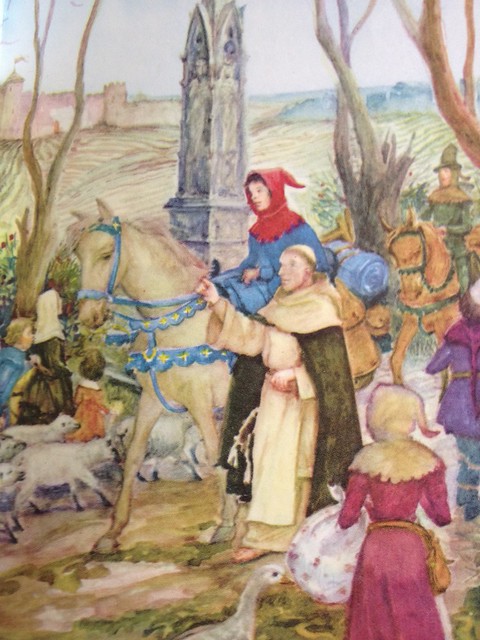
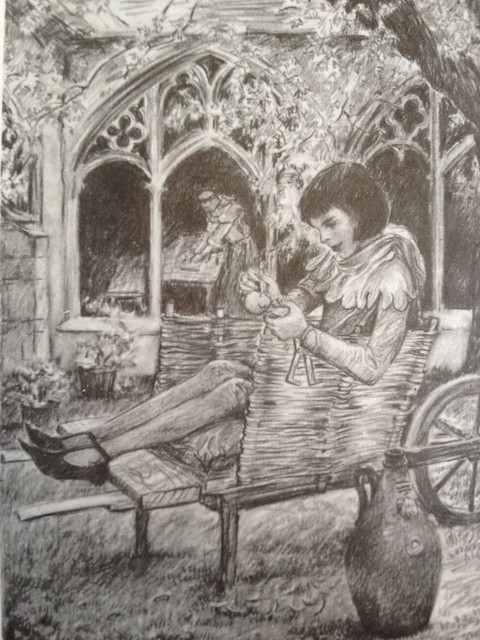
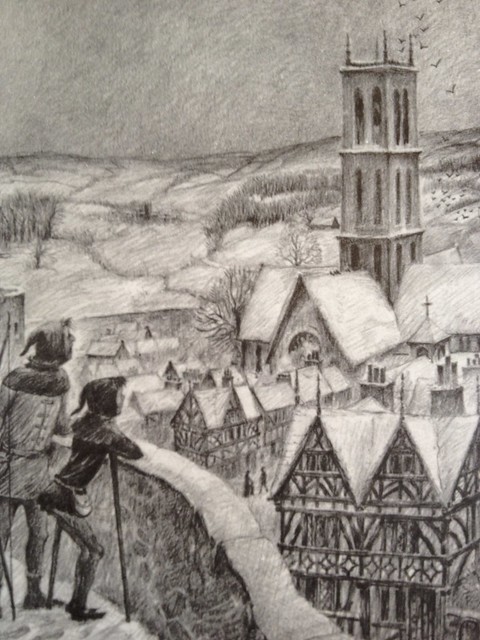

 Image via Wikipedia
 , added an instant authenticity to an unbelievable situation)—but that even though a ghost might retain many features of its person's personality after death—emotions, likes, dislikes, etc.—what might actually provide humanity is a body. That shell, that mortal coil that will someday turn to dust. What if the body, as opposed to the soul, is what essentially gives us our humanity, our kindness? What if the soul is not love, but more our specificity, our personality? This possibility becomes important for one of the main characters, a ghost. As the ghost of Elspeth Noblin struggles with decisions regarding her human nieces, she is analytical, conflicted, sometimes regretful. But she never exhibits empathy or softness, or humanity. She is free, as a ghost, even when restricted to her old apartment, to be her essential, selfish, self. Lack of a body, lack of compassion.
 I just finished Neil Gaiman's Neverwhere
 Another interesting aspect of Neverwhere is the idea of youth, and growing up. One could read the story of Richard's adventures in London Below as his maturation process. But I also saw it as a depiction of what it's like to be young in the city. City life and youth itself can be exciting, dirty, scary, sexy, even life-threatening. If Richard chose to return to his (our) normal world, he could always look back on his time with the Marquis and Door and the others as his wild youth, much like many of us have dim but pleasant memories of our own youthful escapades.
 by Christopher Fowler, whose Bryant and May mystery series I enjoy. Like Neverwhere, Rune is set in London with a male protagonist who doesn't yet realize he might like to break free from his relationship with a perfect woman who isn't perfect for him. An interesting yet offbeat young woman comes into his life and the story is off and running. More a horror story than fantasy, Rune still makes for a good read. In fact my only quibble with both books is that there is a lot, maybe too much, flowing blood. As good as both of these writers are, I was wondering how horrible Neverwhere's Mr. Croup and Mr. Vandemar could still have been without the need to be overly descriptive of half-eaten kittens and the like.
 series, with the wonderful female protagonist Lyra Silvertongue. These books start out in an alternate Oxford and then take off for worlds familiar and imaginary. I can't say enough about this great series of books, except that I look forward to my daughter being old enough to enjoy them. In the meantime I will most likely be reaching for Gaiman's latest
 and see where the book will take me and what other books and worlds I may discover on the way.
