Showing posts with label Laurence Olivier. Show all posts
Wednesday, October 24, 2018
favorite movie #84 - halloween edition: bunny lake is missing
Favorite movies that have had an impact on me - #84 - Bunny Lake is Missing (1965) - Some may consider this more of a thriller, but I have always reacted to this as a horror film. Director Otto Preminger sets the film in seemingly mundane London locations which become creepy, even nightmarish, as Ann Lake (Carol Lynley) tries to convince everyone that her little girl Bunny has disappeared. A police inspector (Laurence Olivier) and even Ann's own brother (Keir Dullea) seem to doubt her and her story as the film progresses.
Thursday, November 08, 2012
happy birthday bram stoker
I have always liked scary movies, since I was a kid. My dad encouraged this enthusiasm, and would watch them with us, mostly on late-night television. The whole family got excited when Dracula starring Frank Langella came out in the movie theater. Finally, a scary movie on the big screen. My Anglophile mom was thrilled that Laurence Olivier was involved. My cousin Barbara was a huge Langella fan, and I quickly followed suit. Dracula was scary and sexy. My dad was probably a bit uncomfortable sitting through some of the love scenes with his kids a seat away, but we all survived.
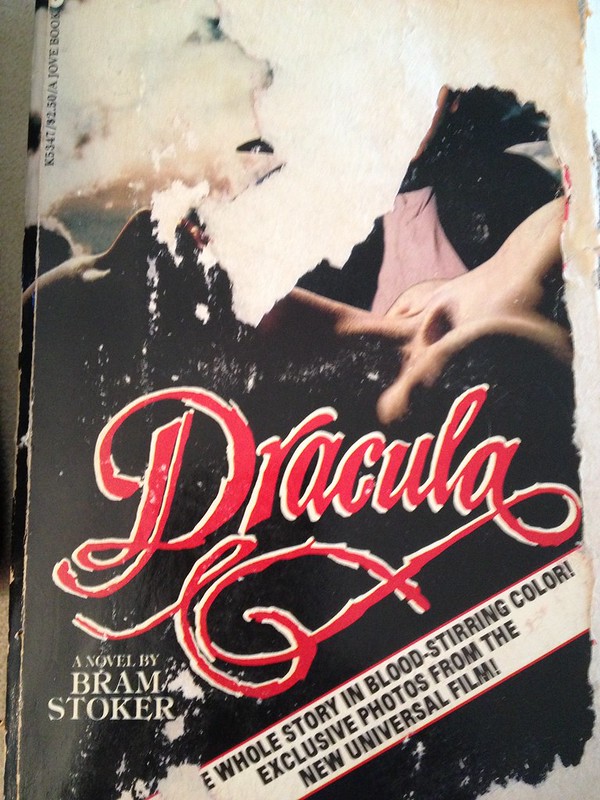
A few days after watching the movie I saw a book with Frank Langella as the Count on the cover in Waldenbooks and begged my mom to buy it for me. I thought it would be a novelization, a way for me to relive what I had just seen on screen. But it was a repackaging of Bram Stoker's original novel, and I'm so grateful to the fabulously sexy Langella for helping to introduce me to this classic Gothic epistolary novel. It became one of my favorite books that summer. I still have it, although it's a bit worse for wear.
I have read plenty of vampire stories since, by Anne Rice and many others (although I have not been tempted by Twilight), but none can compare to the original Stoker novel. Stoker never traveled to Transylvania, or anywhere near there. Maybe as the daughter of a newspaper man, I connected to a novel written by a reporter. Stoker was a theater critic and wrote for the London Daily Telegraph.
A few days after watching the movie I saw a book with Frank Langella as the Count on the cover in Waldenbooks and begged my mom to buy it for me. I thought it would be a novelization, a way for me to relive what I had just seen on screen. But it was a repackaging of Bram Stoker's original novel, and I'm so grateful to the fabulously sexy Langella for helping to introduce me to this classic Gothic epistolary novel. It became one of my favorite books that summer. I still have it, although it's a bit worse for wear.
![]() |
| More than a little dog-eared, but still loved. The back cover included the phrase, "His love is eternal ... His embrace a throbbing dream." |
![]() |
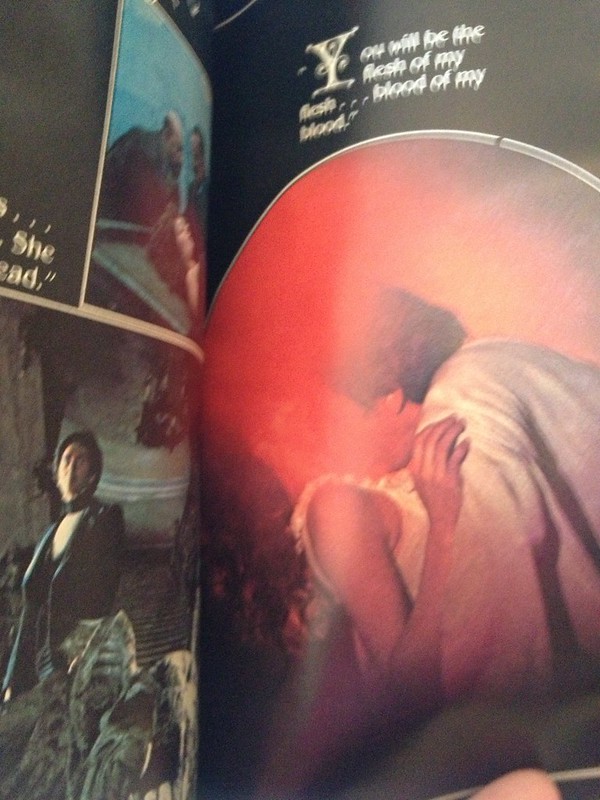
| A 24-page color insert! |
I have read plenty of vampire stories since, by Anne Rice and many others (although I have not been tempted by Twilight), but none can compare to the original Stoker novel. Stoker never traveled to Transylvania, or anywhere near there. Maybe as the daughter of a newspaper man, I connected to a novel written by a reporter. Stoker was a theater critic and wrote for the London Daily Telegraph.
Before writing Dracula, Stoker met Ármin Vámbéry who was a Hungarian writer and traveler. Dracula likely emerged from Vámbéry's dark stories by Carpathian mountains. Stoker then spent several years researching European folklore and mythological stories of vampires. Dracula is an epistolary novel, written as a collection of realistic, but completely fictional, diary entries, telegrams, letters, ship's logs, and newspaper clippings, all of which added a level of detailed realism to his story, a skill he developed as a newspaper writer. — WikipediaI may have originally bought Bram Stoker's Dracula for the color photo insert of Langella & Co., but the book ended up making a huge and lasting impression on me. Reading Dracula led me to other horror writing, by authors like Sheridan Le Fanu, M. R. James, H.P. Lovecraft, Theodore Sturgeon, and Edgar Allan Poe. Thank you, Bram Stoker, for your indelible character of Count Dracula. A character who will undoubtedly continue to inspire countless versions in the future.
Labels:
books,
Bram Stoker,
Bram Stoker's Dracula,
Dracula,
Frank Langella,
Horror,
Laurence Olivier,
movies
Tuesday, October 16, 2012
marilyn and miller — the playwright prince and the reluctant showgirl
Here's another essay from the longer-format piece I'm working on about Marilyn Monroe.
There are countless stories of how difficult Marilyn Monroe was to work with and be around during the making of The Prince and the Showgirl. Many of them come from the her highly indiscreet co-star and director, Laurence Olivier. More recently the actress's behavior has been recounted in two books by Colin Clark, who worked as an assistant to Olivier during the filming: The Prince, the Showgirl and Me, which reads as a snipey yet entertaining diary of his time on the set, and My Week with Marilyn, his recounting of a "lost week" not included in the first book, which reads as a wish-fulfillment fantasy.The latter notably became a film starring Michelle Williams as Marilyn and Kenneth Branagh as Olivier.
When one views The Prince and the Showgirl none of the strife between the lead actors is evident. In fact, Marilyn comes off much more accessible and watchable than Olivier, who is stiff and boring. To be fair, his character may have been written that way. The staginess of playwright Terence Rattigan's play, The Sleeping Prince, was preserved in his screen adaptation. But Olivier's acting approach also seems old-fashioned and off-putting. Marilyn not only understood the camera, but the inherent comedy in the piece, aspects that seemed to elude the great British Actor with a capital A.
Marilyn, no matter the strife in her life or her personal demons, always seemed to manage to put them aside on screen. She is luminescent, sporting golden hair (a wig), rather than her trademark platinum blonde. She also looks great in the period costumes designed by Beatrice Dawson. She is still her seductive self, with just the right combination of innocence, as an American showgirl in London, Elsie Marina.
So why would Marilyn have been in such a state during the filming? She was newlywed, just a few weeks, to playwright Arthur Miller, who accompanied her to London for the making of the movie. She should have been wallowing in domestic bliss. But that was not the case. Marilyn may have felt pressured to marry Miller (by Miller) — he announced their pending nuptials to the press before he bothered to ask the lady herself. Their wedding conveniently coincided with his hearing with the House Un-American Activities Committee. Having the biggest star in the world, Marilyn Monroe, on your side when you are being investigated to determine whether you are a Communist certainly helped Miller's image and case immeasurably.
"The Egghead and the Hourglass" wed quickly, and a week later found themselves ensconced in the tony surroundings of Parkside House in London. During their stay there Marilyn found some of Miller's notes for a project he was working on (which would later become his play After the Fall) — clearly inspired by her and undeniably unflattering. This was a major blow to her marriage fantasy of trust, protection, and hope. Such an incident easily kickstarted the cycle of lateness, forgetting lines, and generally difficult behavior that drove a professional working actor like Olivier mad. It didn't take much for Marilyn to slide into abusing the medications she took regularly. She was aided in these efforts by doctors who were only too willing to placate their celebrity client, and by her business partner and co-producer, photographer Milton Greene, who, along with Miller, Olivier, and countless others, was wrestling for control of the beautiful star.
Especially revealing is a poem she wrote during that time. She was already feeling insecure about the marriage:
I guess I have always been
deeply terrified to really be someone's wife
since I know from life
One cannot love another,
ever, really.
where his eyes rest with pleasure — I want to still be — but time has changed
the hold of that glance.
Alas how will I cope when I am
even less youthful —
Miller, very quickly in their marriage, was put in the role of caretaker, something he was highly unsuited for. It must have been an awakening, and an unpleasant one, for him, too. The responsibilities of being with Marilyn as his wife versus his lover were quite different. One can imagine when they were dating each other in New York that it would make no difference to Miller how long it took Marilyn to get herself together. He could work in the morning and see her in the evening. But sharing a house with a wife who was so addled from sleeping pills and painkillers, and who needed his help to get her up and going in the morning — with a new set of pills to achieve that effect — didn't leave much time for the strong-egoed Miller to concentrate on his own work. He wanted his time in England to bolster his own career. A production of his play A View from the Bridge was in production, and he hoped to cultivate Olivier's favor to his own advantage.
It makes one wonder about those "notes" he left lying around, a notebook left in plain sight, in which he called her a "bitch." Whether by mistake, subconscious, or purposeful needling, it was the wrong tack to take with her. With her fragile ego Marilyn needed someone who was unflinchingly supportive. A cheerleader. She needed the kind of unspoken support that one usually gets from a parent. Marilyn had neither a mother nor a father while she was growing up. That she was continually drawn to men with strong egos who didn't have the time or inclination to be nurturers was understandable, but also her mistake and tragedy. One could think of Hollywood in the late '40s and early '50s as a community of despotic fathers, and Marilyn was constantly put in the position if trying to please them, while simultaneously trying to rebel and shirk off their control.
The very plot of The Prince and the Showgirl reflects this. Set in 1911, Marilyn's Elsie, a beautiful and vivacious American chorus girl in a London review, catches the eye of an older visiting foreign dignitary, Grandduke Charles, the prince-regent of Carpathia. In town to attend the coronation of George V, but with seduction on his mind, he invites her for a late supper at the embassy. Elsie proves much smarter than anyone expects, and deftly dodges the Prince's clumsy attempts to seduce her, as well as interpret some political plotting being organized by his son, the King-regent. By the end of the film it is clear that Elsie has enchanted the Prince. They have both fallen in love, agreeing to reunite in 18 month's time, when both his regency and her music hall contract end.
Elsie is similar to Marilyn, who was attracted to powerful older men. Such men would fall in love with her beauty, and she in love with their intelligence and power. But they would ultimately prove unworthy of her, and she would once again feel crushed and disappointed and abandoned, as she had since she was a child, trying to please a series of foster families, but still inevitably being shuffled off, never having a permanent base to call her own.
A person as insecure as Marilyn must have been no picnic for Miller, but his lack of compassion for the weak cannot be isolated to their marriage. Years later, when married to his third wife, photographer Inge Morath, he insisted that their second child, Daniel, who was born with Down Syndrome, be institutionalized and not socialized with the family. His need to prove his intellectual power was one of his defining features.
Miller chose sides while he and Marilyn were in London, and shockingly to his wife, not hers. He championed Olivier's position, as he recounted in his autobiography Timebends: A Life,
Miller repeated the pattern he started during the filming of The Prince and the Showgirl when he and Marilyn made The Misfits two years later, in 1960. He chose to align himself with director John Huston rather than his fragile wife. The Misfits was supposed to be Miller's "Valentine" to Marilyn, a screenplay and story that he had written especially to showcase her talents as an actress, but the character of Roslyn Tabor was not always shown in a positive light. This was not lost on Marilyn, who cringed as each subsequent re-write became successively more unflattering.
She was furious about a scene late in the film, where Roslyn pleads with Clark Gable's character Gay not to sell wild mustangs to a slaughterhouse.
To add insult to injury, while their marriage was splintering, Miller befriended a young Magnum photographer, Inge Morath, who was assigned to take photos on the set of The Misfits. They married a month after his divorce from Marilyn was finalized in February 1962. Inge gave birth to their first child, Rebecca later that year, which must have been especially hard for Marilyn to hear.
When Marilyn first met Arthur Miller she was impressed with his intelligence and his integrity. As their relationship progressed she watched her idol fade, as he let some of his ideals slip for money (he crossed lines during a writer's strike in Hollywood to act as a script doctor on her film Let's Make Love), and her belief that she would finally be safe and loved turned out to be just a dream. Miller was not the sort of person to nurture and support a fragile actress or human being. His inability to prevent her dependence on doctors, drugs, and gurus is especially puzzling. Was he too weak to stand up to the people who wanted to control her, or was he just trying to protect his interests? The sad fact is that Marilyn's life, although always turbulent, was much worse after her time spent with Miller. She never really recovered after their divorce. One wonders what might have happened if she had either never met him, or moved on to someone else while she was in New York. We'll never know.
There are countless stories of how difficult Marilyn Monroe was to work with and be around during the making of The Prince and the Showgirl. Many of them come from the her highly indiscreet co-star and director, Laurence Olivier. More recently the actress's behavior has been recounted in two books by Colin Clark, who worked as an assistant to Olivier during the filming: The Prince, the Showgirl and Me, which reads as a snipey yet entertaining diary of his time on the set, and My Week with Marilyn, his recounting of a "lost week" not included in the first book, which reads as a wish-fulfillment fantasy.The latter notably became a film starring Michelle Williams as Marilyn and Kenneth Branagh as Olivier.
When one views The Prince and the Showgirl none of the strife between the lead actors is evident. In fact, Marilyn comes off much more accessible and watchable than Olivier, who is stiff and boring. To be fair, his character may have been written that way. The staginess of playwright Terence Rattigan's play, The Sleeping Prince, was preserved in his screen adaptation. But Olivier's acting approach also seems old-fashioned and off-putting. Marilyn not only understood the camera, but the inherent comedy in the piece, aspects that seemed to elude the great British Actor with a capital A.
Marilyn, no matter the strife in her life or her personal demons, always seemed to manage to put them aside on screen. She is luminescent, sporting golden hair (a wig), rather than her trademark platinum blonde. She also looks great in the period costumes designed by Beatrice Dawson. She is still her seductive self, with just the right combination of innocence, as an American showgirl in London, Elsie Marina.
![]() |
| Marilyn and Miller in New York |
"The Egghead and the Hourglass" wed quickly, and a week later found themselves ensconced in the tony surroundings of Parkside House in London. During their stay there Marilyn found some of Miller's notes for a project he was working on (which would later become his play After the Fall) — clearly inspired by her and undeniably unflattering. This was a major blow to her marriage fantasy of trust, protection, and hope. Such an incident easily kickstarted the cycle of lateness, forgetting lines, and generally difficult behavior that drove a professional working actor like Olivier mad. It didn't take much for Marilyn to slide into abusing the medications she took regularly. She was aided in these efforts by doctors who were only too willing to placate their celebrity client, and by her business partner and co-producer, photographer Milton Greene, who, along with Miller, Olivier, and countless others, was wrestling for control of the beautiful star.
Especially revealing is a poem she wrote during that time. She was already feeling insecure about the marriage:
I guess I have always been
deeply terrified to really be someone's wife
since I know from life
One cannot love another,
ever, really.
where his eyes rest with pleasure — I want to still be — but time has changed
the hold of that glance.
Alas how will I cope when I am
even less youthful —
Miller, very quickly in their marriage, was put in the role of caretaker, something he was highly unsuited for. It must have been an awakening, and an unpleasant one, for him, too. The responsibilities of being with Marilyn as his wife versus his lover were quite different. One can imagine when they were dating each other in New York that it would make no difference to Miller how long it took Marilyn to get herself together. He could work in the morning and see her in the evening. But sharing a house with a wife who was so addled from sleeping pills and painkillers, and who needed his help to get her up and going in the morning — with a new set of pills to achieve that effect — didn't leave much time for the strong-egoed Miller to concentrate on his own work. He wanted his time in England to bolster his own career. A production of his play A View from the Bridge was in production, and he hoped to cultivate Olivier's favor to his own advantage.
![]() |
| Milton Greene, Marilyn and Miller arrive at a London premiere |
The very plot of The Prince and the Showgirl reflects this. Set in 1911, Marilyn's Elsie, a beautiful and vivacious American chorus girl in a London review, catches the eye of an older visiting foreign dignitary, Grandduke Charles, the prince-regent of Carpathia. In town to attend the coronation of George V, but with seduction on his mind, he invites her for a late supper at the embassy. Elsie proves much smarter than anyone expects, and deftly dodges the Prince's clumsy attempts to seduce her, as well as interpret some political plotting being organized by his son, the King-regent. By the end of the film it is clear that Elsie has enchanted the Prince. They have both fallen in love, agreeing to reunite in 18 month's time, when both his regency and her music hall contract end.
Elsie is similar to Marilyn, who was attracted to powerful older men. Such men would fall in love with her beauty, and she in love with their intelligence and power. But they would ultimately prove unworthy of her, and she would once again feel crushed and disappointed and abandoned, as she had since she was a child, trying to please a series of foster families, but still inevitably being shuffled off, never having a permanent base to call her own.
A person as insecure as Marilyn must have been no picnic for Miller, but his lack of compassion for the weak cannot be isolated to their marriage. Years later, when married to his third wife, photographer Inge Morath, he insisted that their second child, Daniel, who was born with Down Syndrome, be institutionalized and not socialized with the family. His need to prove his intellectual power was one of his defining features.
![]() |
| Vivien Leigh, Laurence Olivier, Marilyn, and Miller at the theater, |
"It was simply impossible to agree that he could be the cheap scene-stealer she was talking about. ... Marilyn verged on the belief that he [Olivier] had cast her only because he needed the money her presence would bring. I wanted to believe that this was only half the truth; I was sure he saw the legitimate dramatic contrast between their social and cultural types, and if his motives were indeed partly cynical, they did not cancel his valid artistic judgment in casting. ... inevitably, the time soon came when in order to keep reality from slipping away I occasionally had to defend Olivier or else reinforce the naïveté of her illusions; the result was that she began to question the absoluteness of my partisanship on her side of the deepening struggle."Marilyn discovered that she was pregnant while she was in London. She suffered a miscarriage before filming wrapped. While married to Miller she later suffered an ectopic pregnancy, and yet another miscarriage after filming wrapped on Some Like it Hot in 1958. When they returned from England to their home in Roxbury, CT (a house mostly paid for by Marilyn, as Miller had not much money after his divorce), their married life hadn't improved much.
Starting tomorrow I will take care of myself for that's all I really have ever had. Roxbury — … I think I hate it here because there is no love here anymore. I regret the effort I desperately made here. ... what I could endure helped both of us and in a material way which means so much more to him than me. ... When one wants to stay alone as my love (Arthur) indicates the other must stay apart.
![]() |
| Marilyn and Miller, during the filming of The Misfits, photographed by Inge Morath |
She was furious about a scene late in the film, where Roslyn pleads with Clark Gable's character Gay not to sell wild mustangs to a slaughterhouse.
"I convince them by throwing a fit, not by explaining anything. So I have a fit. A screaming crazy fit … And to think, Arthur did this to me … If that's what he thinks of me, well, and I'm not for him and he's not for me." — Marilyn to her maid Lena Pepitone, from Marilyn, by Gloria Steinem
![]() |
| Marilyn photographed by Inge Morath on the set of The Misfits |
When Marilyn first met Arthur Miller she was impressed with his intelligence and his integrity. As their relationship progressed she watched her idol fade, as he let some of his ideals slip for money (he crossed lines during a writer's strike in Hollywood to act as a script doctor on her film Let's Make Love), and her belief that she would finally be safe and loved turned out to be just a dream. Miller was not the sort of person to nurture and support a fragile actress or human being. His inability to prevent her dependence on doctors, drugs, and gurus is especially puzzling. Was he too weak to stand up to the people who wanted to control her, or was he just trying to protect his interests? The sad fact is that Marilyn's life, although always turbulent, was much worse after her time spent with Miller. She never really recovered after their divorce. One wonders what might have happened if she had either never met him, or moved on to someone else while she was in New York. We'll never know.
Related articles
Tuesday, August 07, 2012
his week with marilyn (maybe)
"For five months, whether she turned up or not, she dominated our every waking thought."My Week with Marilyn
It's interesting to read his intimate (fantasist?) diary first, and then read the more reporter-like journal of his days working on the film and catch clues to his possibly more intimate interactions with Marilyn. His dates don't match up exactly, which doesn't help with his credibility. In My Week with Marilyn he is present in her home on the night of September 18 when she suffered a miscarriage. He plays a very active, even take-charge role in getting a doctor, managing her entourage, etc. during the crisis (newlywed husband Arthur Miller was absent in New York at the time). In The Prince, the Showgirl, and Me he hears about Marilyn losing a baby while gossiping with her bodyguard, after the fact, on September 8. Does one of these scenarios sound more realistic than the other?
![]() |
| Olivier trying to direct Marilyn on the set of The Prince and the Showgirl |
![]() |
| Williams as Marilyn and Branagh as Olivier in My Week with Marilyn |
The double-edition is structured so that one reads Clark's lost diary first and then his more day-to-day account of the making of The Prince and the Showgirl. My Week with Marilyn is probably as much fantasy as fact, but the reader still comes away with a sense of what Marilyn must have been going through during her time in London, such a fish out of water, endlessly pampered but also abandoned. It's highly unlikely that Clark could remember verbatim so many conversations so long after the fact, but there is still a ring of truth in his exchanges with Marilyn. On an excursion the pair take to Windsor Great Park he has Marilyn say, "Why do I take all those pills? Why do I worry about what all those men think? Why do I let myself get pushed around? This is how I ought to feel, every day of my life. This is the real me ... " Maybe he writes her as he wishes she had been. But he somehow does manage to capture some essence of Marilyn.
Where the book is at its most observant and entertaining is in his (frequently catty) observations of the other key players. He has no use for Marilyn's husband of a few weeks, playwright Arthur Miller, "... Arthur Miller takes it all for granted — his house, his servants, his driver, his wife's bodyguard, and even, so it seems to me, his wife. That is what makes me so angry. How can you take Marilyn Monroe for granted?"
He is incredibly sympathetic to Marilyn, and frequently criticizes his boss (and family friend) Olivier for his callous treatment of her. "The rest of Olivier's circle, including Olivier himself, actually welcomed reports of her deteriorating condition as evidence that their opinion of her had been right all along. It was only toward the end of his life that Olivier was able to relent." He repeatedly describes her ill treatment on the set and wishes that Olivier and others could be more kind, patient, and understanding with her. "[Lighting cinematographer Jack Cardiff] is the only person on the set who treats Marilyn like a chum. As a result he is the one crew member to whom she can relate, and certainly the only Englishman she trusts. In return he uses all his artistry to bring out her beauty. He clearly adores her, and because he's an artist, with no ulterior motive, she responds to him very well."
My Week with Marilyn, ultimately, is a bit of fluffy wish-fulfillment romance, with the two unrequited lovers parting amicably, never to see one another again. Clark's earlier book, The Prince, the Showgirl, and Me, is a much more straightforward account of Clark's experience during the making of the film. Although the focus is squarely on Clark, including some accounts of youthful, fumbling, sexual encounters, it gives the reader a good sense of life on a movie set; all the drama and romance, as well as describing how shots are set up and what the crew does, including lighting, sets, and make-up.
Clark comes off as a bit of a cad as he boasts of his dealings with the "wdg," his nickname for a nameless wardrobe girl. He is a rich kid, who got the job through his connections with the Oliviers (Laurence and actress Vivien Leigh), friends with his parents. His father was Kenneth Clark, the famous art historian. He is a snob, too, sharing all of his superior attitudes about extras and frequent name-dropping of his parents' friends. But he does bring to life the chaos and management of all of the minute details that go into making a movie. He outlines how difficult it was to wrangle extras for the coronation scene in the film (from the pool of extras as well as a ballroom dancing club) as well as the ridiculous but long-standing power of film unions. He recounts how he wasn't allowed to fetch or move a chair so that elderly actress Dame Sybil Thorndike (who played the Queen dowager in the film) could sit down (a scene included in the film version, with Judi Dench as Thorndike) while they waited for Marilyn to appear on the set — a prop mover insisted that only he or one of his fellow union members could do it, so everybody stood around for ten minutes while that was accomplished.
Even with all of his upper class and film world connections, Clark had to fight to get work on the film. He is quickly blown off by the head of Laurence Olivier Productions when he shows up for a job, but he perseveres, showing up every day, and tries to make himself useful. After a week or so his persistence pays off as he is tasked with finding a suitable house for Marilyn to stay in while filming. He comes up with a clever solution, by securing two houses for the company, but it is also undeniable that his family connections also came in handy, as he travels in the circles where securing an available manor house is a regular occurrence. His success leads to a job as a third assistant director, or gofer, on the film set.
In The Prince, the Showgirl, and Me Clark seems less impressed and sympathetic about Marilyn, "She has got a cute smile, but so far she only turns it on for the cameras. Her figure — and especially her bust — is fantastic but a little on the plump side. Problems — too much fakery: peroxide hair, dead white make-up, heavy lipstick, but that is her image. She looks confused too, lost, troubled."
One interesting anecdote: for some reason they filmed tests with Marilyn first without make-up, and then after in full make-up, wig, and costume. Clark is amazed by her transformation. "The film was magical, and there's no other way to describe it. Stuff we shot in the morning, although it resembled a police lineup mug shot, was quite heartbreaking. MM looked like a young delinquent girl, helpless and vulnerable under the harsh lights. The afternoon footage was even more extraordinary. What an incredible transformation. Now MM looks like an angel — smooth, glowing, eyes shining with joy (Jack [Cardiff]'s lights), perfect lips slightly parted, irresistible."
He is much less understanding of her personal problems and vulnerability in this book. "It's true that MM doesn't notice much of what is going on around her, but the knowledge that 60 actors and technicians are waiting for you, and at enormous cost to you personally, it's hardly one to induce calm in anyone, let alone someone with such a fragile grip on stability as MM. ... MM is so difficult to work with that even hardened technicians are driven crazy. But when she doesn't show up, we miss her! What a paradox."
Amusingly and consistently, he hates Arthur Miller, and never hesitates to say so, in both books, "AM seems big headed, insensitive, and super selfish. I never saw him look tenderly at MM, only with what looks like a sort of boasting self-satisfaction. What bad luck on MM. Why couldn't she have found what she really needs — someone sympathetic to support her? She doesn't move around with those sort of people I suppose."
He doesn't just reserve his criticisms for the Americans. He can be just as tough on his boss, Olivier. Clark may love and respect his old family friend, but he never stints on honesty where he is concerned. "[Olivier] has made many films — some great and some mouldy. Only on stage, to a very limited audience, can he be seen as the great actor he is."
Both books offer a kaleidoscopic view of the difficulties behind making the film. Although Marilyn most definitely added another layer of mayhem, Clark's recounting reminds us that most film sets are chaotic worlds, and that it is a miracle that with so many disparate and opposing elements that any movie gets completed at all. One of the volumes may be more fiction than fact, but together they offer a glimpse behind-the-scenes of the only film produced by Marilyn Monroe Productions. As Clark frequently reminds the reader, none of the tensions, bickering, or even all-out hatred that may have been felt by the parties involved is evident on screen. Marilyn is fresh and lovely and walks away with the picture from a stiff and old-fashioned Olivier. Movie magic.
Related articles
Monday, July 23, 2012
arthur miller's timebends
Arthur Miller's Timebends: A Life
, his time-hopping autobiography, was first published in 1987, when the renowned playwright was 72. In it he chronicles his youth in Brooklyn, his life in the New York theater, and his trials and tribulations and his ability to not "name names" to the House Un-American Activities Committee during the McCarthy red-baiting scare of the 1950s. All fascinating stuff. The book, not unexpectedly, is well written, even poetic at times. But the bulk of (this) and many other readers interest in Timebends is that it is also the first occasion of Miller speaking publicly about his second wife, Marilyn Monroe.
As long and as interesting as Miller's life had been up to the point of his writing Timebends, he spends the majority of the book discussing the period of his life that included Marilyn. He first met her in 1950, when he was touting a screenplay in Hollywood with director Elia Kazan. She made an indelible impression, one that apparently never left him. Miller also made an impression on Marilyn, and she kept in touch with him, exchanging letters over the years.
He based one of his characters, Lorraine, in a(n unfinished) play he was working on in 1951 on Marilyn, although he had only met her the year before, briefly "By now, even after only those few hours with Marilyn, she had taken on an immanence in my imagination, the vitality of a force one does not understand but that seems on the verge of lighting up a vast surrounding plain of darkness. I was struggling to keep my marriage and family together and at the same time to understand why I felt as though I had lost a sort of sanction that I had seemed to possess since earliest childhood. Whom or what was I writing for?" Sounds like a combination of the seven-year-itch and Miller being in search of a muse. There is little to no mention of his life with his first wife, Mary and his family in Timebends.
Miller may not have realized how his private life was seeping into his work, but his colleagues and contemporaries did. He even ruefully quotes playwright Clifford Odets' slam of his 1953 play The Crucible to Elia Kazan: "Just a story about a bad marriage." It may be an overstatement, but Miller admits that before even embarking on the project, the central conflict of his guilt-ridden protagonist John Proctor, who has had a sexual relationship with his servant girl Abigail Williams, might be more related to his own life than he would like. His attraction to Marilyn was already influencing him, and providing a subtext in his work.
As much as Miller was obviously attracted to Marilyn as a woman, he also might have felt that she offered a new chance for him, a new medium for his writing — film. "I could not help thinking in 1953-54 that time was running out, not only on me but on the traditional American culture. I was growing more and more frighteningly isolated, in life as in the theater." As much as Miller admits to being pulled towards her, he never comes out and simply says that he loves Marilyn. But he spends a lot of pages analyzing her and theorizing about her. His descriptions of her don't always sound like a real woman, but rather a character he is fashioning. More than once he says that she is cursed, presumably by her rough childhood. It's unclear whether he believed this on his own, or because he thought she believed it.
Once Marilyn left Hollywood (and Joe DiMaggio) for New York in 1955, she and Miller quickly made their friendship something much more. Miller got a quickie Reno divorce while Marilyn was filming Bus Stop and they married in 1956.
Miller may have loved her, but Timebends and its author maintain a superior tone when he talks about her insecurities and what he deems as her unfounded suspicions of others' motives. They had departed for London for their honeymoon and for Marilyn to film The Prince and Showgirl with Laurence Olivier co-starring and directing. When their two very different acting styles clashed, Miller, unfortunately for his marriage, chose the wrong side, unable to believe an actor of Olivier's calibre could ever be in the wrong, "It was simply impossible to agree that he could be the cheap scene-stealer she was talking about. ... Marilyn verged on the belief that he [Olivier] had cast her only because he needed the money her presence would bring. I wanted to believe that this was only half the truth; I was sure he saw the legitimate dramatic contrast between their social and cultural types, and if his motives were indeed partly cynical, they did not cancel his valid artistic judgment in casting. ... inevitably, the time soon came when in order to keep reality from slipping away I occasionally had to defend Olivier or else reinforce the naïveté of her illusions; the result was that she began to question the absoluteness of my partisanship on her side of the deepening struggle."
By the time they were filming The Misfts the marriage, and their faith in each other, was shattered. "... With The Misfits I was preparing to dedicate a year or more of my life to her enhancement as a performer — I would never have dreamed of writing a movie otherwise ..."Not entirely true, as he had been shopping a screenplay back in 1950, when he first met her. He writes that he hopes The Misfits will save their marriage. Yet he doesn't detail any concrete problems between them, except what he views as her innate despair. He writes about their life from a distance, rarely mentioning her intake of sleeping pills, or the second baby they lost.
"During the shooting of Let's Make Love and Some Like It Hot I had all but given up any hope of writing; I had decided to devote myself to giving her the kind of emotional support that would convince her she was no longer alone in the world — the heart of the problem, I assumed. I went so far as to do some rewriting on Let's Make Love to try to save her from a complete catastrophe, work I despised on a script not worth the paper it was typed on. It was a bad miscalculation, bringing us no closer to each other." He neglects to mention, of course, well-documented in other sources, his agreeing, for a lucrative sum, to work on Let's Make Love during a Writer's Guild strike in Hollywood, which caused Marilyn to lose faith in him and his integrity.
He calls her role as Roslyn in The Misfits, more than once, her first serious part, but that is far from true. What of Bus Stop, Niagara, and The Asphalt Jungle, just to name a few? He spends a lot of pages explaining his ideas behind The Misfits, but skirts how his "Valentine" to his wife created such a negative story. "One afternoon Marilyn, with no evident emotion, almost as though it were just another script, said, 'What they really should do is break up at the end.' I instantly disagreed, so quickly, in fact, that I knew I was afraid she was right. But the irony was too sharp: the work I had created to reassure her that a woman like herself could find a home in the world had apparently proved the opposite."
Even after so many years, he really fudges what was going on behind-the-scenes on the shoot. He points out Marilyn's escalating lateness caused by pills, tension, and personal problems, but waves away director John Huston's staying up all night shooting craps as something that may have adversely affected the shooting of the movie. Instead, he views Huston's casino time as a byproduct of Marilyn's behavior and not the fact that Huston was more than happy to be shooting a movie set in Reno for his own reasons. Miller claims that Marilyn moved out of their shared hotel suite to Paula Strasberg's because "Her control over Marilyn was now so complete… Paula had finally won our long undeclared war. Still, this might clear the air, I thought, and free Marilyn to concentrate solely on the work she now said she wanted to do." Marilyn moving out of a room shared with her husband had nothing to do with the fact that his rewrites showed her in an increasingly unflattering light, or that he had met photographer Inge Morath (who he would marry a year later) on the set?
As he is watching Marilyn film a scene with costar and Hollywood legend Clark Gable near a lake, "I was almost completely out of her life by now, but from my distant view the film seemed purely a torture for her. … To be fair, her work in the film looked far more authentic to me in later years than it did during that bad time. I now marvel at how she managed, under the circumstances, to do as well as she did." Once he is through with The Misfits, through with Marilyn (for the most part), he finally writes about Inge Morath, but not until page 493. But Marilyn soon re-enters his life, and Timebends, through her death.
He wraps up the book with details of his controversial play After the Fall — controversial because of its main female character's uncanny resemblance to Marilyn, as well as his being able to bring productions of his other plays to places as remote as Russia and China. Miller, who died in 2005, had a successful and productive career, producing some of the most lauded and memorable plays in American theater, The Crucible, All My Sons, and Death of A Salesman, for which he will always be remembered. But he will also clearly also always be remembered as Marilyn Monroe's second husband, or as they were dubbed by the press at the time, "The Egghead and the Hourglass." He seems to be at peace with that fact in Timebends, if not completely convinced that it all really happened.
![]() |
| Happy times — Miller and Marilyn dancing at the April in Paris Ball, Waldorf Astoria Hotel ballroom, c. 1957. From Vintage Everyday |
He based one of his characters, Lorraine, in a(n unfinished) play he was working on in 1951 on Marilyn, although he had only met her the year before, briefly "By now, even after only those few hours with Marilyn, she had taken on an immanence in my imagination, the vitality of a force one does not understand but that seems on the verge of lighting up a vast surrounding plain of darkness. I was struggling to keep my marriage and family together and at the same time to understand why I felt as though I had lost a sort of sanction that I had seemed to possess since earliest childhood. Whom or what was I writing for?" Sounds like a combination of the seven-year-itch and Miller being in search of a muse. There is little to no mention of his life with his first wife, Mary and his family in Timebends.
Miller may not have realized how his private life was seeping into his work, but his colleagues and contemporaries did. He even ruefully quotes playwright Clifford Odets' slam of his 1953 play The Crucible to Elia Kazan: "Just a story about a bad marriage." It may be an overstatement, but Miller admits that before even embarking on the project, the central conflict of his guilt-ridden protagonist John Proctor, who has had a sexual relationship with his servant girl Abigail Williams, might be more related to his own life than he would like. His attraction to Marilyn was already influencing him, and providing a subtext in his work.
As much as Miller was obviously attracted to Marilyn as a woman, he also might have felt that she offered a new chance for him, a new medium for his writing — film. "I could not help thinking in 1953-54 that time was running out, not only on me but on the traditional American culture. I was growing more and more frighteningly isolated, in life as in the theater." As much as Miller admits to being pulled towards her, he never comes out and simply says that he loves Marilyn. But he spends a lot of pages analyzing her and theorizing about her. His descriptions of her don't always sound like a real woman, but rather a character he is fashioning. More than once he says that she is cursed, presumably by her rough childhood. It's unclear whether he believed this on his own, or because he thought she believed it.
Once Marilyn left Hollywood (and Joe DiMaggio) for New York in 1955, she and Miller quickly made their friendship something much more. Miller got a quickie Reno divorce while Marilyn was filming Bus Stop and they married in 1956.
"I was forever saving her from crowds, crowds she could handle as easily and joyfully as a minister moving among his congregation. Sometimes it was as though the crowd had given her birth; I never saw her unhappy in a crowd, even some that ripped pieces of her clothes off as souvenirs."
Miller may have loved her, but Timebends and its author maintain a superior tone when he talks about her insecurities and what he deems as her unfounded suspicions of others' motives. They had departed for London for their honeymoon and for Marilyn to film The Prince and Showgirl with Laurence Olivier co-starring and directing. When their two very different acting styles clashed, Miller, unfortunately for his marriage, chose the wrong side, unable to believe an actor of Olivier's calibre could ever be in the wrong, "It was simply impossible to agree that he could be the cheap scene-stealer she was talking about. ... Marilyn verged on the belief that he [Olivier] had cast her only because he needed the money her presence would bring. I wanted to believe that this was only half the truth; I was sure he saw the legitimate dramatic contrast between their social and cultural types, and if his motives were indeed partly cynical, they did not cancel his valid artistic judgment in casting. ... inevitably, the time soon came when in order to keep reality from slipping away I occasionally had to defend Olivier or else reinforce the naïveté of her illusions; the result was that she began to question the absoluteness of my partisanship on her side of the deepening struggle."
By the time they were filming The Misfts the marriage, and their faith in each other, was shattered. "... With The Misfits I was preparing to dedicate a year or more of my life to her enhancement as a performer — I would never have dreamed of writing a movie otherwise ..."Not entirely true, as he had been shopping a screenplay back in 1950, when he first met her. He writes that he hopes The Misfits will save their marriage. Yet he doesn't detail any concrete problems between them, except what he views as her innate despair. He writes about their life from a distance, rarely mentioning her intake of sleeping pills, or the second baby they lost.
"During the shooting of Let's Make Love and Some Like It Hot I had all but given up any hope of writing; I had decided to devote myself to giving her the kind of emotional support that would convince her she was no longer alone in the world — the heart of the problem, I assumed. I went so far as to do some rewriting on Let's Make Love to try to save her from a complete catastrophe, work I despised on a script not worth the paper it was typed on. It was a bad miscalculation, bringing us no closer to each other." He neglects to mention, of course, well-documented in other sources, his agreeing, for a lucrative sum, to work on Let's Make Love during a Writer's Guild strike in Hollywood, which caused Marilyn to lose faith in him and his integrity.
He calls her role as Roslyn in The Misfits, more than once, her first serious part, but that is far from true. What of Bus Stop, Niagara, and The Asphalt Jungle, just to name a few? He spends a lot of pages explaining his ideas behind The Misfits, but skirts how his "Valentine" to his wife created such a negative story. "One afternoon Marilyn, with no evident emotion, almost as though it were just another script, said, 'What they really should do is break up at the end.' I instantly disagreed, so quickly, in fact, that I knew I was afraid she was right. But the irony was too sharp: the work I had created to reassure her that a woman like herself could find a home in the world had apparently proved the opposite."
Even after so many years, he really fudges what was going on behind-the-scenes on the shoot. He points out Marilyn's escalating lateness caused by pills, tension, and personal problems, but waves away director John Huston's staying up all night shooting craps as something that may have adversely affected the shooting of the movie. Instead, he views Huston's casino time as a byproduct of Marilyn's behavior and not the fact that Huston was more than happy to be shooting a movie set in Reno for his own reasons. Miller claims that Marilyn moved out of their shared hotel suite to Paula Strasberg's because "Her control over Marilyn was now so complete… Paula had finally won our long undeclared war. Still, this might clear the air, I thought, and free Marilyn to concentrate solely on the work she now said she wanted to do." Marilyn moving out of a room shared with her husband had nothing to do with the fact that his rewrites showed her in an increasingly unflattering light, or that he had met photographer Inge Morath (who he would marry a year later) on the set?
![]() |
| Awkward — Marilyn and Miller dancing on the set of The Misfits |
"Coming out of the '40s and '50s, she was proof that sexuality and seriousness could not coexist in America's psyche, were hostile, mutually rejecting opposites, in fact. At the end she had had to give way and go back to swimming naked in a pool [in Something's Got To Give] in order to make a picture."Miller's take on the people who surrounded Marilyn differ from other accounts. He demonizes her business partner Milton Greene, but lionizes her doctors, describing psychiatrists Dr. Marianne Kris (in New York) and Ralph Greenson (in Los Angeles) as both "physicians of integrity and unquestionably devoted to her." It is understandable, as he views them as trying to help her, and failing, as he once did. But more recent takes on Kris and Greenson show that they may have done Marilyn more harm than good, and not just by the endless supply of barbiturates that they sent her way. Miller had no contact with Marilyn, or real knowledge of her life in California after they divorced, so his assumptions are just that.
"... She had always been one of those people for whom time is a sticky entanglement that they don't want to touch, perhaps in denial that a past exists."In Timebends Miller writes about her poetically enough, but Marilyn, his conception of Marilyn, rarely comes across as a real person. She is still a muse to his words, almost thirty years after their break-up and her death. Perhaps that is all she really ever was to him. The exception is one story that he tells about her during the filming of The Misfits, where she is being shot up with Amytal by a local, reluctant doctor, while he and acting coach Paula Strasberg look on. An irritated Marilyn sees him and mutters "Get out" repeatedly until he slinks out of the room. Not a pretty scene, but one that has the ring of truth.
He wraps up the book with details of his controversial play After the Fall — controversial because of its main female character's uncanny resemblance to Marilyn, as well as his being able to bring productions of his other plays to places as remote as Russia and China. Miller, who died in 2005, had a successful and productive career, producing some of the most lauded and memorable plays in American theater, The Crucible, All My Sons, and Death of A Salesman, for which he will always be remembered. But he will also clearly also always be remembered as Marilyn Monroe's second husband, or as they were dubbed by the press at the time, "The Egghead and the Hourglass." He seems to be at peace with that fact in Timebends, if not completely convinced that it all really happened.
Labels:
#CBR4,
Arthur Miller,
books,
Elia Kazan,
Hollywood,
Laurence Olivier,
Marilyn Monroe,
xoxoxoe
Subscribe to:
Comments (Atom)


.jpeg)