Showing posts with label thriller. Show all posts

Monday, May 10, 2021

strangers on a train - stranger and strangerer

Every once in a while I get a yen to read the source novel for one of my favorite classic movies. My most recent read (actually listen) is Strangers On A Train, by Patricia Highsmith. I have seen the classic Alfred Hitchcock film, featuring Robert Walker and Farley Granger, many times. There are some indelible, memorable scenes in that movie – the two men crossing legs and crossing lives on the train, the gold lighter which incriminates and absolves, the final deadly and hair-raising sequence on the merry-go-round at the amusement park. Apart from their initial meeting on the train, Hitchcock fans should know that none of those set pieces are in the book.
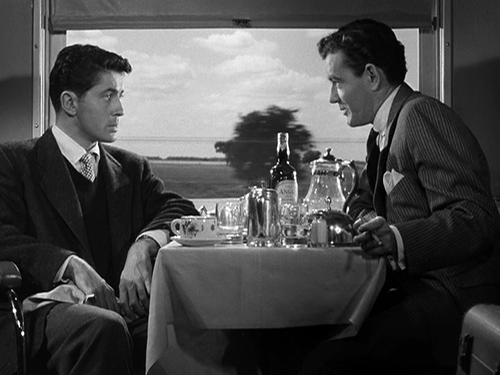
Strangers On A Train
Strangers On A Train, directed by Alfred Hitchcock, with Farley Granger and Robert Walker.

That doesn’t mean that the book isn’t interesting, however. It was Highsmith’s first novel, published five years before her successful The Talented Mr. Ripley. It could be viewed as a precursor of some of the themes that appear in that novel, like the doubling effect of two male protagonists. Charles Bruno is a charming sociopath. He wants to “trade murders” with a random man he meets on a train, Guy Haines, an up-and-coming architect (Hitch made him a tennis pro). Guy doesn’t take Bruno seriously, but he doesn’t condemn him that forcefully, either. Guy’s got his own problems. His estranged wife Miriam is now pregnant by her new boyfriend and he’s hoping she will agree to a divorce so that he can marry his (very rich) sweetheart Anne. But Miriam is not known for being agreeable.

Strangers On A Train is a psychological thriller. Highsmith is most interested in Guy’s mental journey and collapse as Bruno continually pressures him to hold up his end of the bargain. Written in 1950, the undercurrents of homosexuality between the two men must have seemed shocking. Highsmith isn’t exactly sympathetic to the almost perpetually drunken Bruno, but she lets his character grow through his actions and how people react to him, which makes him more interesting than broody Guy. In fact, “hero” Guy becomes more and more unlikable as the story progresses. Highsmith does not do a very good job with her lone female character, Anne, who seems to only exist to be devoted to Guy, but we are never given a reason why she likes the increasingly unpleasant fellow. The story is told at times from both Guy’s and Bruno’s perspectives. The book would have definitely benefited if we had more of Anne’s perspective, too.
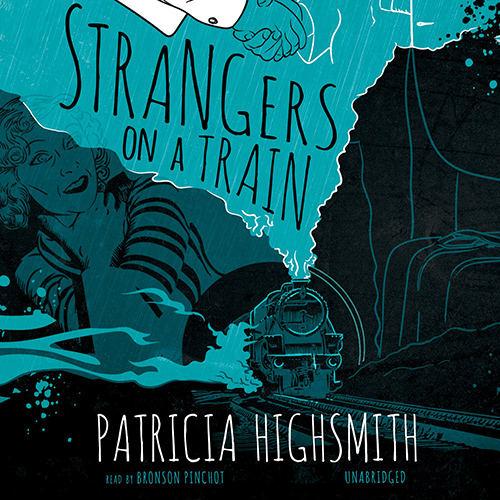
Strangers On A Train
Strangers On A Train, written by Patricia Highsmith, read by Bronson Pinchot

Ultimately Strangers On A Train is an interesting read, but I prefer how Alfred Hitchcock streamlined some of the action and themes and certainly brought his visual flair to Highsmith’s clever plot idea. I “read” the audible version of this book, read by Bronson Pinchot.


Featured on Cannonball Read Instagram and on Cannonball Read

Wednesday, October 24, 2018

favorite movie #84 - halloween edition: bunny lake is missing

Favorite movies that have had an impact on me - #84 - Bunny Lake is Missing (1965) - Some may consider this more of a thriller, but I have always reacted to this as a horror film. Director Otto Preminger sets the film in seemingly mundane London locations which become creepy, even nightmarish, as Ann Lake (Carol Lynley) tries to convince everyone that her little girl Bunny has disappeared. A police inspector (Laurence Olivier) and even Ann's own brother (Keir Dullea) seem to doubt her and her story as the film progresses.


Wednesday, September 26, 2018

favorite movie #55 and art in film: The big clock/no way out

Favorite movies that have had an impact on me - #55 - The Big Clock (1948)/No Way Out (1987) - The Big Clock is an interesting blend of comedy and film noir. The comedy comes mainly from hero Ray Milland, who can never help but be charming, and Elsa Lanchester, who puts in a wonderful comic turn as an eccentric artist. Milland plays George Stroud, a New York editor who works for megalomaniac publisher Earl Janoth (Charles Laughton). Stroud befriends Pauline York (Rita Johnson), Janoth's mistress, who is fed up with his controlling ways. After a madcap night of drinking and complaining about the boss, Stroud leaves York's apartment as Janoth arrives - the jealous Janoth only sees a man's silhouette, but he is still enraged, and in a fit of passion kills York. The rest of the film has Janoth and his right-hand man Hagen (George Macready) tasking Stroud with finding this mystery man so that they can pin the crime on him. As Stroud leads the investigation he has to stay one step ahead at every moment, fearful that he will be recognized as the man in question. Directed by John Farrow, the film is beautifully shot in black and white, with modern furniture and settings, especially the Janoth Publications enormous clock that ticks away,  possibly ticking away Stroud's future and freedom. Art by Lanchester's character is used cleverly both as clues to the crime and for comic effect.

Art by Boris Grisson

Hagen (George Macready) tries to cover up for his boss


Stroud hides out inside the clock

The Big Clock was remade in 1987 as No Way Out. The setting was changed to Washington, D.C., and the emphasis was less on murder mystery and more as a political thriller/romance. Kevin Costner stars as Navy Lieutenant Commander Tom Farrell, who is introduced to the Secretary of Defense, David Brice (Gene Hackman) by a college friend (Will Patton) at an inaugural ball. At the same event he meets Susan Atwell (Sean Young). The two begin an intense, passionate affair, but Farrell soon learns that Susan is also the mistress of a powerful man ... guess who? After seeing a shadowy male figure leave Susan's home, a jealous Brice accidentally kills her, and as in The Big Clock, Farrell is put in charge of the investigation to find the "real" killer. The rest of the film takes place in the claustrophobic halls and offices of the Pentagon, as Farrell tries to avoid capture while proving that Brice is the true culprit. No Way Out is not as stylish as The Big Clock, but it is fast-paced and exciting, and Costner and Young are very sexy in their scenes together. The political setting also provides the filmmakers with some additional twists and turns featuring a Russian spy subplot.


Both films are great to watch and favorites when I'm in the mood for a paranoid thriller.

Sunday, September 23, 2018

favorite movie #52: vertigo

Favorite movies that have had an impact on me - #52 - Vertigo (1958) - I saw Vertigo for the first time, and in a theater during its 1983 restoration/re-release. Wow.


I still remember to this day the hypnotic scene when Jimmy Stewart's Scottie is following Kim Novak's Madeleine and she walks into a flower shop from an alley back door. The alley is dark and dirty and the door is made of wood. I can swear when voyeuristic Scottie opens the wooden for a crack to see Madeleine surrounded by beautiful, colorful lush blooms I got a whiff of fragrant flowers myself.
Scottie (James Stewart) spies on Madeleine (Kim Novak)

Vertigo is Hitchcock's most person film and undoubtedly his masterpiece.


Judy (Kim Novak): If I let you change me, will that do it? If I do what you tell me, will you love me?


Related:

happy alfred hitchcock day!

Tuesday, September 18, 2018

favorite movie #48: the two mrs. carrolls (1947)

Favorite movies that have had an impact on me - #48 - The Two Mrs. Carrolls (1948) - Hollywood likes to portray artists in movies, but they rarely get them right. But I can't help it, I'm a sucker for any movie about an artist. The Two Mrs. Carrolls is a mash-up of Gaslight and Suspicion, with a healthy dose of the Bluebeard fairy tale thrown in. Humphrey Bogart plays an artist who falls in love with women, and then ultimately tires of them, in a homicidal way — after he finishes a grand portrait of them. Barbara Stanwyck is his latest bride and victim, and she suffers marvelously, outfitted by Edith Head. Certainly not the best of either of their pictures, but there is something about this film, from their early romance, which seems charming enough, to Bogart's later Captain Queeg-Like behavior that makes it quite enjoyable to watch. And the paintings (done by studio painter John Decker) are a sight to behold.

Bogie sketches Stanwyck in an idyllic setting

Mr. Carroll considers a Mrs. Carroll #3 (Alexis Smith)
An amazing creation by Edith Head
The first Mrs. Carroll as the angel of death

Mr. Carroll loves his daughter (Ann Carter) — hopefully he'll never paint her

She finally finds what he has been working on behind the locked studio door
Shades of Suspicion ...


Related:

Dark Gallery - art in film