Showing posts with label Patricia Highsmith. Show all posts

Monday, May 10, 2021

strangers on a train - stranger and strangerer

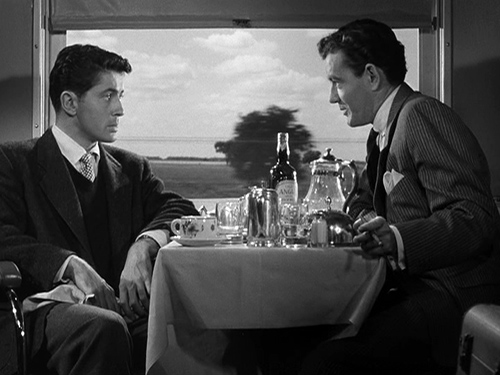
Every once in a while I get a yen to read the source novel for one of my favorite classic movies. My most recent read (actually listen) is Strangers On A Train, by Patricia Highsmith. I have seen the classic Alfred Hitchcock film, featuring Robert Walker and Farley Granger, many times. There are some indelible, memorable scenes in that movie – the two men crossing legs and crossing lives on the train, the gold lighter which incriminates and absolves, the final deadly and hair-raising sequence on the merry-go-round at the amusement park. Apart from their initial meeting on the train, Hitchcock fans should know that none of those set pieces are in the book.

Strangers On A Train
Strangers On A Train, directed by Alfred Hitchcock, with Farley Granger and Robert Walker.

That doesn’t mean that the book isn’t interesting, however. It was Highsmith’s first novel, published five years before her successful The Talented Mr. Ripley. It could be viewed as a precursor of some of the themes that appear in that novel, like the doubling effect of two male protagonists. Charles Bruno is a charming sociopath. He wants to “trade murders” with a random man he meets on a train, Guy Haines, an up-and-coming architect (Hitch made him a tennis pro). Guy doesn’t take Bruno seriously, but he doesn’t condemn him that forcefully, either. Guy’s got his own problems. His estranged wife Miriam is now pregnant by her new boyfriend and he’s hoping she will agree to a divorce so that he can marry his (very rich) sweetheart Anne. But Miriam is not known for being agreeable.

Strangers On A Train is a psychological thriller. Highsmith is most interested in Guy’s mental journey and collapse as Bruno continually pressures him to hold up his end of the bargain. Written in 1950, the undercurrents of homosexuality between the two men must have seemed shocking. Highsmith isn’t exactly sympathetic to the almost perpetually drunken Bruno, but she lets his character grow through his actions and how people react to him, which makes him more interesting than broody Guy. In fact, “hero” Guy becomes more and more unlikable as the story progresses. Highsmith does not do a very good job with her lone female character, Anne, who seems to only exist to be devoted to Guy, but we are never given a reason why she likes the increasingly unpleasant fellow. The story is told at times from both Guy’s and Bruno’s perspectives. The book would have definitely benefited if we had more of Anne’s perspective, too.

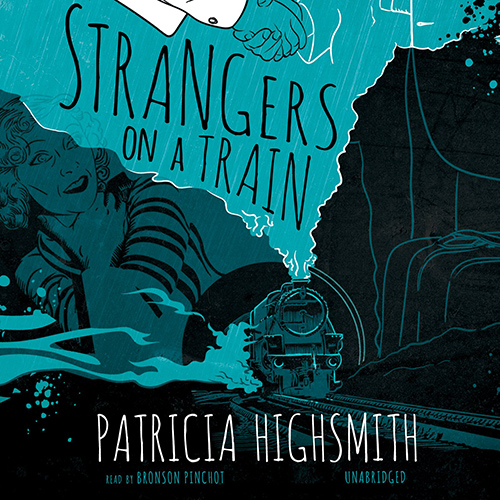
Strangers On A Train
Strangers On A Train, written by Patricia Highsmith, read by Bronson Pinchot

Ultimately Strangers On A Train is an interesting read, but I prefer how Alfred Hitchcock streamlined some of the action and themes and certainly brought his visual flair to Highsmith’s clever plot idea. I “read” the audible version of this book, read by Bronson Pinchot.


Featured on Cannonball Read Instagram and on Cannonball Read

Tuesday, December 17, 2019

book to film: the talented mr. ripley

Patricia Highsmith wrote The Talented Mr. Ripley in in 1955. She based it loosely on Henry James’s The Ambassadors (which I now have to add to my to-read list). The lead character, Tom Ripley, proved so popular, that she brought him back for four more novels.
When the reader first meets Tom he is living close to the bone in New York City, subsisting on his “friends,” or running various schemes, including mail fraud. But Tom isn’t really great at his schemes, and he doesn’t like people, and he doesn’t have any true friends, just people he can sponge on. Tom’s prospects begin to look up when he runs into the rich Mr. Greenleaf, the father of an acquaintance, Dickie Greenleaf. Mr. Greenleaf wants his son, who he believes is frittering away his life in Italy by dabbling in painting, to come home, get serious, and work at the family shipping business. Tom exaggerates his friendship with Dickie, and agrees to track him down in the (fictional) Italian seaside port of Mongibello – staked with cash from Mr. Greenleaf.
Tom Ripley, (Matt Damon), Dickie Greenleaf (Jude Law), and Marge Sherwood (Gwyneth Paltrow) in the 1999 film The Talented Mr. Ripley
Tom doesn’t seem to have any real desire to fulfill his quest and bring home the prodigal son, but he does head to Mongibello and soon meets Dickie and his friend Marge Sherwood. Marge and Tom take an immediate dislike to each other as Tom tries to ingratiate himself with the open and (initially) clueless Dickie. Tom’s motives aren’t clear, to himself or the reader. His strongest motivating factor seems to be survival and acquiring money. He comes from nothing and is determined to not only be able to live, but live well. Dickie enjoys palling around with Tom at first, as a way to avoid Marge’s not-so-subtle attempts to take their relationship to the next level. In the meantime, Tom has been studying Dickie, to the point of copying his mannerisms and attire. One day Dickie walks into his bedroom to find Tom in his clothes – it is from that moment that their newfound friendship begins to sour. Dickie may not be the brightest bulb on the tree, but he can sense that Tom is not the real deal, not from his side of the tracks.
There is definitely an undercurrent of sexuality to Tom’s obsession with Dickie, which was made more blatant in the 1999 film version, directed by Anthony Minghella, starring Matt Damon (Tom), Jude Law (Dickie), and Gwyneth Paltrow (Marge). I had seen the film years ago and didn’t love it. I will say that Jude Law has never looked better on film. It’s a first-class production, with Philip Seymour Hoffman, Cate Blanchett, and Jack Davenport in supporting roles. I just didn’t find Damon to be very compelling. Ripley may be a cipher, but I felt Damon just played him as a blank space. I rewatched it recently, and it’s better than I remember, but Damon is definitely still its weakest link. There is also apparently a French version of the story, Plein Soleil (Purple Noon), filmed in 1960, directed by René Clément and starring Alain Delon that might be fun to track down sometime.
But back to the book . . . even though Tom bristles at memories of being called a “sissie” and is repulsed by Marge, he seems less attracted to Dickie the man than to Dickie’s lifestyle and all its trappings. Tom is first and foremost a parasite. His love of fine clothes and having money to spend will lead to murder and mayhem as he travels across Italy to escape his past and past identity. Tom Ripley is an anti-hero and sociopath who at times may put off the reader, who may find many of his crimes brutal and unnecessary, but Highsmith is such a gifted writer that she effortlessly pulls us into his thoughts and his fears. Will he avoid capture? Do we want him to? I can’t say I liked Tom Ripley much, but I am looking forward to checking out his further adventures.
p.s. Fleabag’s “Hot Priest” Andrew Scott will be portraying Tom Ripley in a new series, Ripley, on Showtime in 2020. So I have to start subscribing to that channel now?
This post first appeared on Cannonball Read 11

Tuesday, September 13, 2011

alfred hitchcock and the three investigators

On a recent trip to the local library with my daughter I was browsing the teen section while she was picking out books and DVDs, and ran across a blast from my past, The Secret of the Crooked Cat.

When I was 8 my dad gave me my first Nancy Drew (The Spider Sapphire Mystery), and I sped through them, getting most of the books through the local library or our bookmobile in the summertime, which is also where I discovered a few years later the Alfred Hitchcock and the Three Investigators series.


Similar in style to Nancy Drew and the Hardy Boys, the illustrated mysteries follow three teenage boys as the solve mysteries, mostly with a supernatural angle. I didn't realize it at the time I was reading them as a kid, but the plots share a lot of similarities to Scooby Doo. As I breezed through The Secret of the Crooked Cat there was even a line at the end,
The robber snarled, "Go to the devil, Carson! All of you! I'd have gotten away except for those stupid kids!"
Oh well. Not exactly high literature, but they were fun to read (and re-visit). I liked the hero, Jupiter Jones, and his friends, who were basically a bunch of misfits who happened to be super-smart. Talk about revenge of the nerds.


Jupiter is overweight, an ex-child star, and an orphan (his parents were killed in a car accident) who lives with his Aunt Mathilda and his uncle, Titus Jones, who runs a junkyard — a very handy place for Jupiter to find bits and parts to use to create all sorts of fabulous gadgets to employ in his investigations. He is called the First Investigator, and doesn't let his friends forget that. It became quite annoying actually, while reading the book as an adult, as the boys refer to each other as "First," "Second," and "Records" quite frequently.

Second Investigator Pete Crenshaw is athletic and resourceful. Jupiter may be the idea man, but Pete usually puts them into action. He and "Records and Research," Bob Andrews, make up the composite Doctor Watson to Jupiter's Sherlock Holmes. They are also reader stand-ins, reacting to the crime at hand as any kid might. Jupiter's eccentricities set him apart from even the normal super-smart geeky kid.

The Three Investigators books were a fun diversion, filling the mystery novel gap between Nancy Drew and Agatha Christie, who I discovered one day after raiding my mom's bookcase, looking for something new to read. I was soon devouring The Hollow, The Moving Finger and The Labours of Hercules.

I also loved the Hitchcock connection with The Three Investigators. My parents were big fans of the slow-speaking, brilliant British director and I had already seen The Birds and North By Northwest as well as Alfred Hitchcock Presents on television. Some of the episodes are still indelibly etched on my brain, such as Lamb to the Slaughter, written by Roald Dahl, which had my grandmother in stitches about the clever murder weapon, Ambrose Bierce's Civil War story The Occurence at Owl Creek Bridge, and the scary and paranoiac Revenge.


Another Hitchcock for Young Readers selection, right next to The Secret of the Crooked Cat, was Alfred Hitchcock's Supernatural Tales of Terror and Suspense. This is a short story anthology, aimed at an older teen audience than The Three Investigators series. I was pleasantly surprised at how absolutely creepy the stories were, and completely enjoyable for adults, too. Among the 10 authors featured are  Raymond Chandler (The Big Sleep, Farewell, My Lovely, The Lady in the Lake) with a very sinister story, "The Bronze Door," as well as Patricia Highsmith (Strangers on a Train, The Talented Mr. Ripley), and Muriel Spark (The Prime of Miss Jean Brodie).

The short stories include:

1. "The Triumph of Death," by H. Russell Wakefield - A creepy old lady, Miss Pendleham, lives with her companion Amelia in an Elizabethan-era house that may be haunted by dangerous ghosts, who may also be Miss Pendleham's ancestors.
2. "The Strange Valley," by T.V. Olsen - Three Sioux Indians see a strange creature in the valley of the Little Big Horn in the middle of the night.
3. "The Christmas Spirit," by Dorothy B. Bennett - A nurse discovers that what modern medicine can do may pale in comparison to a preserved bat wing charm.
4. "The Bronze Door," by Raymond Chandler - A man purchases an antique door that may help him remove some current pests from his life.
5. "Slip Stream," by Sheila Hodgson - Did the pilot and co-pilot really see something on the runway?
6. "The Quest for 'Blank Claveringi,'" by Patricia Highsmith - A scientist is eager to determine if there are indeed giant man-eating snails on a remote tropical island. He should probably think twice about that.
7. "Miss Pinkerton's Apocalypse," by Muriel Spark - an actual flying saucer, Spode, according to Miss Pinkerton, causes some brief but amusing panic.
8. "The Reunion After Three Hundred Years," by Alexis Tolstoy (Vampires - Stories of the Supernatural) - an old woman tells her grandchildren about her romantic past and her brush with some very unpleasant ghosts.
9. "The Attic Express," by Alex Hamilton - A man becomes very obssessed with his model train set.
10. "The Pram," by A.W. Bennett - A policeman tells the story of an undertaker who had no respect for the dead.
11. "Mr. Ash's Studio," by H. Russell Wakefield - A writer of ghost stories discovers that his latest inspiration, a mysterious painting and art studio, may be closer to is subject matter than he was hoping for.

I'm hoping that on our next library trip I'll find some more of these anthologies. Not only is it a fun bit of reading nostalgia, but a rediscovery of the short suspense and horror story, something which I haven't indulged in for quite some time. Thanks, Hitch.

Enhanced by Zemanta