Showing posts with label Film. Show all posts

Tuesday, December 17, 2019

book to film: the talented mr. ripley

Patricia Highsmith wrote The Talented Mr. Ripley in in 1955. She based it loosely on Henry James’s The Ambassadors (which I now have to add to my to-read list). The lead character, Tom Ripley, proved so popular, that she brought him back for four more novels.
When the reader first meets Tom he is living close to the bone in New York City, subsisting on his “friends,” or running various schemes, including mail fraud. But Tom isn’t really great at his schemes, and he doesn’t like people, and he doesn’t have any true friends, just people he can sponge on. Tom’s prospects begin to look up when he runs into the rich Mr. Greenleaf, the father of an acquaintance, Dickie Greenleaf. Mr. Greenleaf wants his son, who he believes is frittering away his life in Italy by dabbling in painting, to come home, get serious, and work at the family shipping business. Tom exaggerates his friendship with Dickie, and agrees to track him down in the (fictional) Italian seaside port of Mongibello – staked with cash from Mr. Greenleaf.
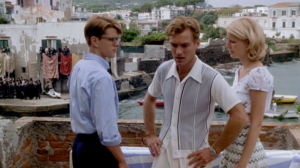
Tom Ripley, (Matt Damon), Dickie Greenleaf (Jude Law), and Marge Sherwood (Gwyneth Paltrow) in the 1999 film The Talented Mr. Ripley
Tom doesn’t seem to have any real desire to fulfill his quest and bring home the prodigal son, but he does head to Mongibello and soon meets Dickie and his friend Marge Sherwood. Marge and Tom take an immediate dislike to each other as Tom tries to ingratiate himself with the open and (initially) clueless Dickie. Tom’s motives aren’t clear, to himself or the reader. His strongest motivating factor seems to be survival and acquiring money. He comes from nothing and is determined to not only be able to live, but live well. Dickie enjoys palling around with Tom at first, as a way to avoid Marge’s not-so-subtle attempts to take their relationship to the next level. In the meantime, Tom has been studying Dickie, to the point of copying his mannerisms and attire. One day Dickie walks into his bedroom to find Tom in his clothes – it is from that moment that their newfound friendship begins to sour. Dickie may not be the brightest bulb on the tree, but he can sense that Tom is not the real deal, not from his side of the tracks.
There is definitely an undercurrent of sexuality to Tom’s obsession with Dickie, which was made more blatant in the 1999 film version, directed by Anthony Minghella, starring Matt Damon (Tom), Jude Law (Dickie), and Gwyneth Paltrow (Marge). I had seen the film years ago and didn’t love it. I will say that Jude Law has never looked better on film. It’s a first-class production, with Philip Seymour Hoffman, Cate Blanchett, and Jack Davenport in supporting roles. I just didn’t find Damon to be very compelling. Ripley may be a cipher, but I felt Damon just played him as a blank space. I rewatched it recently, and it’s better than I remember, but Damon is definitely still its weakest link. There is also apparently a French version of the story, Plein Soleil (Purple Noon), filmed in 1960, directed by René Clément and starring Alain Delon that might be fun to track down sometime.
But back to the book . . . even though Tom bristles at memories of being called a “sissie” and is repulsed by Marge, he seems less attracted to Dickie the man than to Dickie’s lifestyle and all its trappings. Tom is first and foremost a parasite. His love of fine clothes and having money to spend will lead to murder and mayhem as he travels across Italy to escape his past and past identity. Tom Ripley is an anti-hero and sociopath who at times may put off the reader, who may find many of his crimes brutal and unnecessary, but Highsmith is such a gifted writer that she effortlessly pulls us into his thoughts and his fears. Will he avoid capture? Do we want him to? I can’t say I liked Tom Ripley much, but I am looking forward to checking out his further adventures.
p.s. Fleabag’s “Hot Priest” Andrew Scott will be portraying Tom Ripley in a new series, Ripley, on Showtime in 2020. So I have to start subscribing to that channel now?
This post first appeared on Cannonball Read 11

Sunday, November 25, 2018

bohemian rhapsody: freddie mercury, gay superhero

Rami Malek does an amazing job of portraying Freddie Mercury in the Queen biopic, Bohemian Rhapsody. The film takes a pretty typical showbiz road-to-success route, with more than a few inaccuracies. But even with its faults, it serves up a great deal of wonderful rock music, supported by Malek's sensitive portrayal of Freddie. Some viewers may feel that the depiction of Mercury's sexuality is handled too subtly, but I think that is missing the larger impact of the film, which is still performing in the top five at the box office in the U.S. and is currently the highest-grossing musical biographical film of all time. Everyone has always loved, and still loves, Freddie, no matter who he loved.

Rami Malek as Freddie Mercury
Freddie Mercury in concert
So many movies that hit it big at the box office these days are comic-derived fantasies, like the X-Men franchise, also directed by Bohemian Rhapsody's Bryan Singer. It occurred to me after viewing the film that Freddie and Queen's story may be resonating with audiences because it is cast as a similar misfit hero's journey. Teenage Freddie Mercury (born in Zanzibar as Farrokh Bulsara, an Indian-British Parsi) moved to England in 1964. He is an outsider, a misfit, ridiculed for his large overbite and called "Paki." But Farrokh has a secret identity as a musician (as well as secret urges he is trying to come to terms with). He changes his name to Freddie Mercury and displays his superpower — amazing musical talent, stage presence, and the four-octave range of an angel. Freddie bonds with fellow outcasts, and the quartet calls itself Queen and becomes a force to be reckoned with. They take over the world, but have to confront their share of villains, including Freddie's lover-manager Paul Prenter (Allen Leech) and a clueless record exec (Mike Myers).

There were many negative critiques of the film on its release, particularly about the handling of Mercury's sexuality, but that hasn't stopped audiences from finding and adoring the film. That may be partly because the power of the professional reviewer has waned — thanks to the internet anyone can review and rate anything these days. But the film's huge success may also reflect the modern audience's reaction to Freddie's sex and love life. Sexuality is viewed in a more fluid and open sense these days. In a key moment in the film Freddie confesses to his girlfriend and fiancée Mary Austin (Lucy Boynton) that he thinks he is bisexual, and she corrects him, "No, Freddie, you're gay." This interchange straddles the past and the present. People who lived through the AIDs epidemic and lost friends, lovers, and family may relate to Mary's needing Freddie to be true to himself and come out in an open way. Younger viewers may be seeing Freddie's lack of desire to define himself sexually as something they can relate to, and his subsequent AIDs diagnosis as a piece of history from the recent past. Bohemian Rhapsody's Freddie spends the film coming to terms with his sexuality, as it relates to his family, his religious and ethnic background, his status as a rock god, and his quest to balance sex and love.
Mary Austin: What do you want from me, Freddie?
Freddie Mercury: Almost everything.
Freddie Mercury portrayed by Malek is flamboyant, outrageous, and larger-than-life — onstage. He seems happiest, most at home when he is performing before an audience. Queen's music spanned genres as diverse as arena rock, 50's doo-wop, and opera, and Freddie's exuberant vocals and stage persona are a match for any and every musical style. As I watched Malek recreate Mercury's signature posturing it became apparent that rock and roll lead singers, gay or straight, present themselves similarly as strutting sexual objects of desire.

Bohemian Rhapsody bookends its story with practically a shot-for-shot recreation of Queen's epic performance at Live Aid in 1985. To amp up the drama the film plays fast and loose with the facts, having Freddie receive his AIDs diagnosis right before the concert. In reality he was diagnosed with HIV in late 1986 or 1987. It also portrays Freddie's having a solo career as leading to the band's fracture, but Queen never broke up, and all the band members pursued solo projects at different times over the years. While the film does portray Freddie's long-term relationships with Mary Austin (who he is quoted as saying he considered her his common-law wife), as well as his partner at the end of his life, Jim Hutton (Aaron McCusker), it skips any other lasting relationships he may have had, apart from the aforementioned Paul Prenter, who is portrayed as a predatory user who was trying to control Freddie's career and  limit his contact with the outside world by plying him with drugs and other distractions. Prenter, like Freddie, died in 1991. The film does depict Freddie's relationships that probably no one will argue with: his great and abundant love of cats, of which he had many over the years.


It's probably not possible to have a "true" film biography of anyone as iconic as Freddie Mercury. For all of his onstage campiness and theatrics he was also notoriously private in his home life. The surviving members of Queen — Brian May (Gwilym Lee), Roger Taylor (Ben Hardy), and John Deacon (Joe Mazzello) had been open to and involved in making a film about the band for ages. First in 2010, it was cast with Sacha Baron Cohen in the lead, who left the project. He was succeeded by actor Ben Whishaw, and director Dexter Fletcher, who both came and went. In 2017 Rami Malek stepped in to play the central role of Queen's lead singer Freddie Mercury, and Bryan Singer replaced Fletcher. During filming Singer left the project under a cloud (he was fired for "unexplained absences"), but he is still credited as director. Dexter Fletcher returned to finish directing the film after Singer left, and received an executive producer credit. Lots of changes, but also pretty typical for a Hollywood film.

I have wanted to see Bohemian Rhapsody since viewing trailers a year or so ago. It did not disappoint me or my fourteen year-old daughter, who had lots of questions afterward, about the 80s and AIDs as well as wanting to download every Queen song ASAP, and wanting to watch the original footage of the band's appearance at Live Aid. It's impossible not to walk away from the movie without marveling at the band's versatility and uniqueness and Freddie's amazing talent. Bohemian Rhapsody is uplifting and heartbreaking as it charts Freddie's course. Malek has appeared in many interviews detailing his preparation for the role, which included a movement coach and mastering some very impressive false teeth. But as marvelous as he is at portraying Freddie onstage, what leaves the biggest impression are his quiet moments, as he grapples with his needs and never-ending loneliness when he isn't onstage:
Jim Hutton: So all your friends have left you alone.
Freddie Mercury: They’re not my friends, not really. They’re distractions.
Jim Hutton: From what?
Freddie Mercury: The in-between moments I suppose. I find me intolerable. All of the darkness you thought you’d left behind comes creeping back in.

Thursday, May 01, 2014

here's looking at you, kid — the humphrey bogart film festival

This weekend I will be attending the 2014 Humphrey Bogart Film Festival (May 1-4), and writing about my experiences for Cinema Sentries (and also on this blog). I can't wait! I inherited the love of Bogie and classic films from my dad, and am thrilled to have chance to check out this festival, now in its second year. Put together by Bogart's son Stephen Bogart and the Humphrey Bogart Estate, the festival meets every year in Key Largo, Florida, the setting for the classic John Huston film of the same name that starred Bogart, Lauren Bacall, Claire Trevor, and Edward G. Robinson. Also in Key Largo is another iconic item from a Bogart film, the steamboat the African Queen.

This year Stephen Bogart wants to honor his parents, one of Hollywood's most famous couples, Bogie and Bacall, with the festival them of "Romance." Bogie is reported to have said of Bacall, "She's a real Joe. You'll fall in love with her like everybody else." Who can argue with that? ...

Bogie and Baby, during the filming of To Have and Have Not

I will be trying to fit in as many of the Bogie/Bacall pairings as I can, along with classics like The Big Sleep, Dark Passage, Sabrina, and the amazing Casablanca, which is set to be screened outside on Friday evening. As Bogie said of his first truly romantic role, "I didn't do anything I've never done before, but when the camera moves in on that [Ingrid] Bergman face, and she's saying she loves you, it would make anybody feel romantic." Seeing Casablanca and Bogie and Bergman and Claude Rains and all the rest under the stars should be an experience that is hard to beat ...

Check out my full report on Cinema Sentries.

Tuesday, August 13, 2013

happy birthday, alfred hitchcock

The master of suspense — and twisted humor, too.

A promo for my favorite film of his, The Birds


Friday, July 22, 2011

catching up with ... how do you know

This should have been a good movie, but it's not. It's not bad because the main actors — Reese Witherspoon, Owen Wilson and Paul Rudd —lack appeal. They are all fine. The script has some funny moments and even Jack Nicholson is giving it his all. Witherspoon plays a character that is trying to sort out her life, professional and private. For a female character to do that in a movie, and to actually be the focus of the movie, is a rare and good thing. So what exactly is wrong with How Do You Know?


It starts with an original premise — Witherspoon's character is a female jock (softball) who has just been cut from her team and is having a lot of trouble trying to figure out not only what to do next, but who exactly she is. Unfortunately, the film soon introduces the love triangle, and her character seems to completely forget her dilemma. Even though I just watched the movie, I have no idea what her character's name was, or any of the characters. That's not good.

There is a completely uninteresting, unbelievable, and almost unintelligible subplot involving Rudd and his dad, played by Nicholson, involving corporate scandal. Maybe Brooks just wanted to include his old buddy Nicholson in the film? How Do You Know at least is less crass than As Good As it Gets, another James L. Brooks film that starred Nicholson (which I really couldn't stand.)

The either/or proposition that Witherspoon faces is beyond predictable. Before the movie starts we know that Paul Rudd is going to be the one she ends up with. Rudd, who is one of the most charming actors out there, in this movie plays a total shlump. He's a nice guy, but not a nice guy a girl would want to spend too much time with. He is so cringeworthy so much of the time that it is highly unlikely that he and Witherspoon would end up together. I was actually hoping against hope that she would walk off into the sunset by herself, and start dealing with that question of what she was going to do with the rest pf her life post-softball career, which would be far more realistic than ending up with Rudd. I feel like a traitor to my Rudd crush writing this, but he was just icky. Maybe Brooks caved from the original ending, because that's how Rudd played his character throughout the movie.

Owen Wilson, who may have been playing far from the "perfect" guy (as if there is such a guy or girl), was his usual charming self, with a good dose of me-centric professional athlete thrown in. He was perfect in the role. Maybe he wasn't someone Witherspoon would decide to be with forever, but the guy deserved points for trying. Neither Rudd nor the script ever really gave a great reason why she shouldn't at least attempt to give her relationship with Wilson a chance.

The best scene in the movie was when Rudd asked Witherspoon, who he has a crush on but really hardly knows, to tag along with him and visit a female friend who has just given birth. Talk about being clueless about boundaries. But the script says she should go with him, so she does. They witness an exhibition of "true love" in his friend's hospital room and an extreme example of Rudd's character's usual cluelessness (which is actually the movie's funniest moment). Rudd then thinks he's finally broken through, gotten Witherspoon where he wants her, and she, as usual, just doesn't think of him that way at all. It's a real, human moment. But the movie then falls back into cliché rom-com territory and forces the two of them together anyway.


Either Owen Wilson's or Reese Witherspoon's characters got a raw deal, because their dialogue together was far more fun and full of potential than anything she shared with Rudd:
Witherspoon: What am I doing? I caught myself. Don't judge anybody else until you check yourself out, that way you are lucky if it's your fault because then you can correct the situation. I'm nervous over something that is going on with me, and I ended up with an attractive guy who you would have to be an idiot to mistake for anything more than just a fun friendship, and... and, yes amazing sex, and then I give that guy a hard time for just being who he is. Totally my fault, I'm sorry. Please forgive me.
Wilson: Are you apologizing? 
Witherspoon: Yeah. 
Wilson: If you are really apologizing, you may be my dream girl. I heard those footsteps and I'm like, right, somebody nuts is coming back to be more nuts, and now an apology. You might be my dream girl.
As far as I can tell, by movie's end, Witherspoon still doesn't know.
Enhanced by Zemanta

Monday, June 13, 2011

all about sexism?

I just saw All About Steve on cable and it was a fun little movie. Hardly the worst thing out there. So why all the bad press and low ratings? Sandra Bullock actually won the "Razzie" for Worst Actress and being Sandra Bullock, she attended the Razzies and accepted her award. According to imdb, "She brought a wagon full of DVDs of this film for the 300 attendees and asked them to watch or re-watch the movie. If in fact the audience decided she was NOT the Worst Actress and changed their minds, Bullock promised to come back to the Razzies next year, turn back in her award and buy drinks for everybody." The day after the Razzies Bullock won the Best Actress Oscar for The Blind Side. Ahhh, irony.


Watching any of the old classics on TCM there are dozens of movies that weren't box-office bonanzas but were nice character studies and are still fun to watch, as is All About Steve. Why did All About Steve get lambasted by critics? What about the audience? Did they really hate the film, or has everyone been so American Idol'd to death that they need some supposed "expert" to tell them what to watch, what is good?

So why did so many consider All About Steve Razzie-worthy? It's not your standard rom-com. It's not really a rom-com at all, although the studio advertised it as such. It's a comedy with an obnoxious protagonist who happens to be female. There have been plenty of male misfit heroes — Bill Murray is beyond annoying (and also funny as hell) in What About Bob. Jim Carrey and Jerry Lewis have made careers out of playing obnoxious characters. So why was there so much objection to Sandra Bullock playing an equally difficult person in this role? Was it because she was a woman?


All About Steve isn't even remotely about Steve, which is of course, the point. It's about the quirky character of Mary Horowitz, played by Bullock, and how she finds herself through her obsession for news cameraman Steve (Bradley Cooper), and how she breaks out of a self-created cocoon, sees the world, and makes some real friends. It's also a road movie — it's completely absurd and it's quite entertaining. Mary is a person that in real life many, if not most people, would definitely avoid. How many times have you sat on a bus and been stuck seated next to a compulsive talker, wondering, "Is this a crazy person? Or just lonely or socially awkward? Will they get off soon or will I have to listen to them the whole ride?"

Characters like Mary in movies are almost invariably played by men, as women's roles are not typically personality-driven. Women are called on to be beautiful, sarcastic and funny, maybe even sometimes brave. But women can be just as nutty, just as annoying, if given the chance. The panning of All About Steve seems to be mostly a backlash against Bullock's character. Women, especially pretty ones, and heroines, are not supposed be so verbal, so quirky, so difficult to like. The character of Steve keeps calling Mary a stalker, and that is even how the movie was advertised — as a stalker romantic comedy. That sort of description couldn't help but drive people away.

But as every character keeps pointing out to Steve — Mary's not really a stalker. Deluded, going through an emotional crisis after being fired from her beloved job, beyond socially awkward, absolutely. She actually thinks that Steve invited her to join him at his job, on a location shoot. The audience knows that wasn't what Steve intended, but Mary doesn't. As off-putting as Mary may be at times, and as eccentric as her behavior can appear, Steve never seems exactly repulsed by her. He was more than happy to make out with her until she started talking and wouldn't stop. Spouting interesting (to her) but completely extraneous facts while they are in the clinch killed the mood, "There's over a million Stevens with a "V" in the country. It's much more popular than the "PH" way. Twice as popular, in fact. I think it was the the Brits who prefer their PH's."

Mary is too much for Steve to process. He's overwhelmed by her. He can't deal with her. Critics seemed to have had the same reaction. But Bullock is actually wonderful in the movie. She's not afraid to be eccentric, even unlikable. The first scene, where we meet Mary as she walks to work, to a job she loves, and sees people working on the crossword puzzle that she created in the local newspaper she works for is wonderful. She is absolutely giddy with joy. Her walk home, the same day, after a bad experience where she has been made to feel that her job and her life isn't as wonderful as she believes it is, shows the pain underneath all of her manic behavior. Bullock has always been drawn to playing eccentric female characters, and she plays them in movies she produces as well (Miss Congeniality, Two Weeks Notice) — she is one of All About Steve's producers.


Steve and the audience get to know the real Mary as the movie progresses. Steve's friends and co-workers (a wonderful Thomas Haden Church as narcissistic would-be anchor Hartman Hughes and Ken Jeong as producer Angus) see Mary's good points immediately. There is more to her than a hyper personality and her shiny red boots. Hopefully All About Steve will get more attention on DVD and cable. I actually like Bullock's performance in All About Steve much more than The Blind Side. It's quirkier.
Enhanced by Zemanta

Friday, January 14, 2011

i'm the one that i want

When I first saw Grease I was a teeny bopper—the ideal audience. I'm not sure if it was nascent or in-born feminism, but I was always pissed off at the end of the movie when Sandy appeared, all tarted-up, to win the heart of Danny Zuko. She didn't have to do that. She already had him. I wasn't a (too) naive kid. I didn't want or think she would remain a virgin for long. My disappointment in Sandy was that I felt that she had caved, had given up a big part of her identity. Hell, it was the last day of high school. That's when you can stop trying to fit in, trying to dress like the rest and go out into the real world and find out who you really are.

Frenchy: Men are rats, listen to me, they're fleas on rats, worse than that, they're amoebas on fleas on rats. I mean, they're too low for even the dogs to bite. The only man a girl can depend on is her daddy.
Many years later and my almost seven year-old loves this movie. She loves to sing and dance along to lots of musicals, from classics like On the Town to more recent fare like Rent and Hairspray. I didn't think too much about my own personal issues with Grease at first, because I know from personal experience that the more mature themes in movies sail over a young child's head. My daughter is primarily connecting to the fun, exuberance and sassiness of the musical numbers. But even if she doesn't pick up on Rizzo's near-miss pregnancy scare or the finer points of Summer Lovin' there is still something about Olivia Newton John's climactic physical transformation that is unavoidable. It's visual. Images are much more powerful than words.

As I watch that scene today I realize that I am not as put off by it as I was when I first saw it. Maybe I was being a little too quick to judge Sandy by appearances. She is playing dress-up, for sure, but I shouldn't assume that she has tossed out all her dresses and crinolines, just as Danny won't perpetually wear his letterman's sweater. Maybe I could read the scene in a more feminist way. Sandy has observed the behavior of Danny and his friends, both male and female, and has decided to visually fit in, at least long enough to reunite with Danny, to show him that she is capable of fitting in. The funny thing is that her transformation, aided by extremely unskilled aspiring beautician Frenchie, is not too far from what was predicted by Frankie Avalon's guardian angel in the song Beauty School Dropout. Frenchie really can't help but go for the tacky:


Well they couldn't teach you anything,
You think you're such a looker,
But no customer would go to you unless she was a hooker!
Danny reacts immediately, lustfully, but it is Sandy who has the upper hand throughout the You're the One That I Want penultimate dance number. She is showing him and everyone that she is a sexual being who knows what she wants and is in control. She already has Danny's love, now she is just showing him that she can meet him in the sexy department, too. In fact, her look is much more sexy than any of the other aspiring sex bombs in the Pink Ladies.


Frenchy: What do you guys think of Sandy? Do you think we can let her into the Pink Ladies?
Rizzo: Nah, she looks too pure to be pink!

Danny fell in love with a sweet girl at the beach the summer before. He's obviously happy to see a glimpse of whore in his Madonna, but it's doubtful he'd want that 24-7. When Danny and Sandy's car literally takes off at the end of the movie and floats into the clouds which is the fantasy—their future or their time in high school?

Quotes from imdb
Enhanced by Zemanta

Tuesday, November 16, 2010

the two (hundred) faces of alec guinness

The other night we watched two movies starring Alec Guinness—the classic Kind Hearts and Coronets and lesser The Captain's Paradise. In fact the second film really ticked me off, as it presented, all in the name of comedy, a beyond-sexist situation as comedy—a man decides he can have the "perfect" woman by setting up two households, one with the stay-at-home domestic, the other with the ready-to-go babe. Of course all the stereotypes backfires, and the women get the better of him, but the old madonna/whore attitudes towards women are still omnipresent for most of the film. Guinness, and his costars, including Yvonne DeCarlo, were better than this.

I'm sure most people, if they recognize the great actor's name at all, immediately think: Obi Wan Kenobi. And he was great in Star Wars. But I come from a movie buff family, and that is only one of very many Alec Guinness movies. He's been in so many—from comedies to dramas to science fiction—that it's hard for me to think of him as only Obi Wan. Although that is my favorite Star Wars movie, and the only one that I think really holds up as a movie. Apparently Sir Alec thought the same:
[his diary entry after viewing Star Wars (1977) for the first time] It's a pretty staggering film as spectacle and technically brilliant. Exciting, very noisy and warm-hearted. The battle scenes at the end go on for five minutes too long, I feel, and some of the dialogue is excruciating and much of it is lost in noise, but it remains a vivid experience.
Guinness played many parts, big and small: A Passage to India, Lawrence of Arabia, The Bridge on the River Kwai, The Lavender Hill Mob, Great Expectations. In Kind Hearts and Coronets he actually, hysterically, plays eight different roles in one film—all the unfortunate victims of society-climbing Dennis Price. Guinness is amazing, but Price gets all the great lines.


Kind Hearts and Coronets | Robert Hamer | Alec Guinness | Dennis Price | Movie Trailer


Probably his most memorable performance for me would be as the painter Gulley Jimson in The Horse's Mouth. I must have seen this ten times while I was at art school, as it always seemd to be playing in the Parsons auidtorium. And I had already seen it before then on public television. I'm not sure anyone has ever captured so effortlessly an artistic obsession. And made it funny. Much more fun to watch than the other tortured artist biopics that they also showed us back in art school—Kirk Douglas's Van Gogh or José Ferrer's Toulouse Lautrec, or even Charlton Heston's Michelangelo.


THE HORSES MOUTH: Movie Trailer. Watch more top selected videos about: Alec Guinness, Renee Houston

An actor is an interpreter of other men's words, often a soul which wishes to reveal itself to the world but dare not, a craftsman, a bag of tricks, a vanity bag, a cool observer of mankind, a child and at his best a kind of unfrocked priest who, for an hour or two, can call on heaven and hell to mesmerize a group of innocents.
Another favorite Guinness role is as the criminal mastermind Professor Marcus in The Ladykillers. Forget that Tom Hanks tried to remake this classic comedy. I sure did, and avoided it like the plague. Guinness always looks like he is having fun in a role, especially when he is being villainous. And he is especially, evilly, delightful here.

So for a Professor Marcus and a Gulley Jimson and an Obi Wan I can surely forgive him the occasional Captain's Paradise. I hope TCM plays The Ladykillers soon ...


The Ladykillers 1955 Ealing comedy of the same name ...

Flamboyance doesn't suit me. I enjoy being elusive.
[All quotes from Guinness courtesy of imdb]
Enhanced by Zemanta

Thursday, November 11, 2010

grave of the fireflies

I have been wanting to see this anime film for so long, but at the same time dreading it. If you don't know what the movie is about and don't want to know before seeing it, then stop reading, although the fate of its narrator is revealed in the first scene.


I think part of my hesitancy was the hard facts of the plot—two children, a brother and sister, try to survive the aftermath of air raids in war-torn WW2 Japan, only to die of starvation. It sounds so stark, and the movie is rough and intense at times, but there are also so many moments of beauty and courage and joy. It is haunting and tragic and poetic. True art. I am glad I finally made myself watch Grave of the Fireflies.

There are so many wonderful scenes—Two little fireflies meander  their way across the screen, their other companions dead or dying, foreshadowing the chidrens' fate and what has happened to their friends and neighbors in Kobe. Like the incandescent fireflies, the lives of Seita, the older brother, and Setsuko, his younger sister, appear brief and aimless. When a group of young boys discover their home—the siblings have been camping in an abandoned bomb shelter—they run around, poking fun at the meager traces of their existence, but the children are unseen, nowhere to be found, as if they were already ghosts. Setsuko's lifeless doll is often shown lying on a bed or the ground, her color gradually fading.

The film is also a fairytale of sorts—the wicked witch/stepmother is an aunt who wants to steal food from the newly-orphaned children and send them out into the world to starve. People they encounter, like the farmer, or the doctor, who should be helpful, instead are just a hindrance, similar to the unhelpful dwarf in Snow White and Rose Red. There are a few sympathetic people, who at least understand their predicament, but this little Hansel and Gretel will never make it out of the woods.


As I was waching I kept wondering why Seita didn't just go get his mother's money out of the bank and buy them food earlier. But he was living in a nightmare fantasy world—the expectation of grown-ups helping him; of their home, the magical cave of the fireflies, being a safe haven; of their father coming to rescue them. When Seita finally pulls himself together to accept how ill his little sister is, it is too late. Setsuko is already too far gone on the path to starvation. It is clear from the montage we see while she is slowly dying and Seita is returning with food, that she has been left alone too much while her brother has tried to navigate this strange new world. A small starving child, left alone to put inappropriate things like rocks and buttons—anything—in her empty little stomach.

Grave of the Fireflies was based on the real-life experiences of Akiyuki Nosaka and his feelings of guilt at the death of his sister. It is amazing to me, and uplifting, to watch how hard Seita tries to make his little sister happy, to give her some joy, in the midst of all the horror that surrounds them. Unfortunately, it is also this escape from reality that he tries to provide that dooms them. It is tragic.

The first few moments of the film reveal that Seita has starved to death. The rest of the film is a flashback of sorts—memories of his parents, his sister. We don't really see how he got to the train station where he died all the way from the countryside where his little sister died, but it doesn't matter. Their lives and deaths tell forgotten stories of the human fallout of war. Of two vulnerable orphans left to fend for themselves in a world where there is no place for them.


The dvd had some extras which added poignancy—especially commentary by a pre-cancer thumbs-uppin' Roger Ebert. Like the children in the film, he can't go home again, but his words and ideas can still touch us. He points out in his interview that even though it is clearly the United States that is causing the specific devastation in the film, the country is never named, except as "the enemy." This helps the film to be viewed more as a universal comment on what happens to the innocent in a conflict. It was probably through Ebert's recommendation that I first heard of Grave of the Fireflies, years ago. It took me a while, but I'm so glad I took his advice.
Enhanced by Zemanta

Monday, November 08, 2010

a dash of paprika

I recently watched two movies I've been wanting to see for a while, Nausicaä of the Valley of the Wind, by the great Hayao Miyazaki and Paprika, by Satoshi Kon. I have been a huge fan of Miyazaki for ages, but only recently discovered Kon, unfortunately coinciding with his recent death from cancer.

Both movies feature strong female heroines, something that is quite common in Japanese animation, anime. Why is it so easy for audiences to accept a strong female hero, who is often still quite feminine when she is an animation, but not so easy when she is flesh and blood? We seem to want our human heroines to be larger than life and to be able to kick butt and take names just like, well, men. Now don't get me wrong, I love Angelina Jolie in Wanted (although calling her a heroine in that movie is stretching it a bit— maybe female lead is more accurate), but part of the fun of being a girl is getting to dress up all purty, so it's fun to see that too. Buffy Summers could pull it off.

Nausicaä, who also happens to be a princess, but blessedly unlike the typical Disney concept of the same, is smart, resourceful, compassionate— everything a true leader should be. She is willing to sacrifice herself to save the world, both flora and fauna. The drawing, as usual with Miyazaki, is just stunning. The hues of the blue sky and dry sands that Nausicaä glides over are fantastic. The unusual landscapes are somehow like nothing you've ever seen before and real at the same time. Miyazaki manages to work in an environmental theme as well. And even though the story is set in a post-apocalyptic world, my daughter was as thrilled as I. The Ohmu, insect-like creatures which are both threatened and threatening, could have easily just become monsters, but somehow Miyazaki gets us to care for them and their survival as much as the young princess.


Paprika, an adults-only anime, was just as wonderful, yet wildly different than Nausicaä. The eponymous heroine, who may be real or a dream, guides Kon's surreal tale. Part science fiction, part detective story, all fantasy, Paprika takes us on a strange trip through people's dreams and mind control. It splices together ideas about filmmaking, existence, and true love. Just when you think that things are getting too fantastic, Kon either adds or strips away another layer, sometimes simultaneously, to take you a little further down the rabbit hole. His animation is a wonderful collage of standard anime, realistic drawing, and photorealistic images. As dizzyingly as things moved, there were some sequences that will stay with me—Paprika pinned like a butterfly to a table, a crazy parade with good luck kitties and frogs, a man running down a hallway that melts around him.


When Paprika was over I tried to remove the disk from the DVD player, but instead of coming out, it just seemed to go deeper and deeper into the device. I slipped my hand into the slot where the disc tray is, but neither the tray nor the disc would budge. Suddenly I felt like I was in the movie Videodrome, which had flitted across my mind like one of Kon's blue butterflies while I was watching Paprika. I can't say I am a huge fan of that particular Cronenberg film. In fact one viewing many years ago was more than enough. But I can say that some of it's imagery—weird, even gross, was indelible. Like Paprika, not easily forgotten.

I finally had to get a screwdriver and loosen the top of the device to extract the disc, in case you wondered. But that's too real-world practical a solution and not interesting. I probably should have left things in the realm of dreams.
Enhanced by Zemanta

Tuesday, October 19, 2010

i came to casablanca for the waters

Captain Renault: What in heaven's name brought you to Casablanca?
Rick: My health. I came to Casablanca for the waters.
Captain Renault: The waters? What waters? We're in the desert.
Rick: I was misinformed.


I was thinking about this great line, in a whole movie full of great lines, and how it seems to me the epitome of Humphrey Bogart's screen persona and his appeal. The words spoken are innocent enough, but let there be no mistake, Bogie's Rick Blaine is not going to tell anyone anything he doesn't want to.
Dialogue in movies like Casablanca is so subtle and multi-layered. Not only do they not make movies like this very often anymore, but people just don't seem to speak like this anymore. With subtext. I am constantly amazed at the brashness of people in conversation, the questions the have no hestitation in asking. Questions, that I was taught when I was growing up, are plain rude—How old are you? How much do you make?—And anything else that one might consider a tad personal.

It's not the facebook generation. They all grow up knowing each other's business, so they don't need to ask the rude questions. It's their parents' generation. Whenever I am confronted by someone that I feel may be prying, or has crossed one of my invisible boundaries, I am going to try and conjure up Bogie and how he answered Louis's nosy parker-ness. The Bogie of Casablanca, not this Bogie ...


Although I love that Bogie, too.
Enhanced by Zemanta

Monday, August 09, 2010

i know it's elvis week, but . . .

. . . I have to share my favorite number from my favorite Elvis movie, Viva Las Vegas—featuring Ann-Marget singing "Baby Blue Racing Car."


Movies like this were very formative for me growing up. They were filmed while I was just an infant, some even before I was born, but became television movie staples when I was an older kid.

Ann-Marget was adorable, she could sing and dance, and at the end of the movie she drove off in the sunset with Elvis. She wasn't just a submissive Bond girl, the other sixties female hottie prototype that was on television when I was first thinking about boys and how to look sexy. She was sassy and spunky and an entertainer in her own right.

Of course at the end of the movie it's hard to beat Elvis singing the title song, but  she gave Elvis a run for his money. It's one of the few Elvis vehicles where the female lead actually gets to lead, which is why it's my favorite Elvis movie, and that's due to the charm and talent of Ann-Marget.


Enhanced by Zemanta