Showing posts with label Hayao Miyazaki. Show all posts

Thursday, August 23, 2012

we're living in a black and white world

The kid pointed out recently that almost every movie we see has something bad that happens, or a bad guy in it. I thought about it and I think she's right. Even The Parent Trap and Alvin and the Chipmunks have ersatz villains in them. Most Disney movies have evil witches or other creatures (Snow White — The Evil Queen, Sleeping Beauty — Maleficent, 101 Dalmatians — Cruella DeVille, The Little Mermaid — Ursula, The Lion King — Scar) in them. Even the Muppets have to put up with being kidnapped (The Muppet Movie), accused of theft (The Great Muppet Caper), fight pirates (Muppet Treasure Island), or someone trying to shut down their theater (The Muppets). I guess most children's stories need to have conflict or someone for a child to root for — or against. And of course there are so many more. Here are just a few of the best:

Margaret Hamilton as The Wicked Witch of the West in The Wizard of Oz
The Wicked Witch of the West (and Miss Gulch) in The Wizard of Oz
Voldemort and many others in the Harry Potter series
The Child Catcher in Chitty Chitty Bang Bang
Principal Ed Rooney in Ferris Buellers Day Off
Biff Tannen in Back To The Future
Judge Doom in Who Framed Roger Rabbit?
Darth Vader (and his minions) in Star Wars
The mean kids who gave The Karate Kid such a hard time (in both the Ralph Macchio and Jaden Smith versions)
The White Witch in The Chronicles of Narnia: The Lion, The Witch and the Wardrobe
Captain Hook in Peter Pan
The Grand High Witch in The Witches


There are a few children's movies that come to mind with no bad guy:

Hayao Miyazaki's My Neighbor Totoro has some suspense, as little sister Mei goes missing temporarily when she goes to visit her mother in the hospital, but the entire spirit of the movie is loving and gentle.

Totoro and the gang hang out
Disney/Pixar's Finding Nemo features a bratty kid in the doctor's office and some scary sea creatures, but no bad guy or girl — again, just suspense — will Nemo's dad and Dory be able to track him down?

Disney's Mary Poppins has an out-of touch father, but even he comes around at the end, as Mary Poppins' charm and magic is irresistible.

Kiki's Delivery Service, another wonderful Miyazaki film, features apprentice witch Kiki getting into lots of scrapes, but there are no villains to speak of.

Suzanne Pleshette with her canine friends
Disney's The Ugly Dachshund features some pretty naughty little dachshunds, but they're so adorable you don't mind.

That's all that I can think of at the moment. Not too many. Any other movies without a bad guy out there worth checking out?


Related: kiddie catharsis
Enhanced by Zemanta

Sunday, May 20, 2012

scenes from (last) weekend

We spent Mother's Day at the Morikami Museum, a beautiful local museum and Japanese garden. We had a bento box lunch after waiting an hour to get seated — luckily we could peruse the art galleries while we waited for a table, and saw a fantastic show by metal artist Mariko Kusumoto — more on that later. The gift shop was also a blast, as the kid got a Totoro t-shirt, which she had to don immediately, and I got a cat-bus wallet. If you haven't seen Hayao Miyazaki's brilliant My Neighbor Totoro (or any of his other films) than you won't understand our geeky thrill, and you should rectify that situation immediately.

Totoro shirt, Morikami Museum
"Totoro, To-to-ro!"
At the Morikami Museum
At the Morikami

The history behind the Morikami, from its website:
"In 1904, Jo Sakai, a recent graduate of New York University, returned to his homeland of Miyazu, Japan, to organize a group of pioneering farmers and lead them to what is now northern Boca Raton ... they formed a farming colony they named Yamato, an ancient name for Japan. ... Ultimately, the results of their crop experimentation were disappointing ... By the 1920s, the community, which had never grown beyond 30 to 35 individuals, finally surrendered its dream. One by one, the families left for other parts of the United States or returned to Japan.
George S. Morikami in his pineapple field — Delray Beach, Florida, from Florida Memory
... One settler remained. His name was George Sukeji Morikami. A modest farmer, George continued to cultivate local crops and act as a fruit and vegetable wholesaler. In the mid-1970s, when George was in his 80s, he donated his land to Palm Beach County with the wish to preserve it as a park and to honor the memory of the Yamato Colony. ... With the opening of The Morikami Museum and Japanese Gardens, a living monument was created, building a bridge of cultural understanding between George Morikami’s two homelands."
Enhanced by Zemanta

Tuesday, February 21, 2012

arrietty is like walking inside a painting

No one who is a fan of the output of Japanese animation studio Studio Ghibli would be surprised that its latest release, The Secret World of Arrietty is well-made and entertaining, but they might be surprised at how drop-dead gorgeous it is.

From the very first frame of the film the audience is transported into a lush, painterly landscape. The familiarly-drawn anime characters of the story blend seamlessly with the watercolor backgrounds. It is simply beautiful to look at and experience. The story, written by Studio Ghibli mastermind Hayao Miyazaki and Keiko Niwa, is based on Mary Norton's classic children's book The Borrowers. The story is simple — teenage Arrietty lives with her parents, father Pod and mother Homily, below the floorboards of a house. Borrowers are tiny people who survive by borrowing what they need from the human beings, or beans, as they call them. One day an ill teenage boy named Shawn comes to stay in the house, in order to rest and prepare for a heart operation. He spies Arrietty, and while this knowledge becomes an immediate threat — Borrowers should not be seen by humans — the two become friends. Their friendship has a profound effect on each other's lives.

Arrietty in her room
Nina the cat and Arrietty
Arrietty hitches a ride with Shawn
Housekeeper Hara sees the Borrowers not as people, but as proof that she isn't crazy
The touch of Miyazaki is unmistakable — a strong and resilient young heroine (Kiki's Delivery Service, Spirited Away, Princess Mononoke), the very real threat of illness on a child's life (My Neighbor Totoro), a large cat who is both threatening and protective (My Neighbor Totoro, The Cat Returns), the strong bonds that can be formed between people (Whisper of the Heart), and the power and magic of nature and landscape which permeates all of his films. Miyazaki has always been interested in household spirits, and the Borrowers certainly share characteristics with those beings. But the movie has its own pace and very individual look, which must be traced to first-time director Hiromasa Yonebayashi. Yonebayashi worked previously as an animator on the Studio Ghibli films Ponyo, Tales From Earthsea, Spirited Away, My Neighbors the Yamadas, and Princess Mononoke.


The voice talent is also well-cast. Carol Burnett is inspired as more-than-nosy housekeeper Hara, who is the true threat to the Borrowers' safety. Bridget Mendler (Goodbye Charlie) and David Henrie (Wizards of Waverly Place) make a nice pair as Arrietty and Shawn. A restrained Will Arnett and over-the-top Amy Poehler are both perfect in their roles as Arrietty's parents Pod and Homily.

The Secret World of Arrietty is lyrical and gentle, with the story developing at the same pace as Arrietty's and Shawn's friendship. We know generally what Arrietty will find when she goes on her first borrowing expedition with her father, but the film still conveys a real sense of suspense and wonder as we see the pathways taken by the pair, the evidence of generations of Borrowers who have climbed through the walls and floors before them. Scale, which adults forget is always an issue for children, is a prime factor in Arrietty's world. She and her father climb veritable mountains of furniture for a single cube of sugar or sheet of tissue, which will last her family for months. The visual scale is temporarily tipped in her favor when a pair of potato bugs become pet-sized for Arrietty. The filmakers apparently did their nanoscience research, down to droplets of water and tea, which are as lovingly rendered as the many other details in the film.

The movie is different from most animated children's fare. There are no wise-cracking talking animals or hyerkinetic cuts and chases or radio-ready soundtrack. The music, by French musician Cécile Corbel is as laid-back and hypnotic as the visuals. The story, which originally was set in Norton's England, has been moved to the Western Tokyo neighborhood of Koganei, which coincidentally is where Studio Ghibli resides. The movie may take its time, but feisty Arrietty and her family are always on the go. They are explorers and ultimately nomads, but also creative thinkers. Children will love their real-world solutions for survival, like sailing away in a teapot. Arrietty's world sparks imagination.

A sense of temporary magic permeates the film. Children will relate, recalling the instant friendship that is born at the playground, or over a summer, and must sadly dissolve when both parties return home. Adults may be reminded of the feeling of an unfulfilled romance, a brief relationship that can never be. The Secret World of Arrietty charmingly portrays a sense of beauty and loss, but it isn't a sad film. Spring always comes again. Shawn and Arrietty will never forget one another, regardless of whether they ever see each other again.

Enhanced by Zemanta

Friday, February 17, 2012

the secret world of arrietty

Article first published as Book Review: Four Books to Accompany The Secret World of Arrietty, by Hayao Miyazaki, Keiko Niwa, and Hiromasa Yonebayashi on Blogcritics.

To coincide with the release today of the new animated film The Secret World of Arrietty, Studio Ghibli Library and Viz Media have released a series of wonderful companion volumes.


Arrietty is a 14 year-old girl, a Borrower, who lives under the floors of a house with her mother Homily and father Pod. The family "borrows" things that they need from the humans who live in the house above. Shawn, a 12 year-old boy with a weak heart, comes to live in the house with his aunt Jessica, and spies Arietty on her first official borrowing expedition.

To be seen by humans is a no-no — Borrowers need to stay secret to be safe. But Arrietty and Shawn soon become friends. Also living at the house is Nina, a large cat, who is reminiscent of another Studio Ghibli cat, Muta (Whisper of the Heart and The Cat Returns.) Arrietty's family decides they must move on and leave their beloved home if they are going to survive. Nina, who at first appears dangerous, becomes an ally and helps Arietty when the true danger, the housekeeper Hara, tries to capture the Borrowers.

The Art of The Secret World of Arrietty is a large, paperback coffee-table book that includes sketches, art, backgrounds, and film stills from Studio Ghibli's latest animated film release, which was the highest grossing Japanese film in 2010. Key art is by Hayao Miyazaki. The concept art and character sketches are by the film's director Hiromasa Yonebayashi. Additional art by art directors Yoji Takeshige and Noboru Yoshida is also included. Character design is by Ai Kagawa and Akihiko Yamashita.

The beautiful watercolor sketches are interspersed with actual stills and background art from the film, with essays by the artists explaining the concepts behind storyboarding and the script. The Secret World of Arrietty is based on the popular novel The Borrowers by Mary Norton. The book also includes the complete voice-over script of the film, as well as the lyrics to three songs that appear in the film, "The Neglected Garden," "Our House Below," and "Arrietty's Song," all written and performed in the film by French musician Cécile Corbel.

The Art of The Secret World of Arrietty is a treasure for adult fans of Studio Ghibli films and Hayao Miyazaki, but also available is a picture book that will delight children, The Secret World of Arrietty Picture Book. Planned by Hayao Miyazaki and using much of the shooting script as its text, this delightful book incorporates stills from the film as its illustrations. Its large-scale font is easy to read, and the many images keep the pages turning and young minds involved in the story.


A smaller-sized graphic novel has also been produced, in two parts, The Secret World of Arrietty 1 and 2. Laid out in the traditional Japanese right to left format, both volumes are in full color and reproduce the film utilizing the script and still images. The story is divided into four chapters over the film comic's two books.

All four publications are wonderful companions to the animated film, and also a great introduction to the art of Studio Ghibli. The Studio Ghibli Library and Viz Media have produced similar volumes to accompany Miyazaki's films Howl's Moving Castle, My Neighbor Totoro, and many more. Any new film by Hayao Miyazaki and his counterparts is always cause for celebration. It's especially nice to have these books, geared to all ages, to enrich the film viewing experience and to have available to enjoy again and again.
Enhanced by Zemanta

Tuesday, August 16, 2011

catching up with ... tales from earthsea


Japanese animation legend Hayao Miyazaki was busy working on his film Howl's Moving Castle, so couldn't helm Tales from Earthsea, but he must have paid more than a few visits to the studio, as his hand is all over this lovely little anime from 2006. Miyazaki's son, Goro Miyazaki, stepped in for his father to direct the film, a loose adaptation of Ursula K. LeGuin's Earthsea novels. The team at Studio Ghibli delivered the gorgeous painted backgrounds and compelling characters that viewers have come to expect from them. I recently saw the English-voiced version, and even with a pretty standard good vs. evil plot, it was still a treat.


Arren befriends a dragon
Good wizard Sparrowhawk
The movie begins with two dragons, black and white and beautifully rendered, fighting each other over the sea. One kills the other — a bad omen — and the news travels quickly to the King of Enlad, who is then killed by his son, Prince Arren (Matt Levin). Arren is wracked with guilt, and seems haunted by a shadow of himself. He meets a great wizard, Sparrowhawk (Timothy Dalton), a girl, Therru (Blaire Restaneo), and a woman, Tenar (Mariska Hargitay). Together they must try and prevent the evil wizard Cob (Willem Dafoe), who is obsessed with discovering the secret of eternal life. And Arren must decide whether to run from, or face up to, his crime.

Dalton and Defoe are especially good in their voicing of their characters, two wizards in combat, each with a very different interpretation of the eternal battle of life over death. Themes of love and conquering death make for a more adult and sometimes somber story, with some fairly graphic violence at the end of the film, as compared to other Studio Ghibli offerings like My Neighbor Totoro and The Cat Returns. But Hayao Miyazaki, who worked on the story for his son's film, has always added a touch of melancholy to his characters.
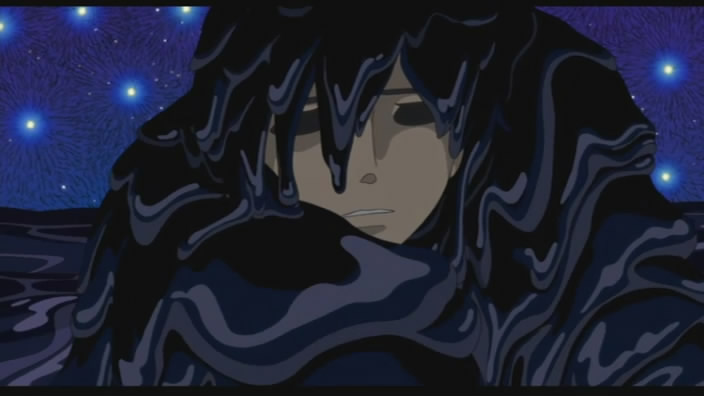
Arren has a dark side


The early Bowie-esque Cob


There are images that just take your breath away — 

Anything featuring the dragons


Our first look at Cob in his medieval fortress


An abandoned villa where Arren first meets Therru


The vistas of the seaside town Hort Town


Arren listening to Therru sing a song of loss and mourning


Wolves advancing to attack Arren in the desert.

Tales from Earthsea is a wonderful animated film, full of color and texture, but you should probably tuck in the kiddies and settle back and enjoy this one for yourself.

Enhanced by Zemanta