Showing posts with label Studio Ghibli. Show all posts

Wednesday, September 19, 2018

favorite movie #49: pom poko

Favorite movies that have had an impact on me - #49 - Pom Poko (1994) - My mom was a huge fan of Japanese anime, especially work from Hayao Miyazaki and Studio Ghibli. We found this movie at the library, after we blew through all the Miyazaki films and were trying to find some new anime to watch. It is a long, rambling, but ultimately powerful take on urban sprawl and the environment. The tanuki, or raccoon dogs who are the primary focus of the film, are finding their habitat encroached upon by the growing human population of Tokyo. Director Isao Takahata portrays the tanuki as fun-loving, mischievous, war-mongering, affectionate, magical, shape-shifting creatures. Different styles of anime portray the tanuki in their different states and moods, and add to the overall epic look of the film. There really isn't anything else out there like Pom Poko. It is so much more than a cartoon. It is a thoughtful, visually rich, at times sad film that can be revisited again and again.


Related:

two (very different) animated tales of animal survival
grave of the fireflies
paprika 's dream world
arrietty is like walking inside a painting

Monday, September 24, 2012

two (very different) animated tales of animal survival

I recently watched two animated films about how society and other pressures have adversely affected animal colonies. One was a Japanese film from 1994, Pom Poko, and the other a British film, Watership Down, from 1978, based on Richard Adams's popular novel.

Pom Poko

Written and directed by Isao Takahata (Grave of the Fireflies, My Neighbors the Yamadas, Only Yesterday) Pom Poko was animated by Studio Ghibli and has become one of my daughter's and my favorite animated films. Its environmental message is as strong as ever. As the suburbs of Tokyo grow, they are sprawling and destroying the countryside, specifically the Tama Hills, the habitat of the tanuki, or raccoon dogs, mischievous shape-shifters who just want their home and their carefree lifestyle to stay the same as it always has. But that is not to be. The tanuki band together to try and fight the encroaching humans. They utilize their shape-shifting abilities to both frighten and blend in. Pom Poko mixes different animation styles — realistic, anthropomorphic, and cartoony drawings. One of the highlights of the film is a monster parade, where the raccoon dogs try to scare their human neighbors by transforming themselves into a number of fantastic creatures, including different ghosts and spirits, goblins, other animals like monkeys and tigers, and giant skeletons.


The three styles of Pom Poko
Watership Down

John Hurt is the voice of Hazel, the leader of a small group of rabbits who have fleed their unsafe warren and are in search of a better, safer life elsewhere. As they journey across the countryside they encounter dangerous animals, traps, rabbits kept in cages, and other threats to their survival. The impressive British voice cast includes Richard Briers, Ralph Richardson, Zero Mostel, Denholm Elliot, Nigel Hawthorne, and Joss Ackland. Not exactly a film for the kiddies, Watership Down includes scenes of violence and many of the rabbits are bloodied on their journey to find a new home. The film is frankly a horror movie. It has a wonderful opening animated sequence, outlining the mythology of the rabbits' world, done in a different, more graphic style, which was directed by original director John Hubley, who died in 1977. Martin Rosen was hired to replace him.


Watership Down was very well made, but it's a bit of a downer, and I doubt we would ever want to see it again. We have already watched Pom Poko numerous times and I know will see it again (and again). Although its story is also poignant, and some of the tanuki come to unfortunate ends, there is still something uplifting about the film. Pom Poko is one of those movies that is hard to describe, except to insist that it is so great that you really just have to see it. Its humor is goofy and unlike any other movie out there. Its characters are at times annoying, touching, and lovable. It's just good and highly recommended. Check it out.


Note re anime styles (big thanks to Mario for putting this so succinctly):
It might help those readers who are not familiar with anime and manga conventions to know that the childish, or "chibi", style is a convention used by some artists to show the character is behaving childishly and thus improperly. The other convention commonly seen in both anime and manga is the "large-eyed" look — if a character has over-sized eyes, it means innocence: a boy younger than about 15 or 16, or a girl younger than about 21 or so. This last can be a very useful marker: in a work that uses this convention, a character who should have the large eyes but doesn't bears watching, because something is very wrong about him or her.


Enhanced by Zemanta

Tuesday, February 21, 2012

arrietty is like walking inside a painting

No one who is a fan of the output of Japanese animation studio Studio Ghibli would be surprised that its latest release, The Secret World of Arrietty is well-made and entertaining, but they might be surprised at how drop-dead gorgeous it is.

From the very first frame of the film the audience is transported into a lush, painterly landscape. The familiarly-drawn anime characters of the story blend seamlessly with the watercolor backgrounds. It is simply beautiful to look at and experience. The story, written by Studio Ghibli mastermind Hayao Miyazaki and Keiko Niwa, is based on Mary Norton's classic children's book The Borrowers. The story is simple — teenage Arrietty lives with her parents, father Pod and mother Homily, below the floorboards of a house. Borrowers are tiny people who survive by borrowing what they need from the human beings, or beans, as they call them. One day an ill teenage boy named Shawn comes to stay in the house, in order to rest and prepare for a heart operation. He spies Arrietty, and while this knowledge becomes an immediate threat — Borrowers should not be seen by humans — the two become friends. Their friendship has a profound effect on each other's lives.

Arrietty in her room
Nina the cat and Arrietty
Arrietty hitches a ride with Shawn
Housekeeper Hara sees the Borrowers not as people, but as proof that she isn't crazy
The touch of Miyazaki is unmistakable — a strong and resilient young heroine (Kiki's Delivery Service, Spirited Away, Princess Mononoke), the very real threat of illness on a child's life (My Neighbor Totoro), a large cat who is both threatening and protective (My Neighbor Totoro, The Cat Returns), the strong bonds that can be formed between people (Whisper of the Heart), and the power and magic of nature and landscape which permeates all of his films. Miyazaki has always been interested in household spirits, and the Borrowers certainly share characteristics with those beings. But the movie has its own pace and very individual look, which must be traced to first-time director Hiromasa Yonebayashi. Yonebayashi worked previously as an animator on the Studio Ghibli films Ponyo, Tales From Earthsea, Spirited Away, My Neighbors the Yamadas, and Princess Mononoke.


The voice talent is also well-cast. Carol Burnett is inspired as more-than-nosy housekeeper Hara, who is the true threat to the Borrowers' safety. Bridget Mendler (Goodbye Charlie) and David Henrie (Wizards of Waverly Place) make a nice pair as Arrietty and Shawn. A restrained Will Arnett and over-the-top Amy Poehler are both perfect in their roles as Arrietty's parents Pod and Homily.

The Secret World of Arrietty is lyrical and gentle, with the story developing at the same pace as Arrietty's and Shawn's friendship. We know generally what Arrietty will find when she goes on her first borrowing expedition with her father, but the film still conveys a real sense of suspense and wonder as we see the pathways taken by the pair, the evidence of generations of Borrowers who have climbed through the walls and floors before them. Scale, which adults forget is always an issue for children, is a prime factor in Arrietty's world. She and her father climb veritable mountains of furniture for a single cube of sugar or sheet of tissue, which will last her family for months. The visual scale is temporarily tipped in her favor when a pair of potato bugs become pet-sized for Arrietty. The filmakers apparently did their nanoscience research, down to droplets of water and tea, which are as lovingly rendered as the many other details in the film.

The movie is different from most animated children's fare. There are no wise-cracking talking animals or hyerkinetic cuts and chases or radio-ready soundtrack. The music, by French musician Cécile Corbel is as laid-back and hypnotic as the visuals. The story, which originally was set in Norton's England, has been moved to the Western Tokyo neighborhood of Koganei, which coincidentally is where Studio Ghibli resides. The movie may take its time, but feisty Arrietty and her family are always on the go. They are explorers and ultimately nomads, but also creative thinkers. Children will love their real-world solutions for survival, like sailing away in a teapot. Arrietty's world sparks imagination.

A sense of temporary magic permeates the film. Children will relate, recalling the instant friendship that is born at the playground, or over a summer, and must sadly dissolve when both parties return home. Adults may be reminded of the feeling of an unfulfilled romance, a brief relationship that can never be. The Secret World of Arrietty charmingly portrays a sense of beauty and loss, but it isn't a sad film. Spring always comes again. Shawn and Arrietty will never forget one another, regardless of whether they ever see each other again.

Enhanced by Zemanta

Friday, February 17, 2012

the secret world of arrietty

Article first published as Book Review: Four Books to Accompany The Secret World of Arrietty, by Hayao Miyazaki, Keiko Niwa, and Hiromasa Yonebayashi on Blogcritics.

To coincide with the release today of the new animated film The Secret World of Arrietty, Studio Ghibli Library and Viz Media have released a series of wonderful companion volumes.


Arrietty is a 14 year-old girl, a Borrower, who lives under the floors of a house with her mother Homily and father Pod. The family "borrows" things that they need from the humans who live in the house above. Shawn, a 12 year-old boy with a weak heart, comes to live in the house with his aunt Jessica, and spies Arietty on her first official borrowing expedition.

To be seen by humans is a no-no — Borrowers need to stay secret to be safe. But Arrietty and Shawn soon become friends. Also living at the house is Nina, a large cat, who is reminiscent of another Studio Ghibli cat, Muta (Whisper of the Heart and The Cat Returns.) Arrietty's family decides they must move on and leave their beloved home if they are going to survive. Nina, who at first appears dangerous, becomes an ally and helps Arietty when the true danger, the housekeeper Hara, tries to capture the Borrowers.

The Art of The Secret World of Arrietty is a large, paperback coffee-table book that includes sketches, art, backgrounds, and film stills from Studio Ghibli's latest animated film release, which was the highest grossing Japanese film in 2010. Key art is by Hayao Miyazaki. The concept art and character sketches are by the film's director Hiromasa Yonebayashi. Additional art by art directors Yoji Takeshige and Noboru Yoshida is also included. Character design is by Ai Kagawa and Akihiko Yamashita.

The beautiful watercolor sketches are interspersed with actual stills and background art from the film, with essays by the artists explaining the concepts behind storyboarding and the script. The Secret World of Arrietty is based on the popular novel The Borrowers by Mary Norton. The book also includes the complete voice-over script of the film, as well as the lyrics to three songs that appear in the film, "The Neglected Garden," "Our House Below," and "Arrietty's Song," all written and performed in the film by French musician Cécile Corbel.

The Art of The Secret World of Arrietty is a treasure for adult fans of Studio Ghibli films and Hayao Miyazaki, but also available is a picture book that will delight children, The Secret World of Arrietty Picture Book. Planned by Hayao Miyazaki and using much of the shooting script as its text, this delightful book incorporates stills from the film as its illustrations. Its large-scale font is easy to read, and the many images keep the pages turning and young minds involved in the story.


A smaller-sized graphic novel has also been produced, in two parts, The Secret World of Arrietty 1 and 2. Laid out in the traditional Japanese right to left format, both volumes are in full color and reproduce the film utilizing the script and still images. The story is divided into four chapters over the film comic's two books.

All four publications are wonderful companions to the animated film, and also a great introduction to the art of Studio Ghibli. The Studio Ghibli Library and Viz Media have produced similar volumes to accompany Miyazaki's films Howl's Moving Castle, My Neighbor Totoro, and many more. Any new film by Hayao Miyazaki and his counterparts is always cause for celebration. It's especially nice to have these books, geared to all ages, to enrich the film viewing experience and to have available to enjoy again and again.
Enhanced by Zemanta

Tuesday, August 16, 2011

catching up with ... tales from earthsea


Japanese animation legend Hayao Miyazaki was busy working on his film Howl's Moving Castle, so couldn't helm Tales from Earthsea, but he must have paid more than a few visits to the studio, as his hand is all over this lovely little anime from 2006. Miyazaki's son, Goro Miyazaki, stepped in for his father to direct the film, a loose adaptation of Ursula K. LeGuin's Earthsea novels. The team at Studio Ghibli delivered the gorgeous painted backgrounds and compelling characters that viewers have come to expect from them. I recently saw the English-voiced version, and even with a pretty standard good vs. evil plot, it was still a treat.


Arren befriends a dragon
Good wizard Sparrowhawk
The movie begins with two dragons, black and white and beautifully rendered, fighting each other over the sea. One kills the other — a bad omen — and the news travels quickly to the King of Enlad, who is then killed by his son, Prince Arren (Matt Levin). Arren is wracked with guilt, and seems haunted by a shadow of himself. He meets a great wizard, Sparrowhawk (Timothy Dalton), a girl, Therru (Blaire Restaneo), and a woman, Tenar (Mariska Hargitay). Together they must try and prevent the evil wizard Cob (Willem Dafoe), who is obsessed with discovering the secret of eternal life. And Arren must decide whether to run from, or face up to, his crime.

Dalton and Defoe are especially good in their voicing of their characters, two wizards in combat, each with a very different interpretation of the eternal battle of life over death. Themes of love and conquering death make for a more adult and sometimes somber story, with some fairly graphic violence at the end of the film, as compared to other Studio Ghibli offerings like My Neighbor Totoro and The Cat Returns. But Hayao Miyazaki, who worked on the story for his son's film, has always added a touch of melancholy to his characters.
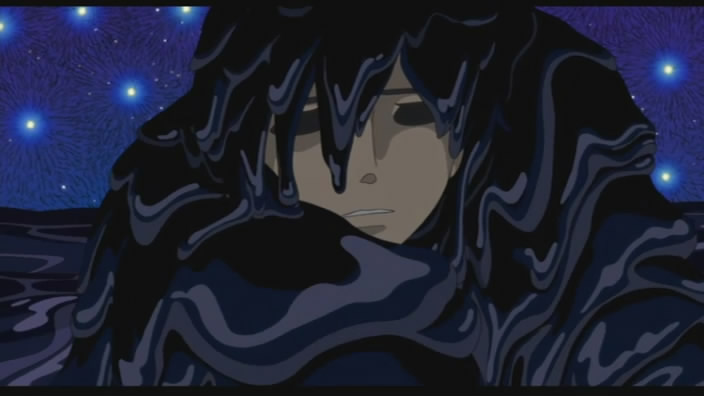
Arren has a dark side


The early Bowie-esque Cob


There are images that just take your breath away — 

Anything featuring the dragons


Our first look at Cob in his medieval fortress


An abandoned villa where Arren first meets Therru


The vistas of the seaside town Hort Town


Arren listening to Therru sing a song of loss and mourning


Wolves advancing to attack Arren in the desert.

Tales from Earthsea is a wonderful animated film, full of color and texture, but you should probably tuck in the kiddies and settle back and enjoy this one for yourself.

Enhanced by Zemanta