Showing posts with label John Huston. Show all posts

Thursday, June 05, 2014

katharine hepburn: the making of the african queen

In the extremely engaging The Making of the African Queen: Or How I Went to Africa With Bogart, Bacall and Huston and Almost Lost My Mind actress Katharine Hepburn recounts her adventures in Africa while making the film classic The African Queen. She set off with director John Huston and Humphrey Bogart and his wife Lauren Bacall in 1951 for what she still calls (more than thirty years after the fact) the adventure of her life.

The intrepid Hepburn, always the iconoclast, stylish as always

Hepburn is endlessly self-deprecating, the first person to admit her quirks and foibles, but she also makes it quite clear that she is also persnickety, demanding, and at times, a real pain to deal with. She is, as Spencer Tracy called her, "A rare bird," and more than a bit old-fashioned about her creature comforts and her focus (even as a 40-something woman at the time) on her Father with a capital "F." She asks him for a letter of credit for her big African trip (didn't the successful actress have her own money?) and is very particular about selecting the perfect gift for him — a hand-carved to order ebony cane.
“Heaven to be the first one up and to eat breakfast all alone.”
She knows what she wants and thinks ahead — carrying her own furniture and other accoutrements. She decides to go off on her own to explore the flora and fauna, refusing to help Lauren Bacall arrange their meals (or take the traditional woman's role?) Hepburn was a vanguard for the time with her style and predilection for menswear, but it really paid off in the jungle, protecting her from bugs and being less binding and layered than women's clothing. Where she ran into trouble was with her holier-than-thou urologist's daughter's insistence on drinking lots of water. She ended up getting sick as a dog. Bogie and Huston stuck to whisky and never got sick.

Reading between the lines, she most definitely seems to have had a crush on Huston. She complains about him constantly, but her brief description of her life with Spencer Tracy suggests that she was used to, and attracted to, difficult men. Although she is against the hunting and killing of animals she is beyond thrilled to join Huston on one of his hunting forays into the jungle. Bogie had no interest. She praises Bogie's bravery and professionalism, but it is clear that he was too no-nonsense, direct, and practical for her to fall for him. But she and Bogie did form a lifelong friendship after making the picture. She briefly describes visiting him frequently with Spencer Tracy when he was dying of esophageal cancer.
“To put it simply: There was no bunk about Bogie. He was a man.”
Bogart and Bacall, having breakfast in their cabin

Some of her statements about blacks and whites are far from poetically correct. But Hepburn is a reflection of the times, and frankly, her class. It is clear from how she approaches the trip and life in general that she comes forms privileged background and was used to having servants and helpers.

Quibbles aside, hers is a fascinating account — it's amazing the film ever got made, with the difficult physical conditions and Huston taking off to shoot elephants whenever he got the chance. Huston's laissez-faire attitude on set and his ability to come up with a classic film makes me want to read White Hunter, Black Heart and his autobiography, An Open Book, next.

Hepburn, Bacall, and Bogart relaxing between takes
The Making of The African Queen is chock-full of behind-the-scenes photos, too. But it is Hepburn's unique voice and perspective that shine through. What an odd assortment of individuals. What a strange experience. And what a great film that came out of it all.

Tuesday, May 06, 2014

the maltese falcon on blu-ray

Continuing my Humphrey Bogart film watching ...

The Maltese Falcon has just been released by Warner Home Video on Blu-ray, and Bogie and classic move fans will not be disappointed.

Set in 1941 San Francisco, this classic film noir follows detective Sam Spade (Humphrey Bogart) who gets mixed up with a group of adventurers who are in search of a treasure - the eponymous Maltese Falcon, which the opening credits tell the audience was "... a Golden Falcon encrusted from beak to claw with rarest jewels ..." On the trail of this priceless and mythical artifact are some wonderful characters: Sydney Greenstreet (in his first screen appearance) as "the Fat Man" Kasper Gutman, Mary Astor as the unforgettably lethal femme fatale Brigid O'Shaughnessy, Peter Lorre as the smelling of gardenias Joel Cairo, and Elisha Cook, Jr. as Gutman's gunsel Wilmer. Character actors Ward Bond and Barton McLane show up as two cops who aren't sure how involved Spade may be in his partner Miles Archer's (Jerome Cowan) demise.

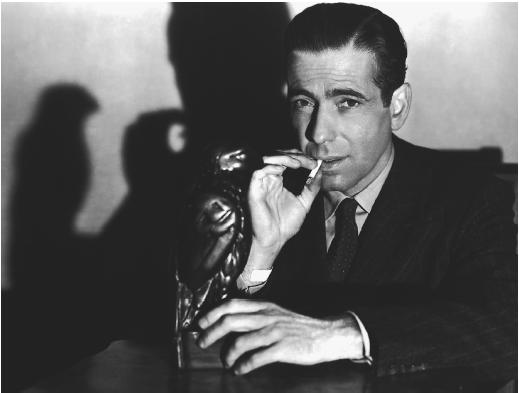
Bogie and "The Black Bird"

John Huston's directorial debut, The Maltese Falcon was made for black and white, and the dramatic lighting and creative camera angles, many of them low-angle, all look great on a high-definition, large scale television screen. The clarity and picture quality is great - you can almost read the title on the spine of a book on Sam Spade's bedside table when the detective takes the call about his partner Miles being found dead. Huston keeps the compositions simple and effective, but includes details like a newspaper clipping tacked to the wall of his apartment and other paraphernalia of Spade's help flesh out his no-nonsense character. But it's Humphrey Bogart's portrayal of Spade that really resonates. It was not only a career-changer, elevating him once and for all into lead parts, but he made Dashiell Hammett's tough-talking private eye his own, a screen classic and the blueprint for movie dicks forever more.
Sam Spade, "When a man's partner is killed, he's supposed to do something about it. It doesn't make any difference what you thought of him. He was your partner and you're supposed to do something about it. And it happens we're in the detective business. Well, when one of your organization gets killed, it's ... it's bad business to let the killer get away with it, bad all around, bad for every detective everywhere."
The film is full screen format and has an aspect ratio of 1.37:1 and resolution of 1080p and looks great on a large-scale high-definition television screen. It has a running time of 101 minutes. The Dolby sound (English: DTS-HD High Res Audio and Spanish, German, and Portuguese: Dolby Digital 1.0) is also crisp and clear. Subtitles are available in multiple languages: English, French, Spanish, Portuguese, German, Danish, Finnish, Greek, Norwegian, and Swedish.

The Maltese Falcon Blu-ray is on one disc, but it has a host of extras, including:
"Warner Night at the Movies" from 1941: a newsreel, the musical short The Gay Parisian, and cartoons "Hiawatha's Rabbit Hunt" and "Meet John Doughboy" 
"The Maltese Falcon: One Magnificent Bird" 
"The Trailers of Humphrey Bogart," featuring TCM's Robert Osborne 
"Breakdowns of 1941," a blooper reel 
Radio show adaptations of The Maltese Falcon: the piece, two with the film's stars, one with Edward G. Robinson 
Commentary by Bogart biographer Eric Lax 
Makeup tests 
Movie trailers for The Maltese Falcon, Sergeant York, and Satan Met a Lady
Sam Spade considers Brigid O'Shaugnessy. Does he love her? Can he believe her?

As much of a tough guy as Bogie is, Sam Spade also has a lot of humor. And fans of Ren and Stimpy will recognize the origin of one of their favorite cartoon characters in Peter Lorre's Joel Cairo, especially when he berates Sidney Greenstreet's Kasper Gutman for letting the Falcon slip through their grasp:
Joel Cairo, "You ... you bungled it. You and your stupid attempt to buy it. Kemedov found out how valuable it was, no wonder we had such an easy time stealing it. You ... you imbecile. You bloated idiot. You stupid fat-head you. [He breaks down crying]."
The Maltese Falcon is the first in a longtime collaboration between the star actor and director, who went on to make Across the Pacific in 1942, The Treasure of the Sierra Madre and Key Largo in 1948, The African Queen in 1951, and Beat the Devil in 1953. Huston wrote the screenplay, based on Hammet's novel, and the third time must have been the charm for a story that had already been turned into unsuccessful movies twice before (The Maltese Falcon in 1931 and Satan Met a Lady in 1936), as it was nominated for three Academy Awards; Best Picture, Screenplay, and Supporting Actor (Greenstreet). When Huston and Bogart and Astor and the rest of the crew got together it was movie magic. As Sam Spade says at the end of the film, "The stuff dreams are made of."

Tuesday, May 01, 2012

film noir: the directors

Article first published as Book Review: Film Noir: The Directors, Edited by Alain Silver and James Ursini on Blogcritics.

Film Noir, The Directors, edited by Alain Silver and James Ursini, is a compendium chock-full of wonderful black and white film stills and production shots film (noir) buffs are sure to enjoy. Film historians Silver and Ursini certainly know their stuff. They have both written or contributed to numerous other titles on the subject of film noir.
This weighty paperback volume (over 470 pages) includes an introduction by Silver and essays on 28 directors the pair consider to be crucial to film noir. The essays are written by the editors and a host of over 20 other historians and filmmakers, with brief bios of all the contributors included at the back of the book.

Each essay on a director includes an overview of films deemed to be the director's best and most important films in the genre; a biography; and a list of their noir films or films with noir elements made during their career.

Humphrey Bogart in John Huston's The Maltese Falcon

Hollywood's classic era of film noir lasted mostly from the early 1940s to the late 1950s. But film noir is not limited to American-made films or solely that era. The most common elements of film noir are crime, drama, chiaroscuro lighting effects, shadows, seedy locations, and themes of sex and violence. The term film noir, which literally means "black film" in French, was coined in 1946 by French film critic Nino Frank.

Directors included in Film Noir: The Directors: Robert Aldrich, John Brahm, Jules Dassin, Andre de Toth, Edward Dmytryk, John Farrow, Felix Feist, Samuel Fuller, Henry Hathaway, Alfred Hitchcock, John Huston, Fritz Lang, Joseph H. Lewis, Joseph Losey, Ida Lupino, Anthony Mann, Max Ophuls, Gerd Oswald, Otto Preminger, Nicholas Ray, Don Siegel, Robert Siodmak, Jacques Tourneur, Edgar C. Ulmer, Raoul Walsh, Orson Welles, Billy Wilder, and Robert Wise.

Many of the films highlighted should be familiar to readers, whether they realized they were considered film noir. William Covey writes about John Huston's The Maltese Falcon, where Humphrey Bogart's Sam Spade became an iconic noir hero. Huston and Bogart also worked together on the noir classic Key Largo, and did a more comedic take on the form in Beat the Devil.

Barbara Stanwyck and Fred MacMurray in Billy Wilder's Double Indemnity

Billy Wilder's Double Indemnity is perhaps the most famous film noir of all time, with Barbara Stanwyck's gorgeous but deadly Phyllis Dietrichson as the ultimate femme fatale. Contributor Sheri Chinen Biesen makes a case for also including Wilder's Sunset Boulevard and The Lost Weekend as noir. William Holden's seedy protagonist Joe Gillis and his voiceover narration (a classic staple of noir films) qualifies, but The Lost Weekend may be more of a stretch. Sometimes the desire to include films that share certain elements with noir classics may dilute how audiences view film noir.

An interesting essay by Jans Wagner on Ida lupino details her various production companies, and how she was able to combine her roles as actress, writer, producer, and director throughout her long Hollywood career. In The Bigamist she became "the first woman in classical Hollywood to direct herself in a starring role." The film was produced by Lupino and ex-husband Collier Young and starred Lupino and Young's second wife, Joan Fontaine. There was probably enough material behind-the-scenes for Lupino to create many more noir intrigues.

Dana Andrews falls in love with a painting of Gene Tierney in Otto Preminger's Laura

Chris D. had another great essay on Otto Preminger's Laura. All of the behind-the-scenes confusion and contention about casting, story, and the ultimate ending of the film, creates its own story of suspense. Luckily none of the possible alterations and producer's arguments were ultimately visible on this glossy noir's surface. Reading about Preminger's later film, Bunny Lake is Missing, helped point out some unexpected similarities to Laura — like Laura, for a good portion of the movie the audience is unsure whether the titular character is a phantom or not.

Film Noir: The Directors also includes some directors whose films may not immediately be associated with noir. Geoff Fordham's essay on Alfred Hitchcock points out how the already-deceased-before-the-credits-even-roll Rebecca may be one of film noir's most lethal femme fatales. Hitchcock's movies usually have too much humor to be consider true film noir, but his style, born through his early work in Germany and love of Expressionist films, showcase many elements of the genre — the blurry lines between good and evil, femme fatales and wronged men, as well as stylish and dramatic lighting.

Judith Anderson and Joan Fontaine in Alfred Hitchcock's Rebecca

There were a few noir inclusions that may create a little controversy with genre aficionados — Don Siegel's Invasion of the Body Snatchers, Orson Welles's Citizen Kane, and Jacques Tourneur's Cat People, "a supernatural version of the noir femme fatales," although it is undeniable that these films utilize noir elements like flashbacks, voice-over narratiion, and atmospheric lighting.

Film Noir: The Directors is an excellent introduction to the work of some great directors and great films. It certainly makes a perfect resource to study the subject, and a reference of must-see films. An index of all of the films included in the text would have been a welcome inclusion. That is the only element lacking in this otherwise meaty and fascinating look at the work of directors who frequently or occasionally made film noir.
Enhanced by Zemanta

Friday, March 18, 2011

the lizard with no name

Article first published as Movie Review: Rango on Blogcritics.


Rango is one of the best durn looking movies in a long time. Not just in animated movies, but movies. Every shot has an amazing sense of composition. Director Gore Verbinski really uses the entire screen, like a canvas, in such a way that points out how other movies just don't do that.


Johnny Depp, in the title role, reminds us all what a good actor he really is, as his lizard is the ultimate actor, a chameleon in the true sense of the word. Talk about adapting. When the fabulous improvisational acting workshop that he apparently holds every day in his lonely fishtank is cut short — said tank goes flying out the back of his owner's car while they are swerving to avoid crashing on the highway — he is cast into the wilderness to find his way through the desert and his dreams until he discovers what he is really made of.

There are all sorts of knowing winks and references to movie genres and specific films — Sergio Leone westerns of course, Clint Eastwood's "Man with No Name," Blazing Saddles, Star Wars wookies and fighters in flight, every last-ditch western town where a stranger walks into a saloon and everything stops dead as the hard characters take in the nervous newcomer. And "Rango," as he calls himself in a fit of improvisation, after he sees the word "Durango" out of the corner of his eye, jumps into his new role as savior and sheriff with relish and phenomenal good luck.


I went with my 7-year-old, and while there were definitely some scary moments, I didn't feel that it was inappropriate for her. I did some parental guidance. The fights and scares and even deaths are all very Wile E. Coyote meets Road Runner. They're kind of gruesome, but kind of funny, too. There is a sequence (quite wonderful) where Rango and pals are being chased by creatures on bats. The scene is about on par with the flying monkeys from The Wizard of Oz, which are admittedly, still quite creepy, but again, I think not too much for the kid. There were a few moments when she snuggled closer, telling me she was scared, but it was the good kind of being scared, when you're happy to share the thrill safely with mom nearby.

The primary palette of Rango is monochromatic, which makes sense for a movie where a lot of the action takes place in a dust-covered, water-deprived, western town. Rango himself provides the main dashes of color, with his bright green skin and his loud red and white Hawaiian shirt. But the film in no way looks flat. The details of every surface of skin, hair, tooth and nail gives the film real texture and interest. It is not a 3D movie, but it has more visual interest than any 3D movie I have seen.


Another thing I loved about Rango was the dialogue. Rango is first and foremost an actor, and he's spent much of his life virtually alone, in a glass terrarium, so he has had plenty of time to develop his gift of gab. When he touches down in the town of Dirt he is surrounded by locals who talk the talk of the movie western and he manages to use his strengths of adaptation to blend right in:

Rango: Now you get back on in there and you assert yourself and I think you'll find the people in this town to be suprisingly hospitable.
Bar Guy 1: Thank you, Sheriff.
Bar Guy 2: What?! Not you again!! (throws Bar Guy 1 out)
Rango: I stand corrected.


Not only is the dialogue funny, but it is multi-sylllabic. Kids big and small in the audience might just learn something, as Rango urges book-learnin', "Stay in school, eat your veggies, and burn all the books that ain't Shakespeare." Rango, first and foremost, always the actor's actor.

For grown-up movie buffs there are some great nods to classic films. Ned Beatty as the Mayor of Dirt sounds eerily like Chinatown's John Huston. Tim Olyphant impersonates Clint Eastwood's Man with No Name, and one of the town residents, owl-like Furgus, has the creaky voice of classic Hollywood western sidekick Andy Devine. Depp and Verbinski also load in lots of fun self-references. In Rango's opening monologue he ponders what sort of character he should be, quite a few of them sounding a bit like past roles on Depp's resume. Later, when he is buffeted about on the highway, he splats momentarily on the windshield of the convertible from Fear and Loathing in Las Vegas, until a windshield wiper sends him on his way.

There is much to love about this film, and I suspect, it will only grow better with multiple viewings. I wanted a chance to examine some of the animal inhabitants of Dirt a little more closely, as they look similar to real animals I may have seen, but ... not quite. But mostly I'd like to hear Rango try to figure it all out again, while having an existential crisis and wisecracking his way through the West.
Enhanced by Zemanta