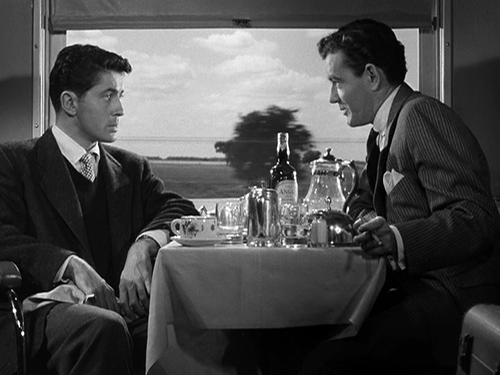
Every once in a while I get a yen to read the source novel for one of my favorite classic movies. My most recent read (actually listen) is Strangers On A Train, by Patricia Highsmith. I have seen the classic Alfred Hitchcock film, featuring Robert Walker and Farley Granger, many times. There are some indelible, memorable scenes in that movie – the two men crossing legs and crossing lives on the train, the gold lighter which incriminates and absolves, the final deadly and hair-raising sequence on the merry-go-round at the amusement park. Apart from their initial meeting on the train, Hitchcock fans should know that none of those set pieces are in the book.
Strangers On A Train, directed by Alfred Hitchcock, with Farley Granger and Robert Walker.
That doesn’t mean that the book isn’t interesting, however. It was Highsmith’s first novel, published five years before her successful The Talented Mr. Ripley. It could be viewed as a precursor of some of the themes that appear in that novel, like the doubling effect of two male protagonists. Charles Bruno is a charming sociopath. He wants to “trade murders” with a random man he meets on a train, Guy Haines, an up-and-coming architect (Hitch made him a tennis pro). Guy doesn’t take Bruno seriously, but he doesn’t condemn him that forcefully, either. Guy’s got his own problems. His estranged wife Miriam is now pregnant by her new boyfriend and he’s hoping she will agree to a divorce so that he can marry his (very rich) sweetheart Anne. But Miriam is not known for being agreeable.
Strangers On A Train is a psychological thriller. Highsmith is most interested in Guy’s mental journey and collapse as Bruno continually pressures him to hold up his end of the bargain. Written in 1950, the undercurrents of homosexuality between the two men must have seemed shocking. Highsmith isn’t exactly sympathetic to the almost perpetually drunken Bruno, but she lets his character grow through his actions and how people react to him, which makes him more interesting than broody Guy. In fact, “hero” Guy becomes more and more unlikable as the story progresses. Highsmith does not do a very good job with her lone female character, Anne, who seems to only exist to be devoted to Guy, but we are never given a reason why she likes the increasingly unpleasant fellow. The story is told at times from both Guy’s and Bruno’s perspectives. The book would have definitely benefited if we had more of Anne’s perspective, too.
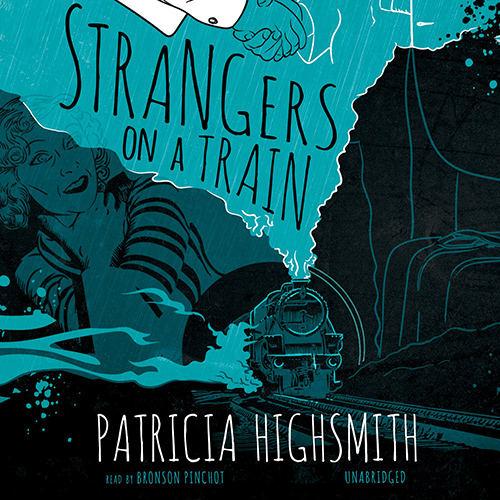
Strangers On A Train, written by Patricia Highsmith, read by Bronson Pinchot
Ultimately Strangers On A Train is an interesting read, but I prefer how Alfred Hitchcock streamlined some of the action and themes and certainly brought his visual flair to Highsmith’s clever plot idea. I “read” the audible version of this book, read by Bronson Pinchot.
Available on iTunes and Amazon on March 10, 2020, comes a new documentary film from Electrolift Creative Productions, Marcel Duchamp: The Art of the Possible. Directed by Matthew Taylor and produced by Michelle Taylor, the 90-minute film mixes biography and opinion to create an intriguing portrait of artist Marcel Duchamp.
Marcel Duchamp was born in Normandy, France in 1887. The film begins with family photos and a quick introduction to Duchamp's youth and then, like the artist himself, quickly sets off for Paris and the art world. Duchamp's primary artistic mentors were his older brothers, artists Raymond Villon and Jacques Villon. The brothers studied Impressionism, post-Impressionism and sold cartoons to make money while attending classes at the Académie Julian. Duchamp made his first big splash at the Salons des Independents exhibition in Paris in 1909 with Nude Descending a Staircase No. 2. The organizers of the show considered the title too provocative and Duchamp, refusing to change the title, even at the advice of his brothers, withdrew the piece from the exhibition.
Duchamp never worked well in groups and left Paris for Munich, and then America, where he landed in New York. The famous Armory Show of 1913 accepted Nude Descending a Staircase No. 2. It was the sensation of the show, receiving tons of press coverage, mostly negative, yet propelling Duchamp to art star status. He met art patrons Louise and Walter Arensberg, who agreed to pay his studio rent in return for acquiring his work, especially The Large Glass (The Bride Stripped Bare by her Bachelors, Even), which took him twelve years to complete.
Marcel Duchamp: The Art of the Possible poses the question: what would modern art be like without Duchamp? Duchamp shirked traditional art-making techniques. His way of making art was cerebral. He believed that language could transport you to another world. His artistic output is comprised as much of his notes and ideas for artwork as it is his actual art pieces, many of which currently reside in the Philadelphia Museum of Art.
Duchamp believed in a new way of making art. He used chance to create pieces, and believed that art should be an open, experimental activity. Creativity itself, his ideas, was the art. He often said that art is made by an artist but doesn't achieve its final purpose until it is seen by the viewer. This idea may have been most clearly embodied in his ready-mades - pieces of sculpture made from common everyday objects such as a shovel (In Advance of the Broken Arm, 1915), bottle rack, (Bottle Rack, 1914), bicycle wheel (Bicycle Wheel, 1913), and urinal (Fountain, 1917). Always a provacateur, Duchamp's sculptures shocked (and sometimes still continue to shock) art audiences. They challenge what we think of art, what art can be.
Duchamp wanted to expand the definitions of art. It is undeniable the readymades had a huge effect on artists of subsequent generations, most notably Robert Rauschenberg, Jasper Johns, and Andy Warhol. Entire modern art movements and genres like Fluxus, happenings, body art, performance art, pop art, conceptual art, and 80s appropriation art all owe a debt to Duchamp. Although he may have had a profound influence on many art movements, Duchamp never wanted to associate his own work with the movents of his day, such as Surrealism or Dada. Marcel Duchamp: The Art of the Possible helps make the case that he helped shift the focus of the art world from Paris to New York.
Marcel Duchamp: The Art of the Possible uses film and stills of Duchamp's artwork as well as his own recorded words.
"Art or anti-art was the question I asked."
Filling in the blanks and helping tell his story are artist interviews and film clips of Joseph Kosuth, Ed Ruscha, Jasper Johns, Robert Rauschenberg, Jeff Koons, Carolee Schneeman, David Bowie, Marina Abramovic, and others. Interviewed art world experts include Michel Gondry, Paul Matisse, Francis M. Naumann, Calvin Tomkins, Carlos Gerard Malanga, and many more.
Marcel Duchamp: The Art of the Possible is a fascinating feature-length documentary film that highlights an innovative and influential artist who can truly be called the father of modern art.
Crime In Progress by Glenn Simpson & Peter Fritsch
Burglars Can't Be Choosers by Lawrence Block
The Burglar Who Painted Like Mondrian by Lawrence Block
The Burglar Who Like to Quote Kipling by Lawrence Block
Seinfeldia: How A Show About Nothing Changed Everything by Jennifer Keishin Armstrong
I'll Have What She's Having: My Adventures in Celebrity Dieting by Rebecca Harrington
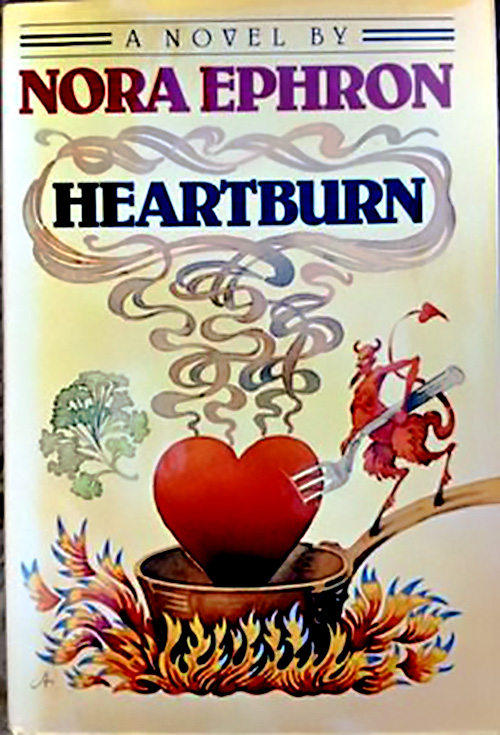
Heartburn by Nora Ephron
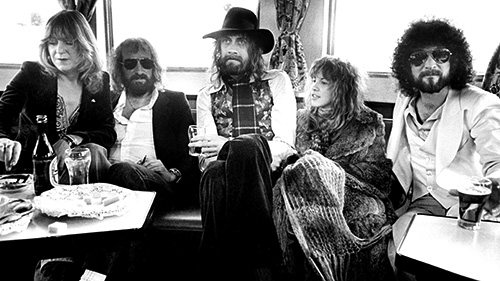
Making Rumours: The Inside Story of the Classic Fleetwood Mac Album by Ken Caillat and Steve Stiefel
O.K., I admit it, I have not posted any reviews lately. It’s just been a weird and for too many, sad time, hasn’t it? But I have managed to do a little reading. These may just be capsule reviews, but that’s just about all I can handle at the moment. There have been some good books and not so good books, but it’s 2020, so that’s par for the course. Looking at this list I realize that I have been drawn to books to help me cope with the current state of the world. My three go-tos seem to be books about politics, old favorites, or humor. Here’s what I’ve been reading to date:
I have always loved this album and was intrigued by the reported behind-the-scenes personal drama that went into making its iconic songs. This book started off interestingly enough, but then petered out. Although Caillat (father of pop star Colby, that he likes to frequently remind the reader) was definitely on the spot and seems to know his stuff about sound engineering, there is a whole lot of the technical (how to splice multiple tracks together, circa 1978) and not so much personal (Lindsey Buckingham was a jerk to women). He slips in side-eye remarks about Stevie Nicks without ever getting specific. She reportedly once said a rude thing about his dog – is that the origin of his grudge? But he also has to grudgingly admit that she became the biggest solo star of the bunch. He also occasionally critiques the band for the copious amounts of drugs and alcohol that were consumed during the making of the album, but brushes off the fact that he was right there, indulging as well. Rumours was lightning in a bottle and no one can really properly capture that.
Lawrence Block has a few crime book series, and this is his most lighthearted. The main character, Bernie Rhodenbarr, is a gentleman burglar who lives on the upper east side of Manhattan and is as ready with a quip as he is with a light finger. The books are a little dated – there is always a luscious babe to throw themselves into his arms and his best pal Carolyn is a hard drinking lesbian who manages to leave her Greenwich Village dog washing shop to help Bernie whenever he is mistakenly accused of a murder after pulling a heist, which is often. But it is fun hearing Bernie wax poetic about what he plans to steal. He fancies himself a quasi Robin Hood, robbing from the rich to give to poor little old him. He also runs an old used bookstore in the Village, which is not just a front – he really loves 0ld books. What’s not to love about that?
This is a definite summer read, if one was having a definite summer … but it is fun to get a behind-the-scenes peek at how Jerry Seinfeld and Larry David put together the “show about nothing” and all the other elements that helped make it the classic that it has become, including casting (especially Julia Louis-Dreyfus) and the many writers who have contributed bits along the way.
This book is a thinly-veiled take on the break-up of Ephron’s marriage to Carl Bernstein. It is a funny collection of scenes from a marriage, mixed in with recipes. Originally written in 1983, it might seem a little hard to believe how her heroine has let herself be so easily deceived by her husband, but it is clear that she was pretty distracted by moving from NY to DC and then being pregnant multiple times. How easy it is to look the other way …
(p.s. the movie based on the book is not as fun – this article about making the movie is actually better than the movie)
This sounds like a fun by the pool read, and I guess it could be for some, but not me. It reads more like the author researched a bunch of celebs on the internet (Gwyneth Paltrow, Jackie O, Beyonce) and whips out some very lightweight essays on each, all framed by the absurd side/challenge that she will eat that way, too, although most of her “diets” don’t last a week. This book is practically a meme.
With all of the endless reporting on the current occupant of the White House I realize that this book may seem too much for a lot of people, but I am really glad that I read it. There are insights into 45’s personality, but I think most of us knew who he was and is already. What is really interesting is her description of her grandparents, especially Fred Trump Sr., and how he made his fortune from sub-par housing in Brooklyn – he was always willing to “work with” local politicians for the best deals. Her descriptions of her father, who just couldn’t hack the expectations of Sr. and his addictive personality is also instructive.
I first became aware of Anand Giridharadas on MSNBC from his appearances on shows with Lawrence O’Donnell and Rachel Maddow. He is whip smart and unrelenting in his insistence that we see beneath and beyond the “philanthropy” of the ruling class to maintain their status quo. This book is his manifesto and a fascinating read.
I read this around the time of the impeachment hearings to gain a better understanding of Fusion GPS (the authors own the firm), the Steele dossier and the investigations into the Trump campaign and its ties to Russia. The book is presented in a very reporterly, clear and concise style. Although the topic is politics, it steers clear of partisanship – notedly Fusion was asked by Republicans and Democrats to look into the Trump campaign’s alleged ties to Russia. The only frustrating thing about this book is that so many still don’t seem to see beyond the repetitive sound bytes. This book goes far in trying to clear up the confusion.
Patricia Highsmith wrote The Talented Mr. Ripley in in 1955. She based it loosely on Henry James’s The Ambassadors (which I now have to add to my to-read list). The lead character, Tom Ripley, proved so popular, that she brought him back for four more novels.
When the reader first meets Tom he is living close to the bone in New York City, subsisting on his “friends,” or running various schemes, including mail fraud. But Tom isn’t really great at his schemes, and he doesn’t like people, and he doesn’t have any true friends, just people he can sponge on. Tom’s prospects begin to look up when he runs into the rich Mr. Greenleaf, the father of an acquaintance, Dickie Greenleaf. Mr. Greenleaf wants his son, who he believes is frittering away his life in Italy by dabbling in painting, to come home, get serious, and work at the family shipping business. Tom exaggerates his friendship with Dickie, and agrees to track him down in the (fictional) Italian seaside port of Mongibello – staked with cash from Mr. Greenleaf.
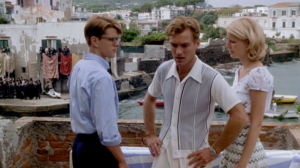
Tom Ripley, (Matt Damon), Dickie Greenleaf (Jude Law), and Marge Sherwood (Gwyneth Paltrow) in the 1999 film The Talented Mr. Ripley
Tom doesn’t seem to have any real desire to fulfill his quest and bring home the prodigal son, but he does head to Mongibello and soon meets Dickie and his friend Marge Sherwood. Marge and Tom take an immediate dislike to each other as Tom tries to ingratiate himself with the open and (initially) clueless Dickie. Tom’s motives aren’t clear, to himself or the reader. His strongest motivating factor seems to be survival and acquiring money. He comes from nothing and is determined to not only be able to live, but live well. Dickie enjoys palling around with Tom at first, as a way to avoid Marge’s not-so-subtle attempts to take their relationship to the next level. In the meantime, Tom has been studying Dickie, to the point of copying his mannerisms and attire. One day Dickie walks into his bedroom to find Tom in his clothes – it is from that moment that their newfound friendship begins to sour. Dickie may not be the brightest bulb on the tree, but he can sense that Tom is not the real deal, not from his side of the tracks.
There is definitely an undercurrent of sexuality to Tom’s obsession with Dickie, which was made more blatant in the 1999 film version, directed by Anthony Minghella, starring Matt Damon (Tom), Jude Law (Dickie), and Gwyneth Paltrow (Marge). I had seen the film years ago and didn’t love it. I will say that Jude Law has never looked better on film. It’s a first-class production, with Philip Seymour Hoffman, Cate Blanchett, and Jack Davenport in supporting roles. I just didn’t find Damon to be very compelling. Ripley may be a cipher, but I felt Damon just played him as a blank space. I rewatched it recently, and it’s better than I remember, but Damon is definitely still its weakest link. There is also apparently a French version of the story, Plein Soleil (Purple Noon), filmed in 1960, directed by René Clément and starring Alain Delon that might be fun to track down sometime.
But back to the book . . . even though Tom bristles at memories of being called a “sissie” and is repulsed by Marge, he seems less attracted to Dickie the man than to Dickie’s lifestyle and all its trappings. Tom is first and foremost a parasite. His love of fine clothes and having money to spend will lead to murder and mayhem as he travels across Italy to escape his past and past identity. Tom Ripley is an anti-hero and sociopath who at times may put off the reader, who may find many of his crimes brutal and unnecessary, but Highsmith is such a gifted writer that she effortlessly pulls us into his thoughts and his fears. Will he avoid capture? Do we want him to? I can’t say I liked Tom Ripley much, but I am looking forward to checking out his further adventures.
p.s. Fleabag’s “Hot Priest” Andrew Scott will be portraying Tom Ripley in a new series, Ripley, on Showtime in 2020. So I have to start subscribing to that channel now?